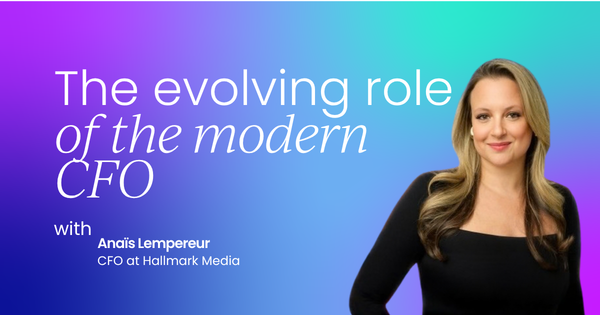

I've been in business for about 20 years now. I obviously haven't been a CFO for all of those years; I've been one for about six or seven. But the biggest thing I've seen over the last few years is just how much more is expected of us.
If I had to describe my personal brand, it would be transformation agent. I've integrated lots of different organizations at what I'd call inflection points.
I joined Hallmark Media a couple of years ago. Before that, I was the CFO of Pluto TV right after it was acquired by Paramount. Before that, I was at Sweetgreen as it went through its Series H and Series I. And before that, I spent about five years at Spotify before it went public.
The common thread across my entire career is that I usually walked into a job and the only thing I ever got was a laptop, plus a bunch of people looking at me and saying, "Good luck."
Hallmark was a very different experience. It was basically the exact opposite. Everything was already there. The finance function existed, but the business needed to be rebuilt and rethought.
The question was how to do that. That question sits at the heart of what I think is happening to our role as CFOs today.
 Nick Rumball
The CFO used to be a force of nature in the background
When I look back at the CFOs I worked for as an analyst, a manager, and a director, they had very similar backgrounds.
Many of them came from the banking world. They were forces of nature who would walk into a room, know the numbers, walk out, and then work with the bankers a lot in the background.
That isn't what I see today. Today's CFOs are very customer facing, very business facing, and work a lot with investors directly. Our world has changed, and we have to keep broadening the way we think about our roles.
I've noticed that a lot of finance leaders have either moved into a new job over the last couple of years or are thinking about moving into one. That says a couple of things. First, it shows how much shorter CFO tenure has become.
Over the last 10 to 15 years, we've watched it keep shrinking. Maybe that's because Chief Marketing Officers no longer get the blame. It used to be the CMOs, but we took all their budget away, so there's nothing left to blame them for.
Now the CFOs get the blame.
Second, if you've gone through a search recently, as I have, you realize how different the skills being asked for today are.
In a sense, companies want us to be everywhere at the same time. That's what I mean by broadening.
And as I've watched this unfold, I've started to see a set of archetypes emerge, each one describing a part of the job that was once a "nice to have" and is now a need.
 Richard King
From accountant to operator
A lot of us came into our roles focused on how important it is for our numbers to be right. Now the business is looking to us to actually make the decision.
Many times, that decision can be as impactful on operations as it is on the financials.
Our roles have evolved into something closer to a COO-CFO than the CFO-chief accounting officer role we saw previously.
Most finance leaders I talk to feel they do much more on the operations side today than they did five or ten years ago, and most of them like it.
I think it gives us more purpose than simply feeling as though we have a seat at the table because we had to be there.
From controller to architect
Having integrated businesses that basically had no accounting, I've found it really interesting how much you can influence the way your financial results look if you architect your P&L the right way and think about the business the right way.
Take a question many of us are wrestling with right now: should we allocate AI costs down to the business units?
It reminds me of what happened when I was at Spotify and we got into big data. Everybody loved this big data thing. But a huge number of inefficient queries were running, and our big data bill came back millions above what we were expecting.
When we started to look into it, we noticed the same thing was happening with other systems.
At Pluto, we had the same issue with an A/B testing tool. It was a really good product, but it was very much event based.
If somebody in the back was just playing around with queries and not paying attention, the bill could run up very high. I think the same situation is happening with AI now.
So the question for us is whether we're architecting the way our business runs to actually get the outcomes we want.
 Ella Harrison
From functional head to enterprise leader
This is where I think we shine, and it's what makes our job the best one in the entire company. We're enterprise leaders rather than functional heads.
Most of the time, we're pretty much the only person looking at the entire business at all points in time.
Maybe there are three others: investor relations if you have it, definitely your head of FP&A, marginally your CEO, and your COO if you have one.
The technology team has a really good understanding of the infrastructure of the business, but it isn't looking at revenue. The revenue team isn't looking at compliance. The compliance team isn't looking at forecasting and planning. And none of them are talking to your investors.
We're supposed to be a mile wide and an inch deep, and that's even more expected of us today because we have access to everything.
Years ago, we could say, "Oh, I'll get back to you on that." I don't think we have much of that leeway anymore.
For expert advice like this straight to your inbox, sign up for Pro+ membership.
You'll also get access to hundreds of hours of exclusive video content, a complimentary Summit ticket, and so much more.
So, what are you waiting for?
The change agent
Being a change agent in our world is something I've personally had a really hard time with.
One thing that's top of mind for me is that sometimes I require the most change from the people who have been asked not to change for a very, very long time.
Look at the implications of AI and agentic AI and how we might start to build those skill sets into our teams.
We're asking team members who have done the same job for 17 or 20 years to start thinking about how to apply a technology when they probably haven't used Excel in any major capacity.
And one of the things we loved most about these team members was that they showed up every single day and processed the same type of invoice for 17 years.
That's difficult from a people perspective, and it's also very difficult from an expectations perspective. In areas like technology and IT, using these tools is much more native.
In finance, I think the change is going to have to come a little more from the top down, because you can't ask people to apply a tool they've never actually been given.
My team at Hallmark is a good example. We just implemented NetSuite and went live a couple of weeks ago. Before that, we were working on an ERP system that had been unsupported for 10 years.
The accounting team was fantastic, and we had an amazing controller who kind of put it all together. But if it weren't for people going above and beyond every single day, nothing would have worked.
 Abhishek Chandna
So how do you turn around and say, "You've been working on an unsupported ERP for 10 years, and now we want you to become an AI expert"?


Become an FA Insider
Thank you for subscribing
Get exclusive insights, frameworks, and strategies from finance leaders driving real business impact.
An email has been successfully sent to confirm your subscription.
 Follow us on LinkedIn