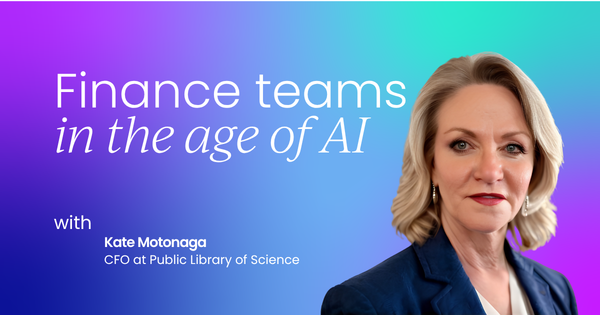


When people talk about AI, I hear a lot about tools.
I hear about the latest platforms, the newest agents, the next implementation, the newest feature inside an ERP system, or the promise that one more product is going to transform everything overnight.
What I don't hear enough about is capability.
I don't hear enough about where people actually are in this process, whether teams are prepared to use these systems effectively, or how organizations move from curiosity about AI to meaningful operational transformation.
That gap matters.
If I were standing in front of a room of finance leaders and asked how many genuinely feel their finance organizations are ready to implement AI effectively into workflows, very few hands would go up.
That hesitation is real, and it reflects what many of us are seeing inside our own organizations.
According to research from the AICPA, 88% of CFOs believe AI will be transformational. Yet only 29% believe their teams are ready.
That difference between belief and readiness is where the real work lives.
I have spent my career leading transformation across industries, from aerospace to service organizations and digital publishing.
Today, I work in a mission-driven organization that provides digital services for media and publishing. Across all of those experiences, one thing has remained true: technology alone does not create transformation. People do.
AI is no different.
 Teresa Garanhel
The problem is not access to tools
Most organizations already have AI entering their systems in some form.
If I talk to our chief digital officer, he will point out that AI has existed in products like Outlook for years. Traditional AI absolutely has.
But generative AI changed the conversation, and now we are moving into AI agents and increasingly sophisticated systems that evolve at extraordinary speed.
The reality is that the major vendors are already embedding these capabilities into finance products.
NetSuite is introducing agents. Salesforce is introducing agents. SAP is introducing agents. Nearly every major provider is integrating AI functionality directly into the systems finance organizations already use.
That means the issue is no longer whether the tools exist.
The issue is whether teams know how to use them intentionally and consistently.
What concerns me most is inconsistency. If different people use the same tools differently, you can end up with different outputs from the exact same data.
You can have three people reach three different conclusions because they approached the system in different ways or interpreted the information differently.
That's not transformation. That's operational risk.
When organizations skip over capability-building and go straight to implementation, they create environments where outputs become unreliable, trust erodes, and ROI suffers.
And that's one of the biggest reasons so many AI initiatives struggle to demonstrate value.
Geeta Malhotra
Why training matters more than most leaders realize
One of the things I find frustrating in conversations about AI is how casually training is often treated.
Someone will spend an hour discussing technology strategy, implementation timelines, vendor partnerships, and automation opportunities, and then training becomes a single sentence at the end of the presentation.
“Oh, and make sure you train your teams.”
That's nowhere near enough.
Some organizations attempt experimental training where people casually explore tools on their own.
That approach works reasonably well for early adopters because those individuals are naturally curious and motivated. But it does not create consistency across an organization.
You cannot build an effective finance function on inconsistent usage patterns.
Training is what creates trust.
Training builds the shared understanding that allows teams to interpret data consistently, apply judgment appropriately, and understand where human oversight is still essential.
Vendors can help with this. Companies like Microsoft and NetSuite provide training around their products.
There are external providers as well, although I have personally found much of the external training market underwhelming. Too often, the training feels more like marketing than capability-building.
Organizations can also attempt to create training internally, but that only works when there is enough expertise and structure to support it.
Even then, training alone is not enough.
Training builds skills, but it does not automatically embed AI into the daily work people perform.
That requires something deeper.
Teresa Garanhel


Become an FA Insider
Thank you for subscribing
Get exclusive insights, frameworks, and strategies from finance leaders driving real business impact.
An email has been successfully sent to confirm your subscription.
 Follow us on LinkedIn