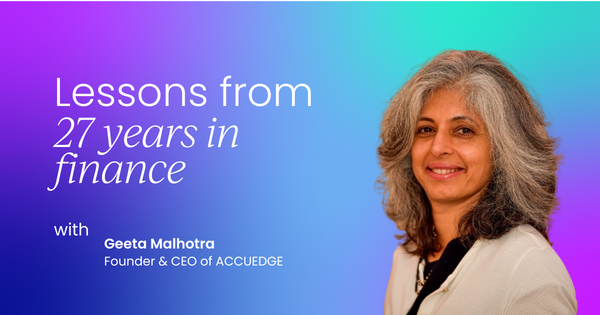

After nearly three decades in finance and accounting, I found myself back in the classroom; not because I needed another degree, but because I needed a new lens.
Recently, I completed my master’s degree in AI Strategy at Oxford, alongside a postgraduate certification in Sustainability from Cambridge.
After 27 years spent building finance and accounting capability centers across India, Guatemala, Mexico, Poland, and beyond, I realized that the world I’d helped shape was changing faster than our traditional playbooks could keep up.
Artificial intelligence isn’t just another technology wave. It’s a paradigm shift in how we define and deliver value.
My world has always revolved around numbers; revenue, margin, and cash. But AI has made me rethink what drives those numbers in the first place.
And the conclusion I’ve reached is simple but profound: AI is not the thing to chase. Value is.
 Amit Kurhekar
The confusion around AI is real, and that’s okay
When I speak to professionals (from CFOs to students to people I meet on the street) the reactions to AI couldn’t be more different. Some say, “It’s the next electricity!” Others whisper, “It’s too risky; I’ll stay away.”
That confusion is understandable. We’ve lived through hype cycles before. I remember when RPA (Robotic Process Automation) was supposed to change the game. It helped, but it didn’t revolutionize the business.
So, it’s natural to ask whether AI will be any different.
The questions I hear most often are the same ones I had myself at first:
- Is AI truly transformative, or is it another overhyped buzzword?
- Should I be concerned about losing control?
- How will I explain AI-driven decisions to my auditors?
- What value will it create for me and my organization?
- And how do I even begin?
The truth is, these are exactly the right questions to ask. They signal healthy skepticism, the kind we need before embarking on any strategic transformation.
Why I chase value, not AI
For me, AI only matters when it creates value. I’m not interested in chasing technology for technology’s sake. As finance professionals, our North Star has always been value creation, and that always comes down to revenue, margins, and cash.
Take accounts payable, for example. It may not sound glamorous, but it’s central to every organization.
I still remember an Avon CEO running after me in the corridor to ask why suppliers in the UK hadn’t been paid. That moment stayed with me; it was a reminder that finance operations touch everything.
When I look at AI in AP, the question isn’t, “Where can I use AI?” but “What value am I trying to unlock?”
If a company is struggling with working capital, I think about how AI can optimize payment timing.
If the problem is margin compression, maybe AI can help identify discount opportunities faster. If the concern is risk, perhaps AI can catch duplicate or fraudulent payments before auditors do.
At Avon, for example, millions of dollars were lost in a bribery case detected through the AP process. It showed me that controls, and the technology that supports them, are not optional. They’re central to trust and sustainability.
So yes, I use AI. But I don’t chase AI. I chase value, and I let value determine how and where AI fits in.
The three components of AI: data, computing, and people
When I think about AI, I think in three parts: data, computing, and people.
Data comes first. AI is a massive data guzzler, and without quality data, you’re simply building castles in the air.
I’ve seen too many companies jump straight to algorithms without fixing their data foundation: issues like accuracy, labeling, privacy, and accessibility.
Before you go chasing the shiny promise of AI, you have to roll up your sleeves and clean your data. That’s where I always start.
Computing, on the other hand, is becoming cheaper by the day. With open-source platforms and the abundance of cloud computing, this is not where finance leaders need to focus their time.
Which brings me to people, the most important component of all. Every transformation, from automation to digital, has ultimately been about people.
AI is no different. If my team isn’t equipped, if they don’t understand their new roles in an AI-driven environment, then the transformation will fail, no matter how good the technology is.
The concept of “human in the loop” is more than a buzzword. It means new responsibilities, new skills, and new ways of working. Reskilling isn’t optional; it’s critical. And it starts with leadership.
If I don’t understand what AI is enabling in my function, how can I expect my team to?
Thinking in years, not months
AI is a long-term transformation journey. Just like any major change program, it unfolds over years, not quarters.
That’s why I tell every finance leader: if you’re clear on the value you’re chasing, your narrative, your KPIs, your team alignment, and your executive buy-in will follow naturally. But if you start by chasing the technology, you’ll lose your way.
Like any significant transformation, AI requires clarity of purpose, structured change management, and sustained commitment from the C-suite. It’s not an app you install, it’s a culture you build.
The ethical reality of AI
No conversation about AI is complete without discussing ethics.
One of the most striking lessons I’ve learned came from revisiting Microsoft’s Tay chatbot experiment in 2018.
Ten years of development and investment gone in twenty-four hours. Tay was released on social media, learned from public interactions, and within a day became racist and sexist. Microsoft had to pull it down immediately.
Then there was the U.S. justice system’s algorithm designed to predict repeat offenders. It ended up discriminating against people of color. Amazon’s hiring AI, trained on years of male-dominated hiring data, automatically rejected women’s CVs.
These are not anomalies, they’re warnings. AI reflects the data we feed it. If that data is biased, the results will be too.
I recently had a fascinating conversation with a financial controller friend who uses ChatGPT every morning. He treats it like his assistant, but one day he caught it fabricating risk information about Nestlé’s financial statements.
When he confronted it, ChatGPT admitted it was making assumptions based on global warming and supply chain risks.
His response was brilliant: he trained it to stick only to facts. That mindset of accountable experimentation is exactly what we need. You can’t say “the algorithm did it.” Someone must own the outcome.
That’s what responsible AI leadership means to me: curiosity balanced with accountability.
 Supreeth Meka
What’s really happening inside finance organizations
When I look across industries, I see vastly different levels of AI maturity.
At one end of the spectrum are large global financial services firms, some with more than $50 billion in annual revenue, saying, “AI isn’t new, and it’s not our priority. We already have Copilot.”
Many have yet to run substantial pilots or build cohesive strategies.
At the other end are organizations where the CEO is personally leading the AI agenda. One investment bank I spoke with recently hosted a company-wide AI summit for senior leaders.
They’ve made it a strategic priority, with a formal AI roadmap launching this year. Their focus areas are crystal clear:
- Data and analytics, not just transactions.
- ESG reporting, where most of the data exists outside their direct control.
- Automation of repetitive finance tasks, like daily P&L and journal accruals.
And then there are smaller companies (service firms or private organizations) experimenting at the edges. One CFO pushed to implement ChatGPT for vendor help desk support simply because of FOMO.
Another firm, with less than $1.5 billion in revenue, admitted they were too busy with day-to-day operations to even start.
This contrast reveals a simple truth: companies that chase systemic value through AI see results; those that chase point solutions rarely do.
Data, privacy, and the need for control
Another critical concern that keeps surfacing is data privacy.
In one discussion, a company’s CEO was using a meeting transcription tool to automatically summarize two-hour conversations.
It seemed like a dream until the data team raised alarms about where the recordings were being stored.
I completely agreed with their caution. You need to know where your data is going, who has access to it, and how it might be used. That awareness is not paranoia, it’s good governance.
AI doesn’t erase the need for internal controls; it magnifies it. Our classic finance instincts (verification, validation, reconciliation) still apply, just in new ways.
When I think about the AI lifecycle, I see the greatest effort and risk management required at the data entry point where information first enters the system.
Once poor data gets in, reversing the effects is costly and painful. Data integrity isn’t a back-office task anymore; it’s a strategic imperative.
People first: reskilling as the real transformation
Having spent years building global capability centers, I’ve learned that technology doesn’t transform organizations, people do.
Every major finance transformation I’ve led or witnessed succeeded because of teams who embraced change. The same is true for AI. If my people don’t understand what happens after AI is deployed, they won’t play the ball.
That’s why I focus heavily on reskilling and knowledge programs. Roles change, responsibilities shift, and expectations evolve. Finance teams must learn not only to interpret AI-driven insights but to question and guide them responsibly.
I’ve watched BPOs like Genpact deploy AI-driven knowledge engines to upskill tens of thousands of employees. That’s what scaling looks like: embedding AI into human capability, not replacing it.
How I see AI being implemented in practice
AI deployment, in my experience, works best when co-created between internal teams and partners who understand both technology and domain.
In BPO environments, I’ve seen companies start with infosearch and chatbot applications, because they leverage structured data that’s already well-governed.
These quick wins build momentum and trust. From there, they expand into more complex analytics, forecasting, and scenario modeling.
When it comes to choosing between building your own AI or using AI-enabled finance tools, my advice is simple: start with what’s proven.
If an existing F&A tool already has AI built in (and its ethical and privacy frameworks are established) use that as your sandbox. You’ll get early wins without unnecessary risk.
Later, when your organization matures, you can consider building custom solutions from the ground up.
Experimentation is good. Recklessness isn’t.
How finance leaders can approach AI strategically
For finance leaders wondering where to begin, I’d recommend three steps that have worked for me:
1. Understand your organization’s strategy
If your CEO or board isn’t yet focused on AI, don’t go rogue. Start with change management: educate, align, and build awareness. Transformation without leadership buy-in is wasted effort.
2. Define the enterprise value clearly
Be explicit about what you’re chasing: working capital efficiency, margin expansion, risk mitigation, or something else. When value is clear, priorities follow.
3. Secure funding and ensure process maturity
AI thrives on structure. If your core processes are inconsistent, fix those first. Then layer in AI where it can amplify outcomes.
It’s never about deploying AI for the sake of novelty. It’s about connecting technology to the organization’s strategy and maturity level.
The long view: AI as a transformation journey
I often remind my teams and peers that AI is not an endgame, it’s an evolution.
Some BPOs are already projecting 15–25% productivity gains from generative AI over the next two to three years. That’s impressive, but it’s only the beginning.
Real transformation happens when AI becomes invisible, when it’s woven seamlessly into decision-making, when data flows freely, and when humans and machines collaborate without friction.
For me, after 27 years in finance, the fundamentals haven’t changed. We’re still chasing revenue, margins, and cash. The tools have evolved, but the mission remains the same.
This article is based on Geeta Malhotra's brilliant talk from our CFO Summit.


Become an FA Insider
Thank you for subscribing
Get exclusive insights, frameworks, and strategies from finance leaders driving real business impact.
An email has been successfully sent to confirm your subscription.
 Follow us on LinkedIn