
Planning for the unexpected has always been close to my heart, perhaps because, in the world of finance, uncertainty is the only certainty we have.
Over the years, I’ve seen how rigid planning can leave even the most established organizations vulnerable when market conditions shift.
That’s why I’m passionate about a different approach; one that embraces change rather than fears it.
Agile FP&A (Financial Planning & Analysis) has become a game-changer for me and the teams I’ve worked with.
Originally born in the world of software development, agile principles have now made their way into finance, offering a more flexible, collaborative, and adaptive way to plan for the future.
This isn’t about throwing structure out the window. It’s about building a framework that evolves in real time, helping organizations make faster, smarter decisions when the unexpected happens.
In this article, I’ll share what agile FP&A really means, how it differs from traditional approaches, and the key methodologies that make it work.
I’ll also explore a real-world case study from Adobe, which successfully transformed its financial planning processes, and I’ll outline practical strategies for putting agile FP&A into action in your own organization.
 Alexander Roche
Exploring agile methodologies
Before diving into the specifics of how to implement agile FP&A, I want to start by clarifying what it really is. The term itself can sound like a buzzword, but the principles behind it are very practical.
What is agile FP&A?
Agile FP&A, short for Financial Planning & Analysis, is an approach to budgeting and forecasting that applies agile principles and values to the finance function.
While agile began in software development, it has proven incredibly valuable in other areas, including finance.
At its core, agile emphasizes collaboration, transparency, iteration, and adaptability.
Unlike traditional FP&A, which often runs on a rigid, annual cycle with infrequent updates, agile FP&A operates in shorter, more dynamic cycles.
This allows teams to adjust quickly to changes in the market, business conditions, or internal priorities.
Stakeholders are involved more frequently, and decision-making becomes a shared, ongoing process rather than a once-a-year event.
How agile differs from traditional FP&A
Traditional FP&A can be reactive, siloed, and slow-moving, producing static budgets that quickly become outdated. Agile FP&A shifts the mindset toward being proactive and dynamic.
It breaks down large budgeting processes into smaller, iterative steps, and it fosters ongoing conversations between finance and the rest of the organization.
This approach helps align financial decisions with real-time realities.
 Sabrinthia Donnelly
The core methodologies of agile FP&A
1. Focus on business value
In agile FP&A, every decision ties back to business value. Financial planning is directly aligned with strategic goals and organizational priorities.
Instead of creating budgets in isolation, the FP&A team works closely with other departments to ensure every projection supports the company’s larger objectives.
This keeps the function relevant and deeply connected to the decision-making process.
2. Foster collaboration
Collaboration isn’t optional, it’s foundational. Agile FP&A depends on regular communication across departments, whether through agile boards, daily stand-ups, or cross-functional planning sessions.
Finance shouldn’t work in a silo; we should be engaging with sales, marketing, operations, and other teams to ensure our reflect the full business picture.
3. Commit to continuous improvement
Agile thrives on iteration. For FP&A, that means continuously refining forecasts, budgets, and processes based on feedback and performance.
This might involve experimenting with new models, testing assumptions, and making small, frequent adjustments rather than waiting for an annual review.
4. Embrace flexibility and adaptability
The business environment can change overnight. Agile FP&A teams are prepared to pivot quickly, whether that means re-allocating resources, rethinking priorities, or adopting new tools.
This adaptability ensures financial planning stays relevant in the face of uncertainty.
5. Use rolling forecasts
Instead of locking into a single 12-month budget, agile FP&A uses rolling forecasts, updating projections every three to six months (or more frequently if needed).
This approach keeps forecasts current and responsive to market conditions, allowing for faster decision-making and better risk management.
6. Make data-driven decisions
Data is the backbone of agile FP&A. By leveraging real-time analytics, we can identify trends, uncover hidden patterns, and produce forecasts that are both timely and accurate.
This not only improves decision-making but also builds trust in the finance function’s insights.
 Kevwe Ijatomi
Case study: Adobe’s transformation
I believe the best way to move from theory to practice is through a real-world example.
One of my favorite cases to share is Adobe’s transformation because it perfectly illustrates how agile FP&A can help a company reinvent itself and thrive in the face of major change.
The challenge
Adobe is a multinational software company, best known for its creative tools like Photoshop, Illustrator, and the now-retired Adobe Flash.
For years, its business model revolved around selling perpetual software licenses, which is a model that produced big revenue spikes when new versions launched, but left long gaps in between.
As technology evolved and customer expectations shifted, Adobe faced a daunting challenge:
- Transitioning its revenue model from one-time license sales to a subscription-based service through Adobe Creative Cloud.
- Integrating data systems to support this new model.
- Scaling agile processes to stay responsive in a rapidly changing software market.
Shifting to a subscription model wasn’t just a pricing change, it required a complete overhaul of how the company planned, forecasted, and analyzed its financial performance.
 Sabrinthia Donnelly
The agile FP&A approach
To navigate this transition successfully, Adobe embraced agile FP&A principles:
1. Subscription model planning – Moving to subscriptions required entirely new revenue forecasting methods and resource allocation models. Instead of predicting large, irregular spikes, Adobe now had to plan for consistent, recurring revenue streams.
2. Data-driven decision-making – Adobe invested heavily in data analytics to gain real-time insights into customer behavior. This data became the backbone of their financial planning, enabling more accurate forecasts and quicker responses to market signals.
3. Iterative planning cycles – Rather than sticking to rigid annual plans, Adobe adopted shorter, iterative cycles that allowed them to adjust forecasts, budgets, and investment strategies in real time based on subscription performance.
The results
1. Predictable, recurring revenue
The shift from one-time purchases to recurring subscriptions smoothed out Adobe’s revenue streams.
Instead of depending on large but unpredictable launch cycles, the company could now count on steady monthly income.
This made long-term planning easier, improved capital allocation, and reduced the uncertainty inherent in the old model.
2. Enhanced customer insights
With real-time analytics, Adobe gained a deeper understanding of how customers used its products. They could quickly identify popular features, spot areas needing improvement, and act on feedback faster.
This responsiveness not only boosted customer satisfaction but also increased loyalty and retention.
3. Faster market response
Shorter planning cycles meant Adobe could bring new products and features to market more quickly.
They could refine offerings almost in real time, staying at the cutting edge of the industry and seizing market opportunities without waiting for the next annual planning round.
4. Stronger cross-functional collaboration
The transformation required close coordination between finance, product development, marketing, sales, and operations.
Agile FP&A encouraged these teams to work together, bringing diverse perspectives into the planning process and ensuring alignment across the organization.
 Geeta Malhotra
Why this matters
Adobe’s adoption of agile FP&A was critical to its successful shift to a subscription-based model.
By combining predictable revenue with data-driven insights, faster decision-making, and cross-functional teamwork, Adobe not only maintained its market leadership but also positioned itself for sustained growth.
Their story is a powerful example of how a company can reinvent itself through agile methodologies and a customer-centric approach, turning uncertainty into a competitive advantage.
Strategies for implementing agile FP&A
Moving from theory to practice requires a clear roadmap.
Over the years, I’ve learned that successful agile FP&A implementation isn’t about adopting a few new tools or updating a forecasting schedule; it’s about creating the right foundation, building the right frameworks, and embedding agility into the way your team works every day.
Here are the strategies I’ve found most effective.
 Alexander Vorobev
1. Establish agile foundations
Before anything else, agility needs to be embraced at the leadership level. Without strong sponsorship from the top, it’s hard to make the cultural and process changes necessary for agile FP&A to thrive.
- Leadership buy-in – Leaders must understand not just the mechanics of agile, but also the value it brings faster decision-making, greater adaptability, and stronger cross-functional alignment.
- Training and development – Equip both the FP&A team and relevant stakeholders with a solid understanding of agile principles. This training fosters flexibility, responsiveness, and collaboration.
- Change management – Moving from traditional FP&A to agile requires careful transition planning. Communicate the benefits clearly, set expectations for new workflows, and prepare the organization for a more dynamic way of working.
2. Build the agile FP&A framework
With the foundation in place, you can develop the frameworks that make agility possible.
- Rolling forecasts – Replace or complement the annual budget with rolling forecasts updated monthly or quarterly. This ensures plans reflect the latest market conditions and business performance.
- Scenario planning & stress testing – Develop multiple financial models to prepare for different possible futures - best case, worst case, and everything in between. This allows you to respond quickly when circumstances change.
- Technology integration – Invest in FP&A software that supports real-time data analysis, collaborative planning, and scenario modeling. AI and machine learning can further enhance forecasting accuracy, provided the tools are user-friendly and integrate smoothly with existing systems.
 Kate Motonaga
3. Operate agile FP&A in practice
Agility isn’t just a planning process, it’s a way of working across the organization.
- Cross-functional teams – Include finance, sales, operations, marketing, and other departments in the planning process. This ensures alignment and eliminates silos that slow decision-making.
- Decentralized decision-making – Empower managers with the information and authority to make timely financial decisions without unnecessary delays.
- Continuous improvement – After each planning cycle, hold retrospectives to review what worked, what didn’t, and how processes can be improved. This keeps the system evolving and prevents stagnation.
4. Define performance metrics
To sustain agility, you need to measure it. Identify metrics that reflect agile goals, such as:
- Speed of response to market changes.
- Forecast accuracy over time.
- Effectiveness of scenario planning.
These KPIs help track progress, validate the value of agile FP&A, and highlight where further refinements are needed.
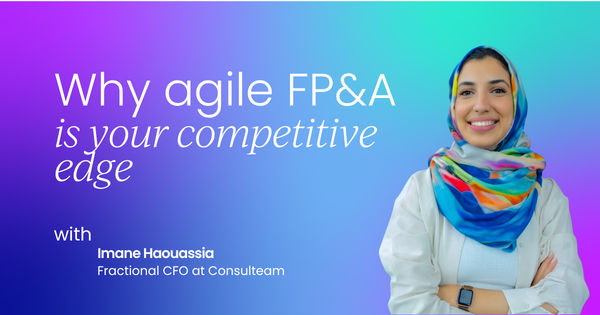
This article is based on a presentation given by Imane Haouassia at our virtual FP&A Summit. There are many more upcoming events you can join to learn from the best.


Become an FA Insider
Thank you for subscribing
Get exclusive insights, frameworks, and strategies from finance leaders driving real business impact.
An email has been successfully sent to confirm your subscription.
 Follow us on LinkedIn