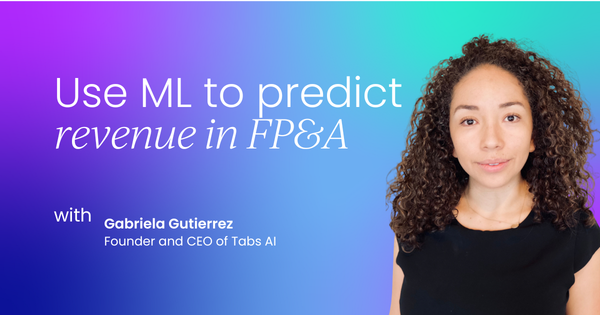


Did you know that you can predict revenue with machine learning?
It’s a fascinating concept that FP&A teams can leverage to gain a significant advantage.
By analyzing historical sales data, marketing efforts, economic indicators, and even customer sentiment, machine-learning models can identify patterns and trends that are difficult for humans to see.
But how can FP&A teams utilize this type of technology in their roles?
Why does FP&A exist?
Before I get into the future of FP&A, I think it’s important to start at the beginning and think about why FP&A exists.
In my opinion, FP&A’s main role is to help businesses make better decisions.
We’re in charge of long-term planning, monitoring market trends, and understanding in-depth business performance. Based on those things, we provide insights and recommendations for future action.
FP&A is essential in shaping the company's long-term strategy.
How data leads to better predictions and decisions
The most important part of our role in FP&A is to collect and analyze data. We can collect business data and base our predictions on it. For example, we can explore a large dataset to create reports (variance analysis) and make accurate predictions.
With those predictions, we can create budgets, and monthly forecasts, and share those insights with different stakeholders.
And then we would have the business partnering side of FP&A. This is when we step up as strategic partners to the business and converse with different heads of departments and even the C-Suite.
Every budget and forecast we create influences the future of the company. Once one cycle ends, another begins.
How FP&A makes predictions
Data holds insights that can help us make better decisions and take different actions. In the past, predictions were based on human judgment.
So, finance professionals relied on their intuition and experience and a lot of it was based on gut feelings and instincts.
The problem with that approach is that you risk sacrificing accuracy. Today, we collect data from different parts of the business and include other departments such as IT. They share their data with us, and we’re provided with a data summary.
 Sabrinthia Donnelly
Without a data summary, we couldn’t comprehend all the data given to us. We would have to look at thousands of rows of data and try to make sense of it all, something that our human brains can't possibly comprehend.
So, data summaries are processed by humans. Usually, these are added to a spreadsheet or dashboard.
But once we have the data, how can we make decisions based on that data? Which data should we choose to create our forecasts and budgets? And which data should we exclude?
Not only that, but data alone isn’t enough to isolate us from human bias. That’s why I advise we give machine learning a chance.
What can FP&A achieve with machine learning?
Machine learning can scale your data analysis because it can handle large data sets that would otherwise be impossible for a human to do on their own.
It increases the accuracy of the predictions as well as the efficiency of the process. What’s more, it reduces human bias and it can even adapt to unknown situations.
Machine learning can be trained. It knows exactly which data to choose and which data to ignore. All we need to do is provide the technology with information and it’ll process the data automatically.
The reason why I believe FP&A and machine learning can work well together is because FP&A’s main goal is to improve the decision-making process (and machine learning can help us do that more effectively).
 Asif Masani
In my previous role, we had tons of data but couldn't scale it. This made forecasting our budget difficult because we were unable to use the relevant data we needed. So, we searched for a solution and found it within machine learning algorithms.
Using a tool called Profit, an open-source algorithm (created by Facebook) to forecast traffic, we were able to:
- Improve cash flow management
- Boost transparency with stakeholders
- Better resource planning
- Increase efficiency
- Increase profitability
- Improve decision-making
- Mitigate risk
As a result, we had a 100% accurate forecast and increased profitability by 62% for one product. The team was then able to focus better on business partnering and guiding the strategy.
Once we knew that our forecasts were so accurate, we were able to take action. We considered different variables including inflation rates, page views, holidays, and their impact on revenue, etc.
We still used spreadsheets to load and store data, but never for analysis. We used the Python Profit Model for that.
An issue that we had, though, was that not everyone in the team could code in Python, so we needed to figure out a way to increase transparency within the team.
Here’s how we did it.
 Supreeth Meka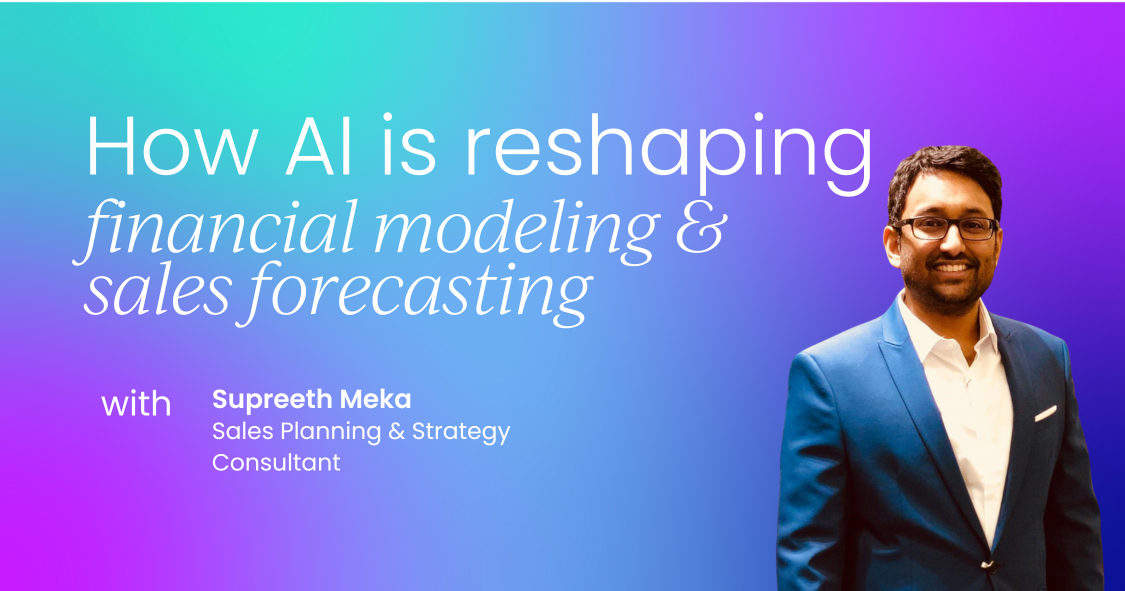
Using machine learning technology, I could provide the data and then tell the model exactly what I wanted it to do.
For example, I would ask it to forecast for the next quarter or even longer than that and it was able to run through the data and provide results within three seconds.
The technology provided the forecast and it also alerted me to different trends it detected within the data, which made it easier for me to pinpoint what happened in those specific periods to assess why the trends/shifts in data occurred.
Will machine learning replace us?
Although machine learning technology is powerful, it will not replace us. Human judgment is still important and necessary. As technology continues to grow, human judgment will become even more valuable over time.
Yes, machines have become better at forecasting, but they don't know what's happening in the business. Plus, they wouldn't be able to understand it in the same way that an FP&A team can.
So, what does human judgment look like in practice?
I want to give you an example.
We were so accurate in our forecast that we already knew how our revenues would look for the next 24 months. But that number still wasn’t within the company's goals. So, we already knew that we would be at 100 million, and we needed to reach 200 million.
So, we started to introduce dynamic pricing. We either had to adapt and reach 200 million, or we would risk stagnation.
The optimal solution was using human judgment and AI-driven solutions to power our strategy and hit our goals.
 Salvatore Tirabassi
What's next for FP&A?
I predict that we will have accurate predictions to make better decisions.
Although machine learning within FP&A is still quite new, if we can learn to leverage this technology in the right way, we will be able to focus our time on becoming better business partners.
This article has been adapted from Gabriela Gutierrez’s talk on predicting revenues using machine learning within FP&A (from our FP&A Summit in San Diego).
Our Salary Survey will help you uncover whether you're being paid enough (and give you an edge when it comes to negotiating your next pay rise).
But we need your thoughts first; your peers are already contributing their insights, so don't get left behind.
 Teresa Garanhel


Become an FA Insider
Thank you for subscribing
Get exclusive insights, frameworks, and strategies from finance leaders driving real business impact.
An email has been successfully sent to confirm your subscription.
 Follow us on LinkedIn