

Most finance teams aren't running agentic AI, but they're automating invoices, building cleaner reporting, summarizing documents and, in a few cases, using a chatbot to stress-test a pitch.
That is the honest picture from our CFO Insights Report (partnered with Multiplier).
We asked finance leaders a direct question: how are you currently using AI and data within finance, and where has it delivered the most value so far?
 Finance Alliance
The answers were less futuristic than the headlines, and far more useful. They ranged from "not yet" to AI embedded in daily workflow, with most teams somewhere in between.
There is a good reason finance moves carefully. Other departments can ship an AI-generated draft, spot the mistake and quietly fix it. A wrong number in a board deck or a regulatory filing is a different kind of error.
When the cost of being confidently wrong is that high, caution is a sensible response, not resistance.
1. Plenty of teams haven't started, and that's fine
Several respondents were refreshingly candid.
Maurisse Johnson, CFO at United Federation of Teachers, said his team hasn't rolled out any AI components yet. Dion Lisle, now VP of Business Development at Root, answered in two words: "Not yet."
What stood out is that neither was vague about what comes next. Both had a specific first use case ready: predictive cashflow analytics for Johnson, and working-capital prediction for Lisle.
That is a better starting position than it sounds. A team that knows exactly which problem AI should solve first is more likely to see a return than one that rolls out a general-purpose tool and waits for value to appear.
Johnson's team is also laying groundwork in the meantime. They are aligning program metrics with a newly rolled-out ERP system and their planned AI efforts, so the data will be ready when the tools arrive.
"We currently have different metrics for different programs. We are aligning those measurements with a new ERP system we just rolled out and our efforts with AI." – Maurisse Johnson, CFO at United Federation of Teachers
2. The earliest wins are in transactional work
When asked where AI pays off first, Christian Frantz Hansen, Partner for CFO Services and Finance Transformation at Implement Consulting Group, pointed straight at accounts payable and receivable.
"AR/AP: highly transactional processes benefit the most." – Christian Frantz Hansen, Partner, CFO Services | Finance Transformation at Implement Consulting Group
The logic is simple. High-volume, rules-based work is where errors are easy to catch and time savings are easy to measure. It is also low-risk: a misread invoice gets flagged in review long before it reaches a board pack.
James Pennington, CFO at Zaizi, took the pragmatic route here. Rather than building something bespoke, his team bought it.
"Off-shelf AP automation." – James Pennington, CFO at Zaizi
Not every team needs a dedicated AI platform for this, either. Theingi Oo, former FRO and Head of Finance & Procurement at ATOM, described a stack built from tools most finance teams already have.
"We use the resources to automate, for example, like the RPA process. We even use the power queries and Excel to make it automated. That can give us more free time for our staff to do the important job, like analysis that gives insight to the business." – Theingi Oo, former FRO and Head of Finance & Procurement at ATOM
3. Reporting and forecasting come next, once the data is in one place
The second wave is reporting. Teams that have got their data into a single home are using it to automate the recurring reports that used to eat days of the month.
"Built a data warehouse to run automated BI reporting." – James Pennington, CFO at Zaizi
At PepsiCo, the use is broader. Noufal Mohamed Basheer, Director of Business Strategy, said the biggest payoff has not been the automation itself but what it unlocks: faster, sharper commercial decisions.
"We are using AI and data to automate reporting, improve forecasting, and identify performance drivers and growth opportunities. The greatest value has come from accelerating analysis and enabling faster, more targeted commercial and resource-allocation decisions." – Noufal Mohamed Basheer, Director of Business Strategy at PepsiCo
GreenWaste sits in the middle. CFO James Redmond described AI use as limited today, mainly within FP&A, with a wider rollout planned.
"AI is being leveraged on a limited basis currently, primarily in FP&A. However, an extensive Finance AI enablement program is underway to expand the use of AI across the Office of the CFO." – James Redmond, CFO at GreenWaste
Notice the pattern. FP&A tends to go first because it already works with structured data and already owns the forecast. It is a natural pilot site before AI spreads to the rest of the office of the CFO.
4. Generative AI is a research and summarizing assistant
For many finance leaders, the most immediate value from generative AI is simply getting through information faster. One anonymous CFO described a use case that will sound familiar to anyone who has spent a month-end buried in attachments.
"Mostly to summarize the data of sales reports from multiple PDF files, preparing financial insights with indicators by uploading the financial figures." – Anonymous CFO
Scott Walley, a CPA and fractional CFO firm owner, uses it the same way for client work: to analyze data, do background research and surface the issues worth raising.
"Efficiencies in data analysis, research, finding issue to discuss with clients." – Scott Walley, CPA, Fractional CFO firm owner
Hansen also named a use case outside the finance process itself: writing client proposals. It is a reminder that some of the quickest returns come from the work around the numbers, not just the numbers.
The common thread is that a person still owns the output. AI produces the first pass; the finance professional checks it, adds judgment and decides what to do with it.
5. The most creative use: AI as a sparring partner
The standout example in the report did not involve automation at all. Emma Martin, CFO (EMEA) at Edelman, described a team member who used ChatGPT to rehearse a commercial negotiation before it happened.
"One of my guys was prepping for a pitch, and he said to ChatGPT: play the role of the procurement [officer] for the client. I'm going to tell you what I'm going to come with from a pricing commercial model, and I want you to pull it apart, pick holes in it, and think of every question you have. That was a really nice way to use AI to prep for the pitch, which he won because he felt very prepared on the commercial side." – Emma Martin, CFO (EMEA) at Edelman
This works for a simple reason. The AI does not need to be right about anything. Its job is to ask hard questions, and the person decides which ones matter. That sidesteps the accuracy concerns that make finance cautious elsewhere.
The same approach applies well beyond pitches. Finance teams could use it to rehearse:
- A budget defense in front of a skeptical board member
- A pricing proposal before it goes to a customer's procurement team
- An investment case before the capital allocation committee
- A variance explanation before the monthly business review
6. Why large companies move slower
Size changes the pace. Nikki Mamedova, who works in the Office of the Corporate CFO and Chief Accounting Officer at RBC, has built finance functions from scratch and worked inside large incumbents. She was blunt about the difference.
"How much bureaucracy do you have in large corporations? Do you understand how difficult it is to change something versus building something from scratch? I'll be honest, when I was building something from scratch at Amazon and Saks (...) it was much easier to build something new, and I would expect AI implementations there would be much faster than in a large Fortune 500 company where we're even debating whether cloud is the way to go." – Nikki Mamedova, Office of the Corporate CFO and Chief Accounting Officer at RBC
That helps explain the spread of answers in the report. A fractional CFO or a lean team at a mid-sized firm can buy a tool on Monday and use it by Friday.
A large bank has to work through governance, security reviews and legacy infrastructure first.
Neither pace is wrong. But it does mean large organizations should judge progress against their own starting point, not against a startup's.
The appetite is there regardless of size. A recent CFO survey found that 68% of CFOs expect their IT and digital transformation spending to increase over the next year.
Where is your finance team on the AI curve?
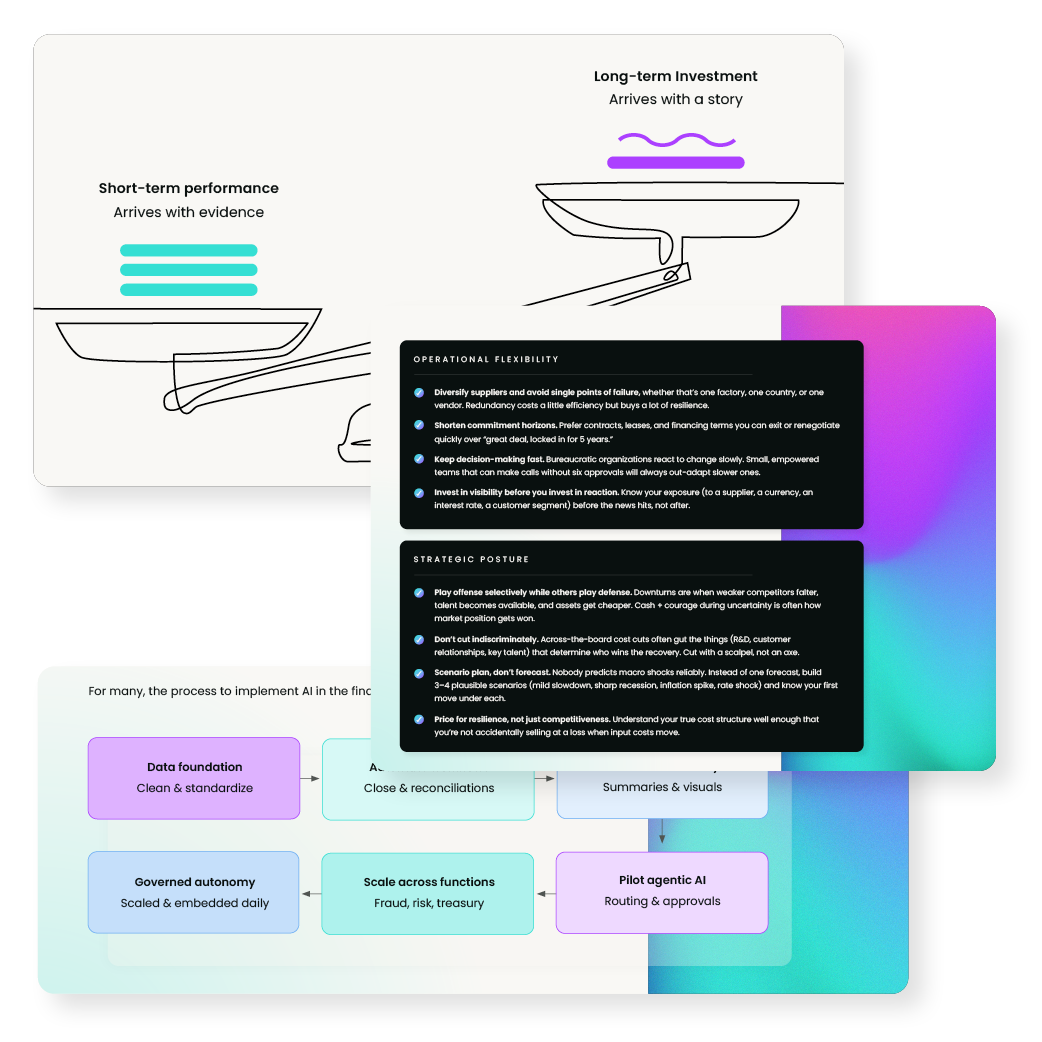
Put the answers side by side and a clear sequence appears. Each stage depends on the one before it, which is why so many teams start with data rather than AI.
- Data foundation: clean and standardize the data.
- Automate workflows: the close and reconciliations.
- Gen AI-assisted analysis: summaries and visuals.
- Pilot agentic AI: routing and approvals.
- Scale across functions: fraud, risk and treasury.
- Governed autonomy: AI scaled and embedded in daily work.
Most respondents in the report sit somewhere between stages one and three. That is not a sign of being behind. It is where the durable value gets built.
Three questions to decide your next step:
- What is your one first use case? Name the specific forecasting, cash or reporting problem AI should solve, as Johnson and Lisle already have.
- Where does your team spend the most hours on low-judgment work? That is your automation target.
- Where could AI challenge your thinking rather than replace it? A pitch, a budget defense or a board question is a low-risk place to try.
The finance teams getting real value from AI today are the ones who picked a specific problem, fixed the data underneath it, and kept a person accountable for the answer.



Become an FA Insider
Thank you for subscribing
Get exclusive insights, frameworks, and strategies from finance leaders driving real business impact.
An email has been successfully sent to confirm your subscription.
 Follow us on LinkedIn