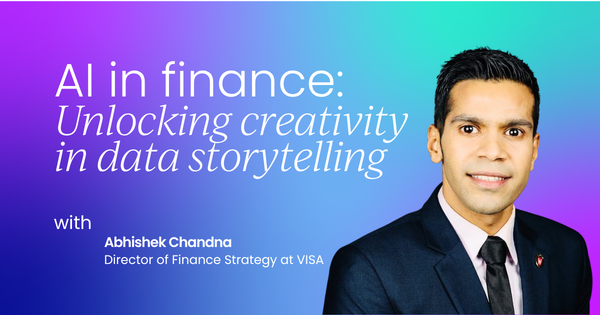

A few months ago, I spoke about building AI products in finance, walking through how teams can move from manual work to more automated, AI-powered workflows.
To make that shift concrete, I introduced a hypothetical character, Jane, and traced her path from drowning in manual work to something I called Jane 2.0: a version of herself equipped with real AI products and a more automated way of working.
That earlier conversation solved one problem but it also created a new one.
Once Jane had the time back, her manager asked the obvious next question: now that you've built a good strategy around AI products, reusable not just for you but for the broader organization, how do you intend to spend the extra time you have?
That question is the real subject of this piece. AI is going to keep automating and improving the mundane parts of finance work. The interesting question is what we do with the time it returns to us, and I'd argue the answer is storytelling.
What follows is a look at what I call the sameness problem, why finance needs to move from producing reports to owning a narrative, a simple framework for making that shift, a few real scenarios that illustrate it, and where Jane's evolution goes next, from 2.0 to what I'm calling Jane 3.0.
 Kate Motonaga
Where Jane started
Not long ago, Jane was the star of her team and drowning in manual work. She spent hours stitching together datasets from multiple sources, relying on her own manual thinking because the systems around her weren't built to help.
She was building reports from scratch, running scattered AI pilots, and functioning as a data plumber rather than the strategic partner she was capable of being.
The fix was an operating model shift: building actual AI products so Jane could move into the strategist role she was meant to occupy.
She made that leap. But the moment she had time back, the conversation shifted from how she works to what she's actually contributing. That's the gap this piece is trying to close.
 Teresa Garanhel
The sameness problem
The new risk in this AI era isn't a bad output. Models keep improving, and the pace of that improvement means most teams can now produce a polished deck, clean commentary, and structured analysis without much friction.
Efficiency has genuinely improved, hours of work condensed into minutes. But the real question isn't whether the output is good. It's whether it's impactful, or simply forgettable. That's the sameness problem.
I ran into this myself recently, when I was asked to share some insights and the response I got back was, essentially, that this kind of output had already been seen multiple times. That response captures the shift well.
The differentiator is no longer how well you can curate an output. It's what story you're trying to tell with it. AI raises the floor for everyone; judgment becomes the ceiling.
The teams that win are the ones who frame the question differently, challenge the narrative, and drive the decision.
AI is very good at standardizing output. The risk is letting it standardize thinking as well.
 Geeta Malhotra
Four shifts finance needs to make
Report creator, variance describer, output polisher, data summarizer: these labels have described finance and FP&A roles for a long time, and they need to give way to something different.
AI should absolutely keep automating the underlying work behind each of these, but the role itself has to shift.
Report creator becomes story owner. Explaining why the numbers moved is no longer the job on its own; translating that movement into real business impact and building the narrative around it is.
Variance describer becomes insight framer. Describing what changed matters less than framing what that change means for a decision that has to get made.
Output polisher becomes outcome shaper. Good commentary is table stakes. Shaping the outcome a team is trying to drive, and figuring out what narrative gets there, is the actual work.
Data summarizer becomes decision driver. Presenting what the data shows isn't enough on its own; the job is driving the decision that the data points toward.
Getting good data and curating clean reports used to be the real constraints in this job. AI has largely closed that gap. What remains as the genuine differentiator is the story built on top of it.


Become an FA Insider
Thank you for subscribing
Get exclusive insights, frameworks, and strategies from finance leaders driving real business impact.
An email has been successfully sent to confirm your subscription.
 Follow us on LinkedIn