

The CFOs who will lead in 2030 will not be the ones with the most sophisticated models. They will be the ones who get accurate information to decision-makers fastest, and who turn AI into changed decisions rather than shelved pilots.
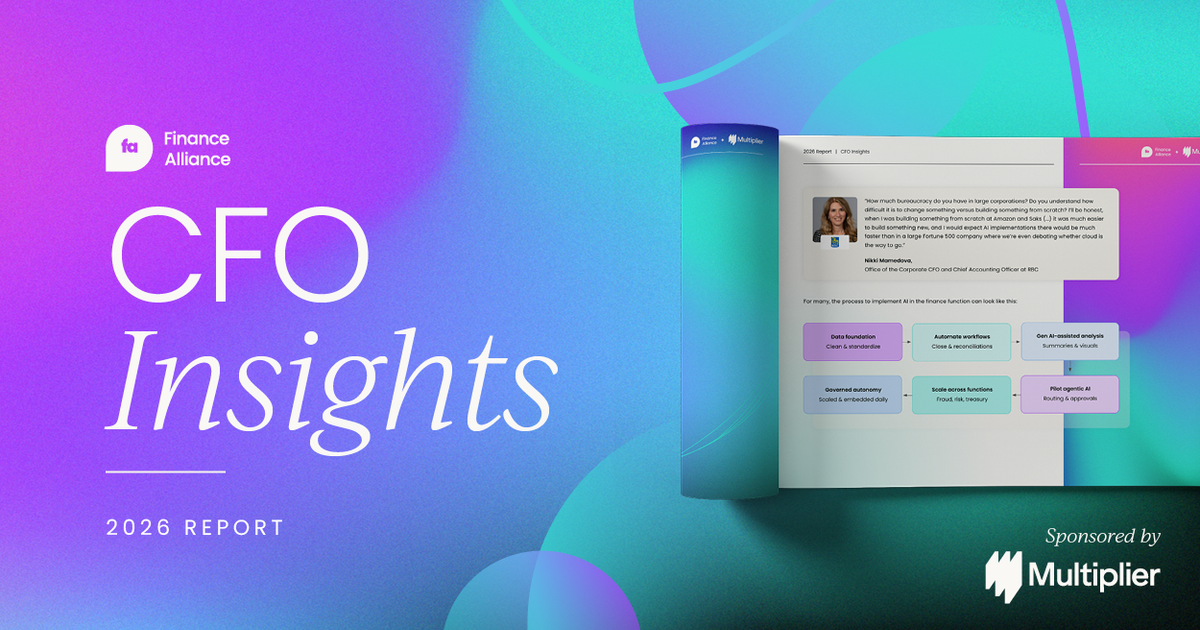
That is the clearest pattern from the 2026 CFO Insights Report by Finance Alliance and Multiplier.
We asked finance leaders a simple question: what will define a high-performing CFO over the next few years?
Their answers came from very different places, including a $500M waste-management platform, a teachers' union, a finance-transformation consultancy, PepsiCo, Citi and a handful of fractional CFOs.
Yet they kept landing on the same five traits.
 Finance Alliance
1. They deliver the answer sooner, not just more accurately
The most repeated idea was timeliness. Finance leaders do not see accuracy and speed as a trade-off; they see slow, accurate information as a failure in its own right.
"The ability to deliver timely, accurate and relevant information. At the same time, control of cash and ability to steer business strategically." – James Pennington, CFO at Zaizi
James Redmond, CFO at GreenWaste, was specific about what that looks like in practice: a fast close, strong controls and real-time data.
"The office of the CFO will be defined by providing timely and effective business insight to the key management teams. This will be built around quick month end close, underpinned by strong controls to ensure accuracy.
"Information will need to be provided on a real time basis to avoid the business focusing on the current conditions rather than the rear-view mirror." – James Redmond, CFO at GreenWaste
David Chavez, CFO at CVS Health, put the challenge most sharply. He asks finance teams to question how much of their decision-making already runs on stale data.
"If I offered you right now a ten percent improvement in forecast accuracy, would you take it? What if I told you that the real value wasn't in accuracy but it was actually in getting the answer sooner?" – David Chavez, CFO at CVS Health
An anonymous treasurer summed up the brief in a single line: "Business knowledge, macro and industry challenges and faster/more accurate financial reporting."
2. They use AI to change decisions, not to produce more dashboards
Every respondent expects AI to reshape finance. The disagreement is about what counts as success. The strongest answers judged AI by one test: did a consequential decision change?
"Finance does not have a technology problem; it has a decision problem. Too many organizations are layering AI onto fragmented data, legacy processes, and siloed metrics, then wondering why the ROI never materializes.
"AI creates value when it changes a consequential decision, not when it produces another dashboard or impressive pilot." – Diego de Aragão, SVP at Citi
Christian Frantz Hansen, who advises finance leaders on transformation, framed it as a shift in where finance spends its time.
"The ability to translate AI adoption into real change in what is done in Finance, i.e., less transactional work and much more business partnering and collaboration with the business." – Christian Frantz Hansen, Partner, CFO Services | Finance Transformation at Implement Consulting Group
Others went further. Miguel Angel Miranda, Founder & Enterprise Value Strategist at SparkCognizant Inc, described the goal as "a new financial operating system orchestrated by agentic AI." Maurisse Johnson, CFO at United Federation of Teachers, pointed to "the ability to integrate technologies that drive decisions."
The catch is scale. Pilots are easy; adoption is not.
"The biggest challenge is moving from successful pilots to adoption at scale. Measurable ROI requires clean data, integration into existing workflows, clear business ownership, and disciplined tracking of outcomes rather than focusing only on technical performance." – Noufal Mohamed Basheer, Director of Business Strategy at PepsiCo
High performers also keep a healthy scepticism. Premal Parekh, CFO at OlympiaUK, has learned to pressure-test what AI gives him.
"There are going to be errors in the AI. And I see it even today. I can put in some financial modeling questions and it'll spit out some top-down answers. But when I work it back, or ask it more probing questions, it starts unpicking gaps in its knowledge or gaps in its workings." – Premal Parekh, CFO at OlympiaUK
That caution is not resistance. In finance, a confidently wrong number in a board deck costs far more than a bad first draft elsewhere in the business.
3. They get the foundations right first
For all the talk of agentic AI, several leaders made an unglamorous point: none of it works without a clean ledger and consistent data. Boards now treat this as a baseline, not a bonus.
"As a CFO, you need to get your ERP right, your general ledger. This is table stakes now for most boards, investors, and CEOs when they're looking to hire a CFO." – Dan Fletcher, CFO of Planful
Ahikam Kaufman, CEO & CFO at Safebooks AI, explained why the foundations matter so much for everything that comes after.
"Everything we will want to do and automate would require that the data will be consistent, complete, and accurate. And today, we have to deal with a lot of data that is fragmented across many disparate systems." – Ahikam Kaufman, CEO & CFO at Safebooks AI
Some finance teams are still at this stage. Justin Conroy, CFO at Luke's Lobster, was candid about it.
"In the midst of a digital transformation starting with an ERP implementation. Current systems do not allow for any AI application." – Justin Conroy, CFO at Luke's Lobster
That honesty is useful. Skipping the foundation to chase AI is how organizations end up with the stalled pilots Diego de Aragão warns about.
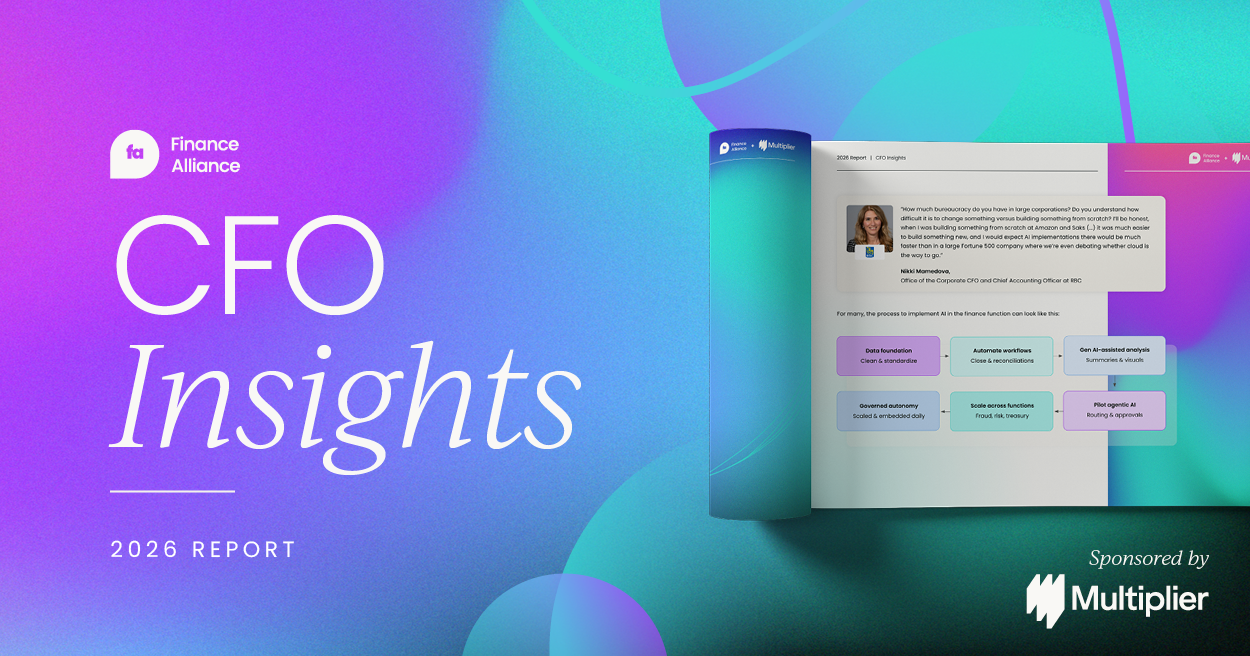
The sequence that works runs roughly: clean and standardize data, automate the close and reconciliations, then add AI-assisted analysis, then pilot agents.
4. They are stewards and strategists at the same time
The old CFO protected the numbers. The new one is expected to shape the business too, without dropping the first job. Respondents described both roles as one job, not a trade-off.
"The CFO of the next five years must be both a financial steward and an enterprise decision architect, disciplined enough to protect today's performance while bold enough to build tomorrow's advantage." – Diego de Aragão, SVP at Citi
"A high-performing CFO will combine financial discipline with strategic leadership, using AI and real-time data to accelerate decisions and resource allocation. The strongest finance functions will automate reporting, anticipate risks, and actively shape growth rather than simply measure performance." – Noufal Mohamed Basheer, Director of Business Strategy at PepsiCo
In regulated industries, that balance has hard edges. Todd Newberry, CFO/COO at Prosperity Bank Equipment Finance, defined success as "becoming someone who is seen as innovative in accomplishing company objectives while operating within legal, regulatory, and compliance boundaries."
Amanjeev Singh, CFO of Ardagh Metal Packaging North America, named the risk of getting the balance wrong.
"I think it's important that we are the keepers of financial discipline, which is our job, but also not become inhibitors of growth. There's a balance there that needs to be struck." – Amanjeev Singh, CFO of Ardagh Metal Packaging North America
Part of being a strategic partner is raising the financial literacy of the people around you. Scott Walley, a CPA and fractional CFO firm owner, pointed to "the ability to increase financial knowledge of CEO's and other management" as a defining trait.
James Redmond added that "business partnering will be a key success factor to allow the business to operate effectively and drive performance."
5. They get more insight from leaner teams, and never lose sight of cash
The final trait is about economics. Finance is expected to produce more strategic value without growing headcount at the same pace.
"The ability to deliver increased strategic and tactical insights with lower investment in personnel." – Mike Kovar, Fractional CFO
James Pennington, CFO at Zaizi, described what that looks like today: "Resilience, having a lean, efficient team with automated processes. [It's] possible to run with one person though only short term." The caveat matters. Lean only works when automation carries the routine load.
Cash and working capital remain the anchor. Dion Lisle, now VP of Business Development at Root, named a single priority: "Predicting Working Capital to reduce cost of capital."
An anonymous CFO gave the most hands-on checklist of all.
"Be on top of the expenses, check the existing manpower and outcomes, market trend and sales forecast, credit period review." – Anonymous CFO
Volatility is the backdrop to all of this. Maurisse Johnson, CFO at United Federation of Teachers, described the job as "being able to power through volatility in the marketplace," which is far easier with a lean, automated team and a clear view of cash.
How close is your finance function to 2030?
The common thread is focus. The high-performing CFO of the next few years will be someone who got very good at knowing which few things were worth going deep on.
Five questions to test where you stand today:
- Speed: How many days does it take for a variance to reach someone who can act on it?
- AI: Can you name one consequential decision that AI has changed in the last six months, not just a report it produced?
- Foundations: Would your board agree that your ERP, general ledger and core data are clean enough to automate on?
- Partnership: Are you in the room when commercial decisions are made, or reading about them in the monthly pack?
- Leverage: Is your team's strategic output growing faster than its headcount?
If any answer gives you pause, that is where to go deep first.


Become an FA Insider
Thank you for subscribing
Get exclusive insights, frameworks, and strategies from finance leaders driving real business impact.
An email has been successfully sent to confirm your subscription.
 Follow us on LinkedIn