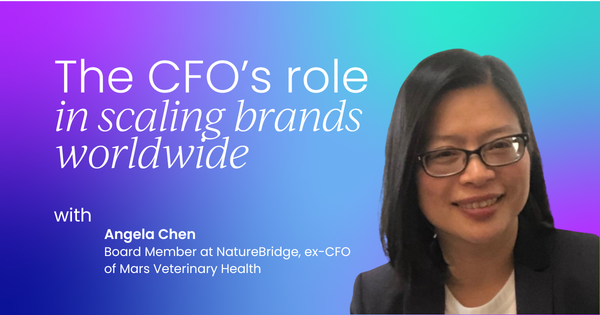

This article is based on Angela Chen’s brilliant talk at our CFO Summit when she was the CFO for Mars Veterinary Health.
I’m excited to share a few stories and lessons from my career about the CFO’s role in scaling consumer brands across markets and cultures.
When people hear “CFO,” they often think of spreadsheets, budgets, and cost controls; and yes, those are part of the job.
But for most of my career, the work has been broader: creating value, enabling growth, guiding strategy, and helping organizations stay grounded in purpose while building a business that can win not just next quarter, but over the long term.
I’ve spent over thirty years working for global consumer companies across both the United States and Asia.
I began as a financial analyst at Taco Bell. Later, I took on my first expat assignment as a young finance manager at Pepsi, sent to China as one of the “foot soldiers” in the cola wars.
I served as Asia Pacific CFO for General Mills, helped bring Gap brands from North America into Europe and Asia, and then spent about eleven years as a CFO at The North Face, one of my proudest assignments.
Most recently, I completed a five-year run as the CFO of Mars Veterinary Health. Many people don’t realize this, but Mars, Inc. has quietly become the world’s largest pet care company, and veterinary health is one of the divisions they own (think animal hospitals).
When I talk about “driving global growth,” I’ll admit that’s jargon. What I really mean is: this is how I understood the assignment.
 Sabrinthia Donnelly
What the modern CFO role really is
The modern CFO role isn’t surprising anymore. Finance leaders like to think of ourselves as strategic partners. We are financial stewards. We are value creators. And we are storytellers.
That version of the CFO has existed for at least twenty years.
Within that, I’ve always tried to focus on one core responsibility: identifying the unique value creation drivers of the business.
Every business has value drivers, but they’re not generic. They’re specific to context: the capabilities of the organization, the management team, industry dynamics, market maturity, competition, culture, consumer behavior.
The “right” answer in one moment can be wrong in another. As a CFO, you can’t operate from a textbook. You have to see what is actually happening and identify what truly moves the needle.
Of course, you also have to ensure the business has the right structural economics.
And you have to develop what I call a balanced scorecard: measures and practices that go beyond the financials, because scaling globally requires a holistic view. It’s not just about the numbers.
There’s always a tension between profit and purpose, and leaders have to be able to hold both.
One superpower I’ve seen in truly great CFOs (and it’s something I’ve tried to build) is the ability to connect money, ideas, and data.
In my most recent role at Mars Veterinary Health, I had finance, strategy, and analytics reporting into me. That structure gave me a real chance to connect the three.
I’m not saying we did it perfectly, but there are very few seats in the enterprise that can integrate those elements across the whole business. Done well, it becomes a point of difference between good and great.
The hardest part: sustainable growth over time
People talk about a growth mindset all the time. But sustainable growth is genuinely hard.
Anyone can deliver the next quarter. The real question is: can you deliver twenty quarters?
That’s where CFOs can keep an organization honest. Part of the job is pitching for, investing in, and optimizing the infrastructure needed for long-term growth. It isn’t glamorous, but it’s foundational.
Because a plan without execution is just a binder collecting dust on a shelf.
I’ve seen organizations commission a beautiful strategy deck (sometimes from firms like McKinsey) and everyone gets excited. But does it come true? Usually it doesn’t, unless someone drives disciplined execution.
That’s why I’ve become so focused on what I call “managing what matters.”
Early in my career, I tried to manage everything. It can feel responsible, but over time I learned that when you hire great management teams, you have to let them do their jobs.
At the C-suite level, your responsibility is to focus on what matters for the entire enterprise.
For me, that means establishing a cadence of review and decision-making so you can constantly recalibrate, reinvest, and course-correct. And you have to ensure the plan is seen through to completion.
That follow-through is an unsung part of driving global growth, and it’s often the difference between brands that expand and brands that stall.
And there’s one more truth I’ve learned, something that might sound strange coming from a finance leader: to do this work well, you have to lead with both heart and mind.
Finance people are analytical and logical. We rely on rigor. But your analytical rigor has to be guided by true purpose and values. That’s what creates a sustainable business for a generation.
I didn’t fully understand that until I moved into animal health, where the emotional core of the work is impossible to ignore.
 Sabrinthia Donnelly
Three stories that shaped how I lead
Whenever I share these ideas, I try not to make them purely theoretical. Stories are how people remember what matters.
I often anchor my thinking in three stories: one about ice cream, one about a tent, and one about an adorable pup named Gulliver, who became my pandemic pup.
They’re very different, but they all connect back to the same question: how do you scale across markets and cultures in a way that creates value and stays true to purpose?
Haagen-Dazs and the lesson of globalism going both ways
The first story is about Haagen-Dazs, owned by General Mills; specifically, the green tea matcha flavor.
When people think about globalism (especially early in my career, when I worked for Pepsi) globalism often means bringing American goods to emerging markets. I’ll say it plainly: it’s a little egotistical.
Over time, my understanding changed. Globalism doesn’t flow in one direction. It flows from region to region. It’s not only exporting Western products outward. It’s also learning from local markets and scaling ideas outward from them.
Matcha Haagen-Dazs was created as a joint venture with a Japanese partner to develop a Japan-specific flavor for Japan first, then expand into limited markets across Asia, and eventually globally.
Today, in most major urban centers, you can find green tea ice cream. That didn’t happen because someone decided Japan needed an American product. It happened because a local flavor became something the rest of the world wanted.
At the time, I was the CFO of General Mills Asia Pacific. I wrote a business plan and pitched multimillions of dollars to build the procurement and manufacturing capabilities to make best-in-class matcha green tea ice cream.
Fine, best-in-class matcha powder is hard to get. It requires the right sourcing, expertise, and investment. That was the lesson: “local” isn’t a limitation. Done well, local becomes the foundation for global.
And personally, I had a lot of fun sampling the first pint that came out of the assembly line.
 Lewis Danby
The North Face and making the outdoors locally relevant
The second story is about The North Face, and it starts with one of its most iconic products: the geometric dome tent.
It’s used on expeditions. It costs about $6,000. You’ll see it in National Geographic photos of Everest expeditions. It represents the pinnacle of outdoor sport: elite athletes doing, in my personal opinion, insane things that feel out of reach.
That’s who The North Face was, historically. The brand began in 1968, founded by a group of dirtbag rock climbers and mountaineers with origins in Yosemite.
It was rooted in mountaineering and extreme performance. When I became CFO in 2005, The North Face was a premier niche brand: iconic, respected, and not for everyone.
And yet during my roughly eleven years there, we drove 5x organic growth. That didn’t happen by staying niche. It happened because we opened up access to the outdoors for everyone.
We took The North Face from the summit down the mountain, into the city, into your mudroom, and ultimately into your closet. Because just because you’re not someone who will ever climb Everest doesn’t mean you don’t want the best-in-class jacket in a New York City winter.
That was the shift: making the outdoors locally relevant.
We started talking about “your personal Everest,” because everybody has an Everest. Mine isn’t better than yours. That framing invited more people into the outdoor movement, with the deeper hope of welcoming the next generation of environmental stewards.
I’ll be a little political for a moment: I feel like the outdoor environment is under assault, and that made this work feel even more important.
That growth required CFO discipline underneath it. I learned quickly that innovation without economics doesn’t scale. I remember one of my first experiences as a novice CFO at The North Face.
I was young and naive, and I bought into a $3,000 MSRP jacket that would automatically heat up using battery power.
We spent a lot of money chasing that product. It made no margin. And nobody wanted to buy a $3,000 jacket twenty years ago. Maybe today the super billionaires might, but it wasn’t accessible. It wasn’t locally relevant to real consumers.
That lesson stayed with me: you have to understand the right price point, the right margin, and the right value equation for both the customer and the business.
Mars Veterinary Health, Gulliver, and the universality of love
The third story is about Mars Veterinary Health and about Gulliver, my pandemic pup.
I welcomed him home in November 2020, at the height of the pandemic. I’ve always loved dogs, and like many people, I needed more joy and companionship at that moment. He’s a doodle, and I think of him as my son.
At Mars Veterinary Health, we operated the world’s largest veterinary company: around 3,000 animal hospitals around the world, 70,000 associates, serving 30 million pets a year. And when you step into that world, you realize quickly that the center of it isn’t numbers.
It’s love.
 Sabrinthia Donnelly
Dogs are pure love and joy. Veterinarians join the profession because they love animals. They’re not in it to make a buck. They go to medical school like human doctors, incur just as much debt, and yet the motivation is different. It’s about love, service, and passion.
If you’re a pet owner, you know what I mean; you love that animal like your child.
In the last thirty years, the human-animal bond shifted. Pets moved from farms, to backyards, into our houses, and ultimately into our beds.
That emotional connection is universal. Love is universal.
Yes, the consumer journey in healthcare varies across cultures. There are nuances. But the deeper driver is consistent. When you understand the unique value creation driver (love) you can build plans that are locally relevant and scalable.
For me, that was one of the most powerful lessons of my career: you can be as analytical as you want, but you have to understand what truly matters to people.
The playbook I use for scaling across markets and cultures
After those stories, I’m often asked: what’s the framework? What’s the playbook?
At the center is value creation. Around it, I think about six pillars of growth:
- Having a powerful brand,
- Understanding the consumer journey,
- Running a strong product development cycle,
- Going to market appropriately for the conditions,
- Getting structural economics right, and
- Investing in the infrastructure needed for sustainable profitable growth.
I also believe in a balanced scorecard because businesses operate within macro trends. In the consumer brands I’ve worked for, trends like premiumization, personalization, sustainability, and health and well-being have mattered deeply.
I’m not going to talk about AI, because there’s already so much buzz about it, but it’s relevant too.
Just as important is remembering stakeholders. Consumers are obvious, but associates matter too, especially in retail, where employees are your brand ambassadors. Shareholders matter, of course. Retail partners matter as well.
For example, REI was one of The North Face’s biggest partners, and cultivating that partnership was important.
And industry matters. In the outdoor industry or the veterinary industry, the businesses I worked for were leaders. What we did set the tone. I never forgot the responsibility, not just to the business, but to the broader purpose and cause connected to it.
When I describe brand power, I focus on purpose rooted in excellence, best-in-class product and service, and compelling storytelling.
For the consumer journey, it comes down to having the right value proposition, engaging the consumer in the right place and time, opening access, and building a consumer for life.
But I always come back to the part many people underestimate: structural economics.
Unit economics are critical, especially in retail. The “unit” might be a product, or it might be a store you own or lease, but it has to make money.
You need operating efficiency for fixed costs. You need a clear reinvestment cadence and an understanding of the relationship between investment and revenue growth, a value creation algorithm.
And then there’s infrastructure investment. People think of physical capital first: plants, equipment, distribution networks.
Those matter, but human capital matters just as much. Retail associates, marketing talent, and emerging capabilities all drive success. You can’t always measure ROI on human capital investment, which is where faith has to come in. I know that’s strange from a CFO, but I believe it’s true.
Ultimately, growth comes down to integrated business planning and disciplined execution. It’s a holistic plan, and it only works if it’s executed with rigor.
That’s how you win.
The balance I still strive for: purpose and profit
I want to end with one idea that continues to guide me. Grant Reid, the former CEO of Mars, said something that resonated deeply with me: purpose without profit is impossible, but profit without purpose is not meaningful.
That’s a call to lead with both heart and mind.
 Nick Rumball
I’ve gone through walls for leaders who struck that balance, who cared about results and understood why the work mattered. I believe purpose and profit are mutually reinforcing, even though I don’t claim to have struck that balance perfectly every time. It’s an aspiration.
Large organizations can become bureaucratic, and the CFO office can become a grind. And it is a grind. That’s why passion and purpose matter so much.
For me, working at Mars Veterinary Health meant working for a business that saves pets’ lives. That mattered. And because it isn’t a nonprofit, the business has to be viable so it can serve more pets.
I’ve also learned to accept tradeoffs when you choose purpose. Did I win every time? No. Did I get looked at like I was an alien? Yes. Did I not advance because I didn’t play certain games? Sure. And that’s okay.
There are more important things in my life than climbing a ladder. That’s why I volunteer time with nonprofits and stay connected to causes I care about, especially the outdoors and environmental education for kids through NatureBridge.
And one final truth about the CFO role: the partnership with the CEO is everything.
I’ve always believed the CFO and CEO have to be joined at the hip. You need chemistry, complementary strengths, and alignment on purpose and values. That’s often why, when a new CEO comes in, they bring in their own CFO. It’s about alignment.
One leader I learned from put it this way: there are two people a new CEO needs at their side (the CFO and the Chief People Officer) because there’s nothing more valuable than money and people in an organization. Everything else you’ll get.
I agree completely. And I would never work for a CEO I’m not truly simpatico with. I always ask about the purpose side first. The “why” beneath the numbers.
Because driving global growth across markets and cultures isn’t just about expansion. It’s about building something meaningful and durable, something that can last quarter after quarter, year after year, generation after generation.
That’s how I’ve understood the assignment.
Join your finance peers in giving us your insight into current finance salaries in a global survey that'll show how much you should be making and how you can leverage the next pay rise discussion.
 Teresa Garanhel


Finance alliance insider
Thank you for subscribing
Level up your finance alliance career & network with finance alliance experts.
An email has been successfully sent to confirm your subscription.
 Follow us on LinkedIn