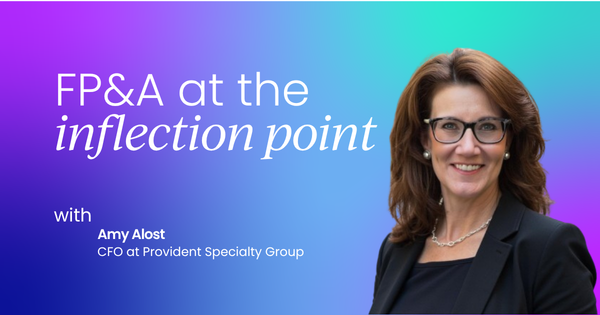

The role of FP&A has not changed.
We have had a lot of tools over the years, and we have a lot of tools today, but the job itself, the work of financial planning and analysis, is fundamentally the same as it has always been. We hold the keys to all the data.
I like to ask a room a simple question when I get the chance: who believes their data comes only from accounting?
It is always interesting to see the hands go up, because the truth is your data is coming from operations, it is coming from sales, it is coming from every function inside the company, and somehow it all consolidates into FP&A.
At the CFO level, we are looking to that function for the information, the insights, and the decisions that get derived from the data you have your hands on.
But the data does not live only in the systems. I ask people whether they get their data only from their computer screen, or whether they also get it from the people around them, the teams they interact with every day.
Maybe it is a water cooler conversation, a bathroom conversation, a hallway conversation. Maybe you are out for drinks, or you are on a golf course. Wherever your data comes from inside the company, you also have influences on you from outside the company.
That is the world FP&A operates in, and it is the world I want to walk through, because I think it helps to look backward before we go forward, especially now that AI is coming at all of us from every direction, every single day.
 Geeta Malhotra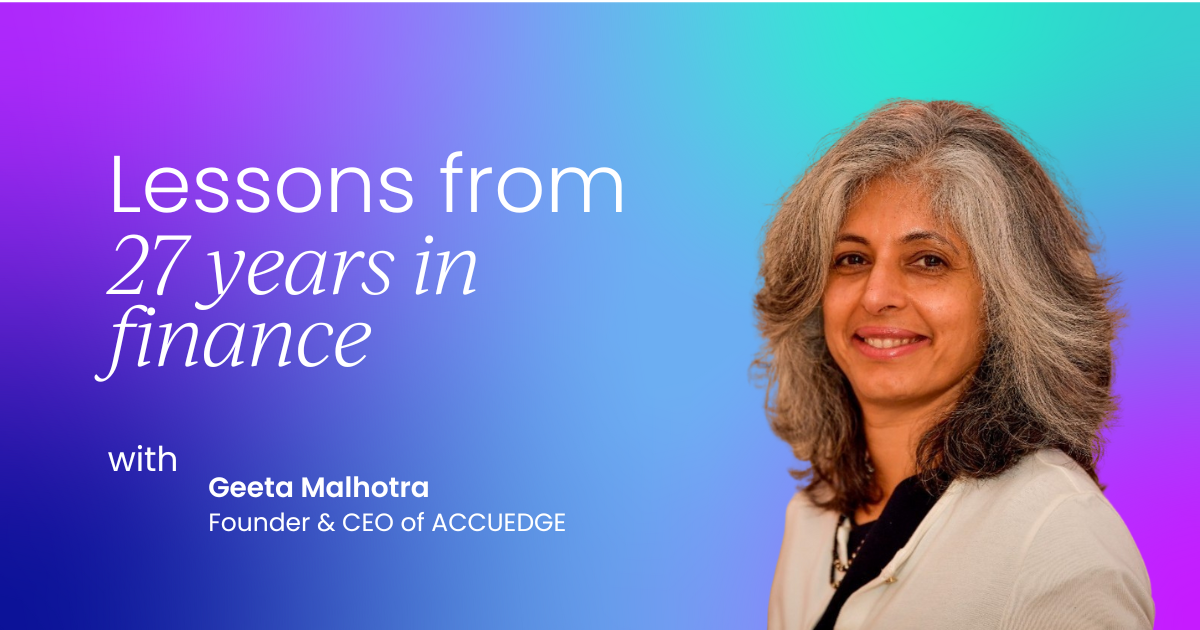
Where we started, and how we got here
I like to ask who in the room remembers green ledger paper and handwriting journal entries. Then I ask who remembers keying into a black screen with green font on a DOS system.
Then I ask who was the guinea pig who had to migrate that into a Windows-based system.
I am dating myself here, but I remember when Hyperion came out, in the late nineties, and it felt like a reporting system unlike anything we had seen before, with little pluses and minuses running up and down the screen, and the ability to set your own security permissions.
I did a baby bell reintegration when I was at Andersen. We were working out of San Jose, and then back in Texas, in San Antonio, and it was the most massive reporting effort I had ever seen, twenty-seven segments, with everyone in the company permissioned correctly to see the data relevant to them, from the top level all the way down to the person out in the field.
From there we moved into a new challenge: we needed all our data in one place, one central source of truth. How often do we still hear that phrase today? That need gave rise to the ERP system, and everybody had to have one.
I think most of us would agree those are some of the clunkiest pieces of software in our tech stack, but they solved a key problem. They kept every transaction from the company in one place, feeding the financials, with separate schedules coming off of them.
You may or may not still keep your inventory in that system. You may or may not still run project management out of it. You almost certainly do not run your sales system through it. A whole wave of bolt-on tools arrived after that ERP era.
And from there we moved on to dashboards. I do not think there is anyone left who does not have a dashboard today, although I have been in rooms, within the last twelve months, where a CFO has told me they have not even made it to dashboards yet.
We are all over the map, different companies, different sizes, different industries, all carrying our own tech stack, all talking about how to get started with AI and what it is going to do for us.
 Alexander Roche
What the numbers are telling us
I like to bring stats into these conversations, even though they can be all over the place.
The FP&A Trends Survey found that 60% of CFOs believe AI will be among the most transformative technologies for finance, yet only 11% are actually using it today, and 35% remain stuck in pilot.
When I ask a room who is experimenting with AI versus who is acting on real use cases, versus who has it built into their core, routine workflows, versus who is actually measuring the return on investment, the answers tend to thin out quickly at each step.
Very few companies have moved all the way through to active measurement, comparing a real baseline to where they stand today.
When I ask what the biggest concern is around AI adoption, risk, data governance, and controls used to top the list on their own.
Now they are tied with something else: the accuracy and reliability of the underlying data itself. That was a bit of a surprise to me.
For the last couple of years, the biggest holdup I heard from CFOs across the country was fear of leaks and the need for airtight security.
That is shifting now that people are actually running use cases and discovering they have to stop mid-process to go check whether the data came out correctly.
Teams move quickly, then have to backtrack. And here is the thing: FP&A already understands how that data flows. We know the sourcing, we know who keyed it in, who approved it, why something landed on our desk unapproved.
For expert advice like this straight to your inbox, sign up for Pro+ membership.
You'll also get access to hundreds of hours of exclusive video content, a complimentary Summit ticket, and so much more.
So, what are you waiting for?
Our AI tools are not going to cure bad workflows. They are not going to cure faulty data.
They will hand that faulty data back to us, and the insights that come from it, inaccurately, only faster.
They will highlight and accentuate where the problems already exist, but they will not fix the workflows or the data underneath them.
Too many AI implementations are not returning value in a way we can communicate to our CEOs, and I think that comes down to treating AI as a technology project rather than what it actually is: a transformation project involving the entire organization.


Become an FA Insider
Thank you for subscribing
Get exclusive insights, frameworks, and strategies from finance leaders driving real business impact.
An email has been successfully sent to confirm your subscription.
 Follow us on LinkedIn