


There's a version of this conversation that's been happening in boardrooms, finance team offsites, and panel sessions for the past two years.
Someone mentions AI. Half the room leans in. The other half crosses their arms. And then somebody asks the question that nobody has a clean answer to yet: when is AI-generated analysis actually good enough to act on?
That's not a question about the technology. It's a question about judgment. And if you're a finance leader, it's probably one of the most consequential calls you're being asked to make right now, often without a framework to guide you.
We're past the era of debating whether AI belongs in finance. Finance professionals who use AI regularly report improved quality of work (98%), enhanced decision-making (97%), and cost savings (96%).
The benefits aren't theoretical. The ROI is real. But the hard question isn't whether AI can help; it's whether the output in front of you, right now, is good enough to move money on.
That line between "useful analysis" and "decision-grade insight" is where the real debate lives.

Join our summit to hear how finance teams are embedding AI in FP&A, forecasting, planning and control workflows: where it saves time, where it improves decisions, and where human judgment still matters most.
Tune in live and access every session recording OnDemand.
The trust gap nobody talks about openly
Here's something worth sitting with. While 78% of Americans now use AI-enabled tools in their daily lives, only 18% say they would trust AI to make financial recommendations on its own.
That's a staggering gap. And it holds across the industry in ways that matter even more at the institutional level.
Last year, only 10% of consumers said they used AI to help manage their personal finances. In 2026, 55% reported doing so. The adoption curve is steep.
But the trust curve is lagging well behind, and for good reason. Adoption tells you that people find AI useful for doing things. The trust gap tells you they haven't yet handed over the final call.
For finance teams, this distinction is everything. You can use AI to surface patterns in a dataset, to stress-test a forecast, to flag anomalies in your accounts receivable. All of that is enormously valuable.
But when the analysis lands on your desk and someone has to sign off on a capital allocation decision, a credit approval, or a scenario recommendation heading to the board, that's when the real question kicks in.
Is this output decision-grade, or is it still just directional?
A report reveals that finance teams see AI's value clearly but face a persistent trust gap; and that closing it depends on governance, training, transparency, and better data quality. Those aren't soft concerns. They're the actual infrastructure of trustworthy AI output.
 Jay Dyer
What "decision-grade" actually means in practice
The phrase "decision-grade" doesn't have an industry standard definition yet, and that's part of the problem. But if you talk to finance leaders long enough, a working definition starts to emerge.
AI analysis is decision-grade when you can defend every step of it. When the assumptions are visible. When the data lineage is clean. When a regulator, a board member, or a skeptical CFO could pick it apart and you'd have a clear answer for every challenge.
That's a high bar. And a lot of AI output (even impressively accurate AI output) doesn't meet it.
Wolters Kluwer's guidance on AI in finance makes a point that sticks: “If an organization cannot explain a decision output, it cannot be used.”
The bar isn't just accuracy, it's traceability. Finance teams need to show how a conclusion was reached, not just what it was.
This isn't only a compliance concern, though regulation is a big part of it. It's about intellectual honesty. When you put your name on a recommendation, you're accountable for the reasoning underneath it, not just the figure at the end.
The pattern is consistent across every credible source on this topic: AI in finance only scales where it earns trust. And earning trust means being able to show your working.
The complexity that makes AI so powerful (its ability to process thousands of variables simultaneously) is often the exact same thing that makes it difficult to interrogate. A model that detects fraud in milliseconds is impressive.
But if nobody can articulate why it raised the flag, the institution is exposed the moment that decision gets challenged.
The CFA Institute's work on explainable AI makes the stakes clear: transparency in finance isn't a nice-to-have governance feature, it's load-bearing infrastructure.
Without it, highly accurate models remain unusable in any situation where the accountability is real and the stakes are high.
You can have a model that's right 94% of the time, but if you can't explain the 6% it gets wrong (or show why it was right in the first place) it has no place in a decision that will be scrutinized.
Supreeth Meka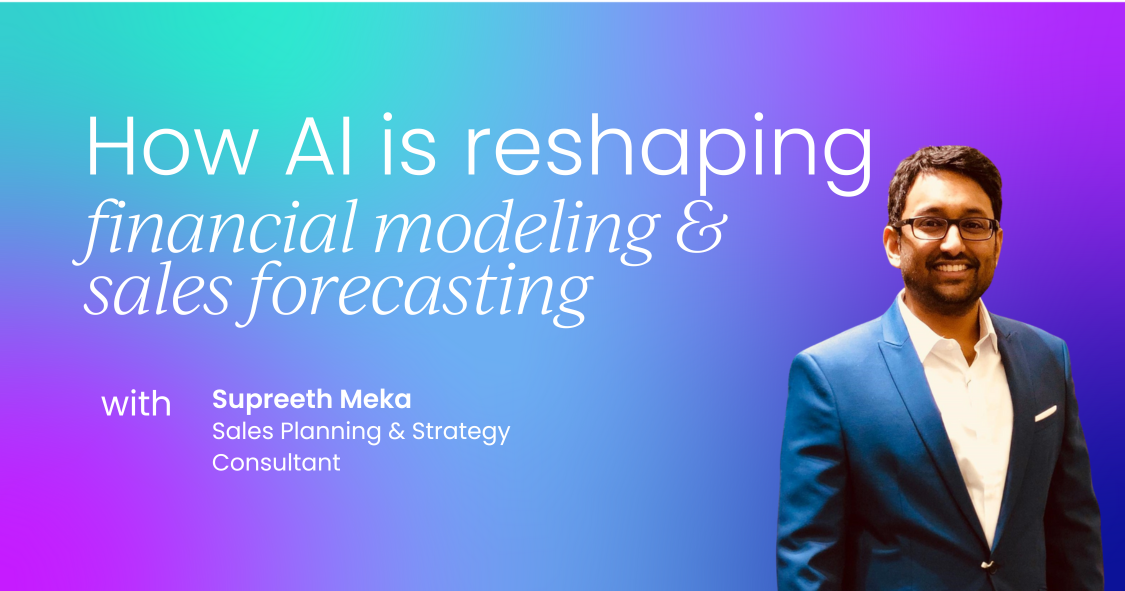
Where AI earns your trust (and where it doesn't)
Not all finance decisions are created equal. The judgment call about when to trust AI isn't binary, but deeply contextual.
Some areas are genuinely well-suited to AI-driven analysis. Others require human expertise in ways that current models simply can't replicate.
AI performs well and earns higher trust in areas where it's processing structured, historical data at scale.
Fraud detection is the clearest example.
AI is genuinely excellent at scanning transaction data for anomalies, building creditworthiness profiles from multiple data streams, and spotting cash flow irregularities that a human analyst might miss entirely buried in a spreadsheet.
In these domains, AI isn't making the call, it's doing the legwork that makes a better call possible. The human still decides what to do with the finding, and that distinction matters.
More than half of finance professionals regularly use AI for financial analysis (63%), reporting (62%), forecasting (58%), and fraud detection (57%).
These are exactly the places where AI adds the most value: structured inputs, historical baselines, repeatable logic. The model's assumptions are checkable. The output is testable.
Where trust gets shakier is in forward-looking, high-stakes, and politically charged decisions. M&A strategy. Board-level scenario planning. Credit decisions that are going to be scrutinized for fairness.
This is where the sophistication of the model becomes a liability rather than an asset, because the more complex the algorithm, the harder it is to catch the biases baked into the training data.
Models have produced discriminatory credit outcomes without any protected characteristic being explicitly included, simply because the patterns in historical data reflected historic inequities.
That's a risk no finance leader should quietly accept.
Sabrinthia Donnelly
Human judgment isn't the problem, it's the point
One of the more frustrating framings in the AI-in-finance conversation is the implicit suggestion that human oversight is just a temporary awkwardness we'll eventually engineer our way out of.
That once the models get good enough, we won't need the human in the loop.
AI doesn't eliminate the need for judgment, it raises the stakes for it. When AI is surfacing more analysis, faster, with higher apparent confidence, the human's job isn't to rubber-stamp the output.
It's to bring the contextual knowledge, the ethical awareness, and the organizational accountability that the model simply doesn't have. The judgment call becomes more important, not less.
IMD's research on the evolving CFO role makes a similar point: the skills that matter now aren't just technical.
Finance leaders need to be able to read a model's output critically, communicate what it actually means to non-finance stakeholders, and build teams that combine domain expertise with enough AI fluency to know when to push back.
That's a different kind of talent development than finance functions have traditionally invested in, and the teams that get it right are pulling ahead.
The division of labor that's emerging in high-performing finance teams reflects this clearly.
AI handles the volume work: pulling data, reconciling accounts, flagging outliers, processing invoices.
The human takes the handoff at the point where judgment is required: interpreting what the anomaly means, deciding which scenario to act on, communicating to the board what the numbers actually imply for strategy.
That's not a transitional arrangement while AI catches up. That's the sustainable design.
Teresa Garanhel
What good governance actually looks like
If you're trying to build a framework for when to trust AI in finance decisions, governance is the scaffolding that makes it operational. Without it, you're making trust calls on a case-by-case basis, which is exhausting and inconsistent.
Organizations are moving beyond experimentation toward scaled deployment, but persistent gaps remain in strategy, governance, and risk management.
The maturity model matters here. Organizations that have done the governance work (defined accountability, established data quality standards, built review processes for model outputs) are the ones that can actually trust AI at scale. Everyone else is flying on intuition.
Finance professionals are calling for stronger governance frameworks (52%), clearer accountability for AI decisions (47%), improved data lineage and quality controls (45%), and broader role-specific training (43%).
These aren't abstract wishes, but the preconditions for trusting AI output at a level where it can actually influence decisions. Without clear accountability, you don't have trustworthy analysis. You have plausible-sounding output with no one responsible for its accuracy.
A practical governance approach has a few key elements:
- First, you need to know who owns the AI output. Someone has to be accountable for validating the model's assumptions, checking the data inputs, and signing off that this analysis is fit for the decision it's being used to support.
- Second, you need a consistent review process, not just for exceptional cases, but as standard practice.
- Third, you need documentation. If you can't explain what the model did and why you trusted it, you don't have decision-grade analysis. You have a black box with a recommendation attached.
Teresa Garanhel
Hear it straight from the people making these calls
If this question, “when does AI-generated analysis become decision-grade?” is one you're actively wrestling with, you're not alone. And there's a session coming up that tackles it head-on.
At the AI-Powered Finance Summit on May 20, 2026, Abhishek Chandna, Director of Finance Strategy at Visa, is presenting a session called "AI handles the output, finance owns the story: Unlocking creativity in data storytelling."
It sits right at the intersection of everything this article has been building toward: the gap between what AI produces and what a finance leader can actually act on, and the human skill of bridging that gap with clarity and accountability.
The summit brings together finance leaders from Amazon, Meta, Google, Adobe, Unilever, and more, across many sessions covering everything from FP&A transformation to governance at scale.
Attendance is free, sessions are recorded, and you can earn up to 8 CPD credits by attending.
So, if you're a finance leader trying to figure out where to actually place your trust in AI (and how to build the judgment and storytelling skills to make that trust defensible) this is exactly the room to be in.


Become an FA Insider
Thank you for subscribing
Get exclusive insights, frameworks, and strategies from finance leaders driving real business impact.
An email has been successfully sent to confirm your subscription.
 Follow us on LinkedIn