

A finance director is a senior board member who’s responsible for managing a company’s finances.
They use their experience and financial know-how to advise on spending, making sure everything aligns with the company’s larger objectives.
But what does a finance director do? And how do you know if the position is right for you?
In this career guide, we take you through all the major pillars of this role, such as:
...and more. So, let’s dive in. 👇
Key takeaways
- A finance director's main purpose is to oversee the financial health of a company.
- An MBA is not mandatory for finance directors, but it can be a big competitive advantage.
- 5-10 years of experience is typical for this role.
What does a finance director do?
Alright, let’s get to the core question: what does a finance director do?
A financial director juggles a lot of different responsibilities, but it all comes down to one main goal: ensuring the financial stability of the company.
To do this, they provide guidance to help the company meet its financial commitments while attaining its overarching goals.
The finance director will also head the development of policies and procedures to uphold financial management and control over the company's business operations.
Responsibilities
The responsibilities of a finance director may differ from one company or industry to another, but their main duties tend to cover:
- Creating budgets that meet the needs of each department.
- Building annual financial plans and forecasts.
- Offering advice and guidance to executives on financial decisions.
- Examining potential financial risks and gains for business initiatives.
- Assessing possible investment opportunities.
- Providing funds for capital projects and keeping financials in check with the Facilities Director (if there is one).
- Managing the company’s financial operations.
- Supervising the creation of the company's financial records to make sure they’re presented on time and accurately.
- Overseeing and facilitating training for accountants on staff.
- Performing weekly and monthly financial evaluations and creating reports for senior management.
- Conducting recurring financial reviews.
 Teresa Garanhel
Day-to-day vs strategic responsibilities (with examples)
Finance directors operate across two distinct modes: operational execution and strategic leadership.
Understanding how these responsibilities divide (and how that division shifts based on company context) helps you frame your experience effectively, whether you're building toward the role or hiring for it.
As Amit Singhi, a finance executive, notes, one of the key things finance does is "drive the operating cycle": the monthly, quarterly, and annual cadence of budgets, forecasts, and plans.
That cadence sits at the intersection of operational and strategic work, and the finance director typically owns both sides of it.
Janice Lambert, former CFO at the Smithsonian Institution, observed that in many organizations, finance teams "spent the majority of the time on transaction processing and reporting" because they lacked the tools and skill sets for higher-value analytical work.
Strong finance directors actively manage this tension, building systems and teams that handle operational demands efficiently so they can dedicate meaningful time to strategic contribution.
The split between operational and strategic work changes significantly based on company size and team maturity.
In lean finance teams, the finance director often spends 70% or more of their time on operational execution; close, reporting, cash management, approvals.
As the team scales and processes mature, that ratio can shift toward 50% or even 40% operational, freeing capacity for business partnership and strategic planning.
For recruiters and hiring managers, look for candidates who can articulate both types of work clearly.
The best finance directors describe specific operational accomplishments (reducing close time, implementing controls, improving cash visibility) alongside strategic contributions like leading a budget transformation, supporting a funding round, or building a forecasting capability.
For candidates, frame your experience to show you can operate at both levels, because that's what the role demands.
 James Manning
Finance director KPIs: how success is measured
Measuring a finance director's effectiveness requires looking beyond whether the books balance. The role spans operational execution, financial stewardship, and business partnership, and the KPIs should reflect all three dimensions.
Simon Dealy emphasizes that while finance has "hundreds of KPIs," what matters is identifying "a good subset of data" that shows whether the company is on track to achieve its strategic objectives.
That subset should include both financial and non-financial indicators, and the data must be accurate before it reaches the CEO or board.
Cash and liquidity
Cash visibility and working capital management sit at the core of finance director accountability.
Key metrics include days sales outstanding (DSO), days payable outstanding (DPO), cash conversion cycle, and forecast accuracy on cash position.
Good performance means the company never faces unexpected liquidity constraints and working capital is optimized for the business model.
Close and reporting
Timeliness and accuracy of financial reporting reflect operational discipline. Track days to close (monthly, quarterly), number of post-close adjustments, and audit findings.
A well-run finance function closes quickly, with minimal corrections and clean audit outcomes.
Forecast accuracy
Forecast accuracy serves as a leading indicator of finance's understanding of the business. Measure variance between forecast and actual results at revenue, gross margin, and operating income levels.
Amit Singhi notes the importance of understanding what drives changes )"how much was volume, how much was pricing, how much was mix") which reflects the analytical depth behind the forecast.
Budget performance
Budget adherence and variance analysis show whether the organization is executing against plan. Track budget vs actual at the department and company level, and monitor the quality of variance explanations provided to leadership.
Controls and compliance
Audit findings, control deficiencies, and compliance incidents are lagging indicators of control environment health. The goal is zero material weaknesses and minimal significant deficiencies.
Business partnering
This is harder to quantify but essential. Consider tracking the number of strategic initiatives supported by finance analysis, stakeholder satisfaction scores, and the finance team's involvement in key business decisions.
Target-setting should reflect context.
A high-growth company may tolerate wider forecast variances in exchange for speed, while a mature business expects tighter accuracy. Industry norms, systems maturity, and growth stage all influence what "good" looks like.
The finance director's job is to establish appropriate targets, measure consistently, and improve over time.
Skills
Here’s a simple overview of some key finance director skills:

As you can see, there are quite a lot of skills that potential employers will expect you to have. For example, you need to have a firm understanding of all things finance and accounting (no surprises there).
Beyond the numbers though, you’ll need excellent business acumen and strategy skills. This is because as a finance director, you’ll often map out long-term money strategies that’ll keep the company heading in the right direction.
Leadership is huge too. As head of the finance team, you’re responsible for motivating and guiding them in their roles. You’re also expected to have strong communication skills to convey complex financial information to different audiences.
Analytical skills are also a must because you’ll often analyze situations and from there, spot issues, weigh the risks, and come up with smart solutions. This becomes even more difficult when the pressure is on, and deadlines are looming.
Another important skill for finance directors is general computer and technical skills. In this role, you’ll use a lot of different tools and software, so being proficient in things like Excel is crucial.
With their eagle-eyed attention to detail, a finance director ensures the books are spotless and everything's ‘by-the-book’ compliant.
But it's not just about following rules; they need genuine business smarts to understand how to best advise the company to meet its financial goals.
Qualifications
Finance directors must have certain qualifications, industry experience, and professional skills to land the role (and succeed in it).
If you’re thinking about becoming a director of finance, you’ll need a relevant bachelor’s degree in a related field like finance or accounting.
You’ll also have a competitive edge with a Master of Business Administration (MBA) or a similar master’s degree with emphasis on finance, economics, money and banking, or accounting, etc.
Certifications
Some finance directors choose to complete professional certifications to help develop their skill sets and advance their careers.
A few favorites amongst finance professionals include:
- Certified Public Accountant (CPA)
- Chartered Financial Analyst (CFA)
- Certified Treasury Professional (CTP)
- Certified Financial Planner (CFP)
- Chartered Global Management Accountant (CGMA)
- Financial Risk Manager (FRM)
There are others you may want to consider, so take some time to do your research and decide if pursuing a certification is beneficial for you.
CPA vs CFA for finance directors: which one matters more?
The short answer is that it depends on where you want to focus your career.
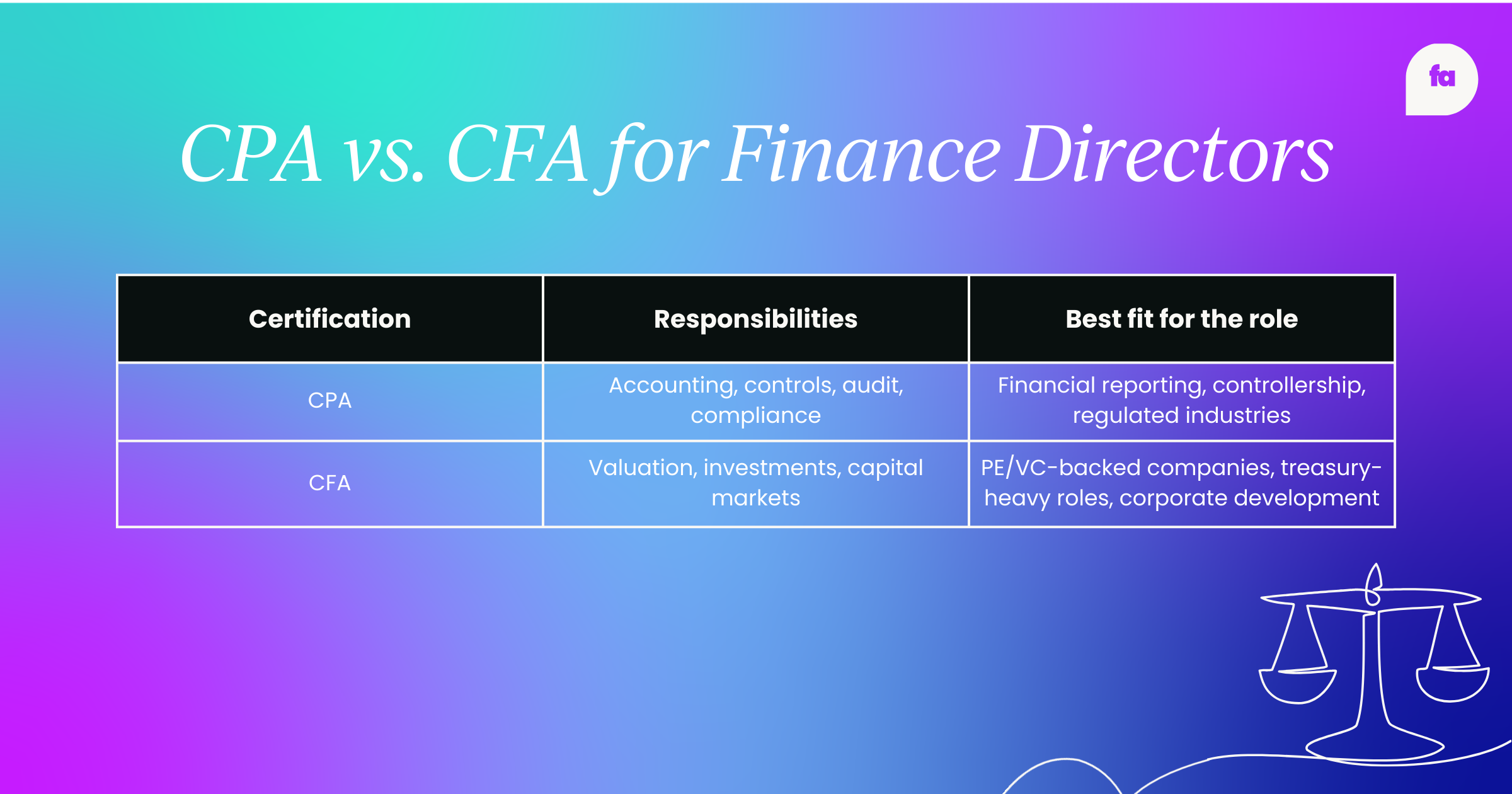
CPA credentials signal deep expertise in accounting, controllership, compliance, and audit readiness: the foundational work that keeps a company's financial house in order.
CFA credentials signal strength in investments, valuation, and capital markets: skills that matter most when the role involves funding strategy, investor support, or corporate development.
For most finance director positions, particularly those with heavy responsibility for financial reporting, internal controls, and regulatory compliance, the CPA tends to carry more weight.
It demonstrates that you can own the close, manage audits, and ensure the numbers are defensible. In markets like the US, UK, and Australia, CPA or equivalent chartered accountant credentials often serve as a baseline expectation for senior finance roles.
The CFA becomes more valuable in specific contexts. If you're working in a private equity-backed company where valuation, deal modeling, and investor communication are central to the role, the CFA signals relevant expertise.
Similarly, if your finance director position involves significant treasury work, capital allocation decisions, or corporate development activity, the CFA credential can differentiate you.
Consider three common scenarios. A controller moving into a finance director role will typically benefit more from CPA credentials, since the work builds directly on accounting foundations.
A finance director at a private equity-backed roll-up, where deal support and investor reporting dominate, may find the CFA more relevant.
And in corporate development-heavy environments, where M&A analysis and valuation work are frequent, the CFA often provides a clearer advantage.
That said, experience often matters more than credentials once you reach a certain level.
A finance director with ten years of close ownership, strong controls implementation, and demonstrated business partnership will typically outcompete someone with certifications but limited operational depth.
The certification question is really about signaling and skill development; choose the one that aligns with the type of finance director you want to become.
 The Alliance
Experience
Most will need a minimum of five years of experience in a management role in finance. For example, they could have experience as a financial manager, controller, or even as an assistant finance director.
Having this type of experience is essential because it gives you a solid understanding of accounting principles, financial analysis, and the day-to-day workings of financial operations.
While not always mandatory, knowing the ins and outs of the specific industry of the company you’re applying for can be a major advantage.
By understanding the financial landscape, regulations, and unique challenges of the industry, you can become a more targeted and relevant advisor, making you even more appealing to those making the hiring decisions.
Career path: accountant to finance director
The path from accountant to finance director typically spans 10 to 15 years and involves deliberate skill-building at each stage.
Understanding what changes at each level (and what you need to demonstrate to move up) helps you plan your progression intentionally.
Santiago Spada, former CFO and Head of HR at Pirelli Tires Australia, describes a common trajectory: starting in audit at a firm like KPMG, which provided "really good exposure to a number of different companies and different businesses," before moving into head of finance roles at multinationals and eventually reaching the CFO level.
John Cochrane, another finance leader, came up through a traditional accounting path, starting in public accounting before helping "manage the cash engine at a variety of different startup businesses."
The typical progression ladder
Stage 1: Staff Accountant (Years 1-3)
You're learning the mechanics: journal entries, reconciliations, supporting the close. Focus on accuracy and understanding how transactions flow through the system.
Stage 2: Senior Accountant (Years 3-5)
You own specific areas of the close and begin reviewing others' work. Start building relationships with business partners who provide the data you need.
Stage 3: Accounting Manager or Finance Manager (Years 5-8)
You manage a team and own the close process end-to-end. This is where you develop leadership skills and begin contributing to budgeting and forecasting.
Stage 4: Controller or Senior Finance Manager (Years 8-12)
You're responsible for all accounting operations, controls, and financial reporting. You work directly with auditors and begin advising leadership on financial decisions.
Stage 5: Finance Director or Head of Finance (Years 12+)
You own the entire finance function and serve as a strategic partner to the business. You're accountable for financial performance, not just financial reporting.
Skills to build at each stage
- Early career focuses on technical accounting and close execution.
- Mid-career requires developing FP&A capabilities, cash management skills, and the ability to lead teams.
- Senior roles demand business partnership, strategic thinking, and executive communication.
 Jon Yuregir
Three portfolio-building moves that accelerate readiness
- Own the monthly close. Take full accountability for close timing and accuracy. Reducing close time from 15 days to 10 days demonstrates operational leadership.
- Lead a budget cycle. Volunteer to coordinate the annual budget process. This builds cross-functional relationships and strategic planning skills.
- Implement a system or process improvement. Whether it's a new reporting tool, an automation initiative, or a controls enhancement, demonstrating that you can drive change shows readiness for senior leadership.
Alternative paths
The audit-to-controller-to-FD path is common, but not the only route. Some finance directors come through FP&A, building forecasting and business partnership skills before taking on broader finance leadership.
Others arrive via treasury, particularly in capital-intensive industries where cash management is central to the role.
The key is developing breadth across accounting, planning, and business partnership, regardless of which function you start in.
The difference between a finance director and similar roles
People often get confused when trying to distinguish between a finance director and other senior finance roles within an organization, and it’s understandable.
The titles can sound similar, which leads to confusion about the specific responsibilities and hierarchies involved.
You’ll also find a lot of similar responsibilities between these roles, so let’s clear the air and break down some of the key differences between them:
Finance Director vs Chief Financial Officer (CFO)
The main difference between a CFO vs director of finance lies in their positions within the company.
The CFO is the most senior member of the finance team. They oversee the company’s financial operations, focusing on the long-term vision and strategic goals of the business.
The finance director, on the other hand, oversees the day-to-day financial operations and is the company’s chief accountant. They manage the accounts of the company and prioritize short-term objectives.
 Sabrinthia Donnelly
Differences for Finance Directors in a startup vs a large company
The distinction between a finance director and CFO looks very different depending on company size and stage. In a seed-stage startup or early SMB, one person often owns both roles entirely.
The finance director title might appear on the org chart, but the actual work spans everything from closing the books to pitching investors to managing the company's line of credit.
As Simon Dealy, a seasoned finance leader, explains, senior finance work at growing companies involves understanding whether growth will come through organic expansion, M&A, or new markets, and then determining how to fund that strategy, whether through credit facilities, capital raises, or private investment.
In larger corporations, these responsibilities separate cleanly. The CFO operates at the executive level, focused on board strategy, investor relations, and long-term capital allocation.
The finance director manages the operational finance function: monthly close, reporting accuracy, compliance, and cash management. The CFO sets the direction; the finance director ensures the engine runs.
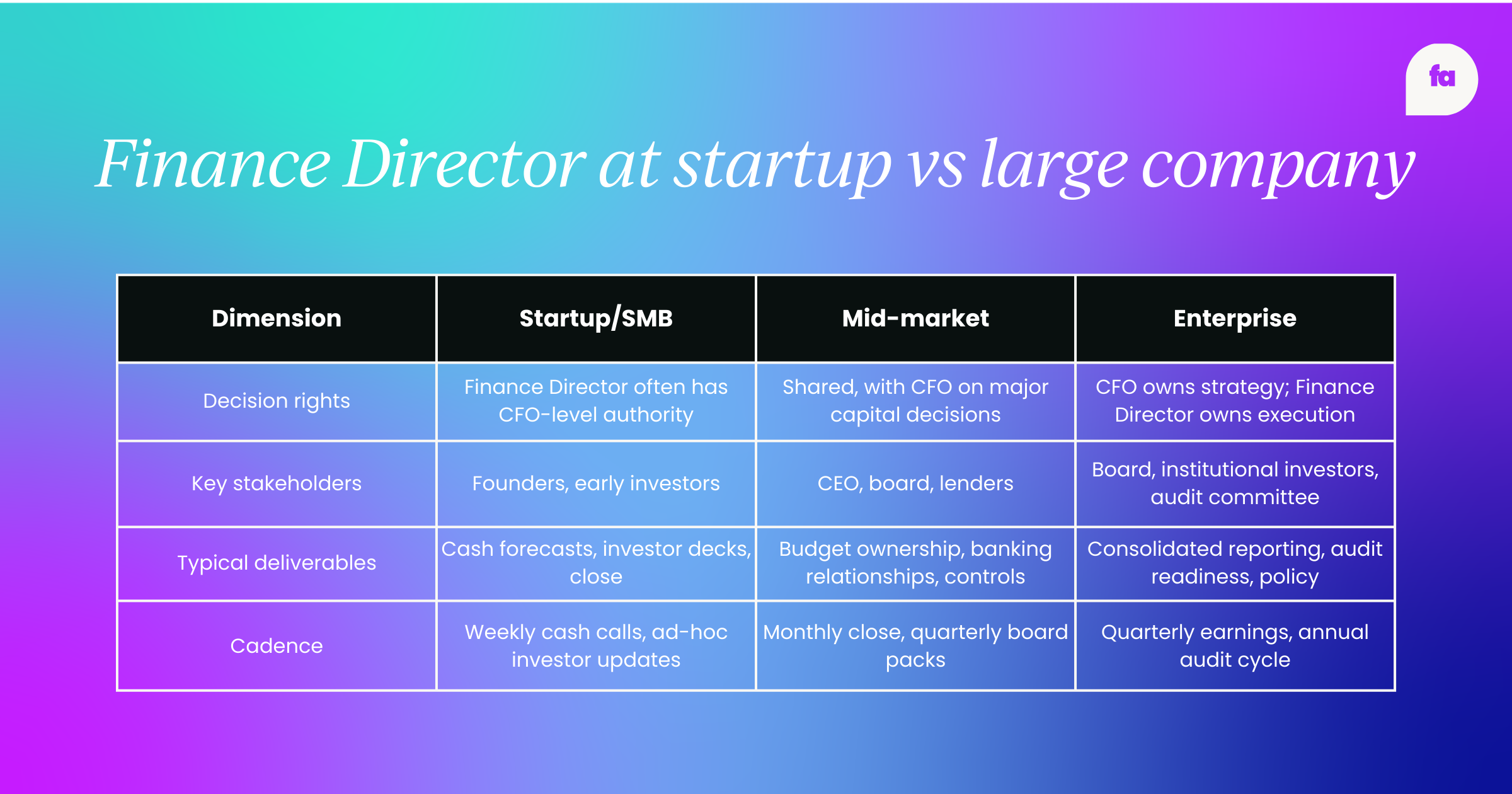
Some responsibilities shift predictably as companies scale. Capital raising, M&A due diligence, and board-level strategy typically move from the finance director to the CFO once the company reaches a certain complexity threshold.
Investor relations and public market communications almost always sit with the CFO in larger organizations.
Here's a simple rule of thumb: if you're leading capital structure decisions, negotiating with institutional investors, or presenting to the board on strategic direction, you're operating in CFO territory.
If you're owning the close, managing working capital, ensuring audit readiness, and driving budget accountability, that's classic finance director work.
In practice, the best finance directors in growing companies develop both skill sets, because the line moves as the company scales.
CFO vs Finance Director: Three main differences
Experience: CFOs tend to have extensive experience in finance with a broad and deep understanding of finance across various industries. They typically have over 20 years of experience, whereas finance directors tend to have around 5-10 years of experience.
Level in the company: The CFO is part of the executive team, making them high-level decision-makers. Finance directors aren’t quite at that level. They’re considered to be senior management so that makes them about one level below the CFO.
Responsibility: Finance directors are responsible for analyzing budgets, account management, ensuring compliance, and monitoring cash flow. CFOs, on the other hand, collaborate with executives, oversee the financial strategy, and develop growth plans.
Finance Director vs Finance Manager (and when to hire each)
The distinction between a finance director and a finance manager comes down to mandate and scope.
A finance manager typically leads a functional area within finance: accounts payable, financial reporting, or FP&A, for example.
A finance director serves as the company-wide finance leader and executive partner, accountable for the entire finance function and its contribution to business strategy.
Janice Lambert observed that many organizations have finance teams that "spent the majority of the time on transaction processing and reporting" because they lack the capability for higher-value analytical work.
When a company reaches the point where it needs that higher-value work (forecasting, decision support, strategic planning) it often signals the need for finance director-level leadership rather than additional finance managers.
Simon Dealy notes that at the senior finance level, "you shouldn't be getting too far down into the minutiae of the transactional executing," but you need to understand what's happening and have confidence in your team.
That distinction captures the difference: finance managers execute; finance directors ensure execution happens while focusing on strategic contribution.
Hiring triggers: When to upgrade from Finance Manager to Finance Director
- Investor or board demands: External stakeholders expect a senior finance leader who can present financial performance, answer strategic questions, and provide credible guidance.
- Multi-entity complexity: Managing multiple legal entities, currencies, or business units requires someone who can design and oversee consolidated reporting and controls.
- Audit readiness: Preparing for external audits, particularly first-time audits or audits required for fundraising, demands senior finance leadership.
- Capital planning needs: When the company needs to model funding scenarios, manage banking relationships, or support capital raises, that work typically exceeds a finance manager's scope.
- Department budgeting rigor: As the organization grows, budget ownership and accountability across departments requires someone with the authority and perspective to drive discipline.
Three company scenarios
Early-stage startup (under 20 employees): A strong finance manager or fractional finance leader often suffices. The volume of transactions is manageable, and strategic finance needs are limited.
Fast-growing mid-market (50-200 employees): This is typically when a finance director becomes essential. Complexity increases, external stakeholders multiply, and the CEO needs a finance partner, not just a finance function.
Mature enterprise division: A finance director manages the division's finance operations, reporting to a group CFO. The role focuses on operational excellence and business partnership within the division's scope.
Interview litmus test
If you're unsure which role you need, ask these questions during the hiring process:
- Do we need someone to execute financial processes, or to design and oversee them?
- Will this person present to the board or investors?
- Are we expecting strategic recommendations, or accurate reporting?
- Does this role require building a finance team, or managing existing staff?
If the answers lean toward design, board presence, strategic input, and team building, you need a finance director.
If the answers focus on execution, internal reporting, and managing existing processes, a finance manager may be the right fit.
Head of Finance vs Finance Director
The terms "head of finance" and "finance director" are often used interchangeably, especially in smaller or fast-growing companies. However, they can also be two distinct roles.
Here are some points to keep in mind when comparing the roles of head of finance vs finance director:
- The head of finance title can often be used to refer to the top finance position in smaller companies where there is no CFO.
- They both share similar responsibilities. However, the head of finance usually has a more hands-on managerial role in the finance operations rather than being purely strategic.
- While experience varies, head of finance roles often require 5-10 years of experience in financial management, similar to what’s expected from a finance director.
Director of Finance vs Financial Controller
A financial controller is typically the head of an accounting department, while the financial director takes on a leadership role. A financial controller’s focus is to ensure accuracy and compliance in daily financial operations.
Their main responsibilities include:
- Managing the accounting team and ensuring accurate financial records.
- Preparing financial statements (balance sheet, income statement, etc.).
- Overseeing internal controls and compliance with financial regulations.
- Managing cash flow and budgeting.
What is an Assistant Financial Director?
An assistant financial director is the right-hand person to the finance director or CFO, acting as a bridge between senior leadership and the day-to-day operations of the finance department.
They also support strategic initiatives and may oversee the finance team to some degree, ensuring smooth operations and providing support where needed.
Finance director salary
A finance director's job is obviously very important, so they tend to get paid pretty well. But there are a few things that can affect how much they make:
1. 🌎 Location: Where you work can make a huge difference in how much you get paid. The big money is in major finance hubs like London or New York. Smaller cities and towns typically don’t pay as much, which is something to keep in mind.
2. ⭐ Industry: The kind of industry also matters. Finance directors in heavily regulated fields like banking or healthcare can often rake in more compared to other industries.
3. 🏢 Company size: Bigger companies with complicated financial operations usually pay their finance directors pretty well to get top talent. Smaller companies aren’t always able to compete on salary.
4. 🎓 Experience: Just like most jobs, more experience can equal more money. Those with a long-proven track record can demand higher salaries.
5. 🎨 Skillset: Finance directors who have it all (amazing number skills, leadership abilities, deep industry know-how) can earn a higher salary than someone lacking important skills.
Salary ranges
US: Finance director salaries in the US can range from $100,000 to $240,000+ annually, depending on the factors mentioned above.
US averages from key sources:
- Salary.com reports the average salary of a finance director to be anywhere from $187,185 and $227,209 with top earners making $248,863.
- Built in states the average base salary of $162,248 with an additional cash compensation of $31,505.
- Indeed reports the average salary to be $121,638 per year in the United States.
UK averages from key sources:
- Indeed reports an average base salary of £88,940.
- Glassdoor states an average salary range between £79,000 to £124,000 with an additional cash compensation average of £21,567.
 Sabrinthia Donnelly
How to become a finance director
Alright, we’ve covered most of the basics about the role of a finance director, so let’s get into the steps to become one.
Of course, not everyone’s career path to this role will look the same. But the steps to reach that position tend to look something like this:
Step 1: Earn a relevant degree
You’ll need a bachelor’s degree in finance, economics, accounting, business administration or a related field. While not mandatory, a relevant MBA or PhD will also help you become more desirable to potential employers.
Step 2: Gain experience
If you can take an internship while in university, you should consider it. Building experience early will help you gain experience before you graduate.
From there, you’ll need to gain more experience by securing roles or positions within the finance department. Aim for at least five years of experience.
Step 3: Develop your skill set
A lot of finance directors move up the ladder by getting promoted at their current company. Or they use a finance position somewhere else as a stepping stone.
Either way, it’s important to prioritize developing and proving your skills in finance, accounting, leadership, communication, and more.
Step 4: Target your job search
When applying for finance director positions, tailor your resume and cover letter to highlight the specific skills and experience required for the role.
Emphasize achievements and contributions that demonstrate your ability to lead and make a strategic impact on the company's financial health.
FAQs: Finance director role
Q. What are the qualities of a good finance director?
Strong analytical skills, strategic thinking, leadership, communication, and a deep understanding of financial regulations are key qualities.
Q. What is the role of a finance director?
A finance director manages the company's financial planning, reporting, budgets, and financial policies.
Q. What qualifications do you need to be a financial director
Typically, a bachelor’s degree in finance or accounting, often supplemented by an MBA or professional certifications like CPA or CFA.
Q. What are the expectations of a finance director?
They are expected to ensure financial health and growth, provide strategic financial guidance, and manage financial reporting and budgeting.
Q. How can I be a better finance director?
Enhance your financial knowledge, improve leadership skills, stay updated with industry trends, and foster strong team collaboration.
Q. Is finance director the same as CFO?
No, a finance director is not the same as a CFO. The CFO is a higher-level executive who oversees the broader financial strategy of the organization.
Q. What does a finance director earn?
A finance director typically earns between $90,000 and $200,000 annually, with variations based on factors like industry, location, and company size.
Q. Is Finance Director higher than finance manager?
Yes, a finance director is typically higher than a finance manager and oversees broader financial operations.
Q. Is a Finance Director an accountant?
A finance director often starts as an accountant but their role encompasses broader strategic and management responsibilities.
Q. Does a finance director report to the CFO?
Yes, in most companies, the finance director reports to the CFO.


Finance alliance insider
Thank you for subscribing
Level up your finance alliance career & network with finance alliance experts.
An email has been successfully sent to confirm your subscription.
 Follow us on LinkedIn