
I've always wanted to be a weatherman. Strange confession for someone who ended up as a CFO, right?
But bear with me; this childhood dream has taught me more about successful mergers and acquisitions than any finance textbook ever could.
Growing up in Connecticut, I was that kid glued to the Weather Channel, watching cloud formations and tracking storm patterns.
Hurricane season in 1979 hit our state hard, and something about predicting these massive, complex systems just clicked for me.
Fast forward a few decades, and here I am: not forecasting weather, but trying to predict whether two companies can successfully merge without destroying each other in the process.
 Sabrinthia Donnelly
The perfect storm: When two systems collide
You know what's fascinating about hurricanes? Sometimes two storm systems meet and create something called the Fujiwara effect.
These tropical systems literally dance around each other until the larger one absorbs the smaller one, creating an even more powerful storm.
Sound familiar? That's exactly what happens in mergers and acquisitions: two companies circling each other, trying to figure out if they'll create something stronger together or tear each other apart.
Just like Hurricane Helene colliding with another weather front in the Appalachians created unprecedented damage, I've seen perfectly good companies merge and create absolute chaos.
The key difference is that weather systems don't have a choice, companies do. And that's where proper due diligence comes in.
The dating game of M&A
Let me be straight with you: most mergers fail because companies rush into marriage without properly dating first.
In my 25 years working in higher education and finance, I've been on both sides of acquisitions.
I've been the buyer, the seller, and even the "acquired" (my current university was purchased by another institution; yes, my school has a parent company, as weird as that sounds).
Here's what I've learned: successful M&A is like dating. You start with public information like checking out their LinkedIn, reading reviews, doing some light stalking (we all do it).
That's your pre-due diligence phase. You're screening for obvious red flags before you invest real time and energy.
The Dunning-Kruger effect in action
Remember that confidence curve where you start off thinking you know everything, then realize you know nothing? That's every acquisition I've ever seen.
CEOs meet at the country club, discover they're both in software, and boom: "”We should merge!”
No. Just no.
I've watched brilliant executives convince themselves that acquiring a company will be easy. "We'll just combine our sales forces and double our revenue!" they say. "We'll eliminate redundancies and save millions!" they proclaim.
Then reality hits like a category 5 hurricane.
The three pillars of due diligence
When you move past the public dating phase into serious due diligence, you need to examine three critical areas:
Operational due diligence
This is where you discover that their star salesperson has one foot out the door, or that 80% of their revenue comes from one client who happens to be the CEO's golf buddy.
I once worked with a company where a disgruntled employee walked out with the entire customer list on a thumb drive. Three months later, we discovered he'd taken half the clients with him to a competitor.
Financial due diligence
Private companies will show you what they want you to see.
I've seen financial statements where revenue is reported differently on every document, "one-time" adjustments that happen every year, and EBITDA calculations that would make your head spin.
My favorite? “Oh, that million-dollar severance package? That's just a one-time thing, don't worry about it.”
Legal due diligence
This is where the skeletons come tumbling out of the closet.
Pending lawsuits, discrimination claims, vendor contracts that become void upon acquisition; these hidden landmines can obliterate your expected synergies faster than you can say “material adverse change.”
The culture clash nobody talks about
Here's the uncomfortable truth: even if the numbers work perfectly, culture misalignment will kill your merger. I'm living this reality right now. Two and a half years after our acquisition, we still have massive culture gaps.
It's like trying to blend two families where one believes in strict bedtimes and the other lets kids stay up until midnight. Good luck getting everyone on the same page.
Remember those university acquisitions I mentioned? Boston College bought Pine Manor to diversify their student body. BU acquired Wheelock for their unique programs.
Emerson purchased Marlboro for their real estate and endowment. Three different strategies, three different outcomes, but all struggling with the same challenge: making two distinct cultures work as one.
The EBITDA shell game
Let's talk about everyone's favorite metric: EBITDA. It's become the standard for valuing companies, but it's also the most manipulated number in finance.
Every acquisition I've seen involves creative EBITDA adjustments. Sellers inflate it with aggressive add-backs, buyers project unrealistic synergies, and somehow everyone convinces themselves the numbers are real.
Why EBITDA over free cash flow? Simple: it's easier to benchmark against similar companies. When you're comparing multiples across an industry, EBITDA gives you a quick and dirty valuation.
But remember that quick and dirty often leads to expensive and messy.
 David Yates
Protecting your investment post-merger
Here's where most companies drop the ball: post-merger integration. They spend months on due diligence, negotiate for weeks, celebrate the closing, and then... nothing.
No integration team, no clear leadership, no plan for actually achieving those promised synergies.
It's like my knee surgery story. First time around, I didn't do the pre-hab exercises. Post-surgery? I'm at 80% capacity, permanently. Second knee? I did everything right beforehand, and the results were dramatically better.
Same surgeon, same procedure, completely different outcomes. The difference is preparation and follow-through.
The bottom line
After decades in this business, here's my advice: slow down. That company you're dying to acquire? Date them first. Really get to know them.
Look under every rock, ask the uncomfortable questions, and for heaven's sake, make sure your cultures align.
Remember, unlike weather systems that have no choice but to collide, you get to decide whether to merge.
And unlike weather forecasting, where being wrong just means carrying an umbrella, being wrong about an acquisition can destroy both companies.
The synergies you're banking on? Cut them in half. The cost savings you've identified? They'll take twice as long to realize. The cultural integration? It'll be three times harder than you think.
But when it works (when you've done your homework, found the right partner, and executed a thoughtful integration) it's beautiful.
Like those rare moments when two storm systems combine to bring perfect weather instead of destruction.
Just remember: in both weather and M&A, it's always better to be the one doing the forecasting than the one getting rained on.
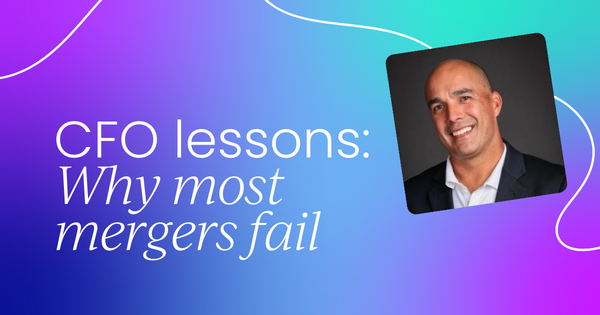
This article is based on Bill Guerrero's brilliant talk at our CFO Summit event.
Join our (free) Insider membership for exclusive content, real-world case studies, and so much more.
 Sabrinthia Donnelly


Finance alliance insider
Thank you for subscribing
Level up your finance alliance career & network with finance alliance experts.
An email has been successfully sent to confirm your subscription.
 Follow us on LinkedIn