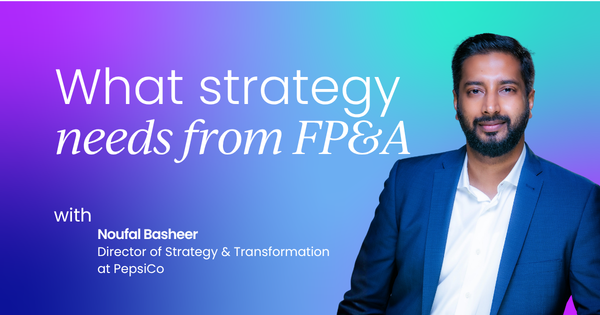


Over fourteen years in this profession, I've spent eight years in FP&A and six in strategy, so I've sat on both sides of the table.
I started at Boston Consulting Group in Mumbai, pivoted into FP&A, and led the function at Algani Industries, a large conglomerate in Kuwait.
A year in treasury followed, then four more years back at BCG in New York and Dubai.
About two years ago I moved to PepsiCo, where I now lead global strategy and transformation for away from home, the channel outside traditional retail: restaurants, movie theaters, hotel catering, airports, and entertainment venues.
When I was in FP&A, I always wanted more from strategy. Now that I'm in strategy, I want more from FP&A.
What follows is how much has changed in the relationship between the two functions, especially since COVID, and where I think they still owe each other more than they're giving.
 Alexander Roche
The world moved faster than the models did
The pace of business has changed. Technology has made things faster, shareholder expectations have shifted, and the market itself has been a bit wonky, as anyone working with publicly listed companies will understand.
The traditional discounted cash flow model isn't capturing value the way it used to, traditional CAPM doesn't really work for valuing equity anymore, and a company like SpaceX shows returns that traditional finance theory wouldn't predict.
Pressure testing assumptions and sizing the prize for a strategy project are hygiene factors at this point.
What matters more is how the old handoff between strategy and finance used to work: strategy designs a plan, FP&A validates it afterward, sizes the P&L, and once approved, moves it into execution with KPIs monitored quarterly.
That model is breaking down on two fronts.
 Asif Masani
Strategy refreshes are happening far more often
The first is that strategy refreshes are happening much more frequently.
When I started at BCG in 2010, the norm was a five-year strategy with a refresh roughly every two years, and you knew the cadence well enough to time the pitch for the next one.
Even hundred and two hundred billion dollar organizations, typically slow to pivot, are now running three-year strategies instead of ten-year ones.
In areas where AI is influencing the business, like marketing and customer experience, refreshes happen almost every year because the underlying technology moves so quickly. Six months ago, conversations about AI and CX centered on omnichannel integration.
Then generative AI moved into agentic AI, well suited to that same work. In just the last couple of weeks, the conversation has shifted again, to voice-based agents replacing humans in contact centers.
I was recently on a vendor call where fifteen minutes in, someone joined to tell us we'd been talking to an agent the entire time, and none of us had noticed. That's how fast everything is moving now.
If there's one overarching theme to what strategy needs from finance today, it's speed and agility, whether that shows up in how KPIs are defined, how they're measured, or how resources get allocated.
 Abhishek Chandna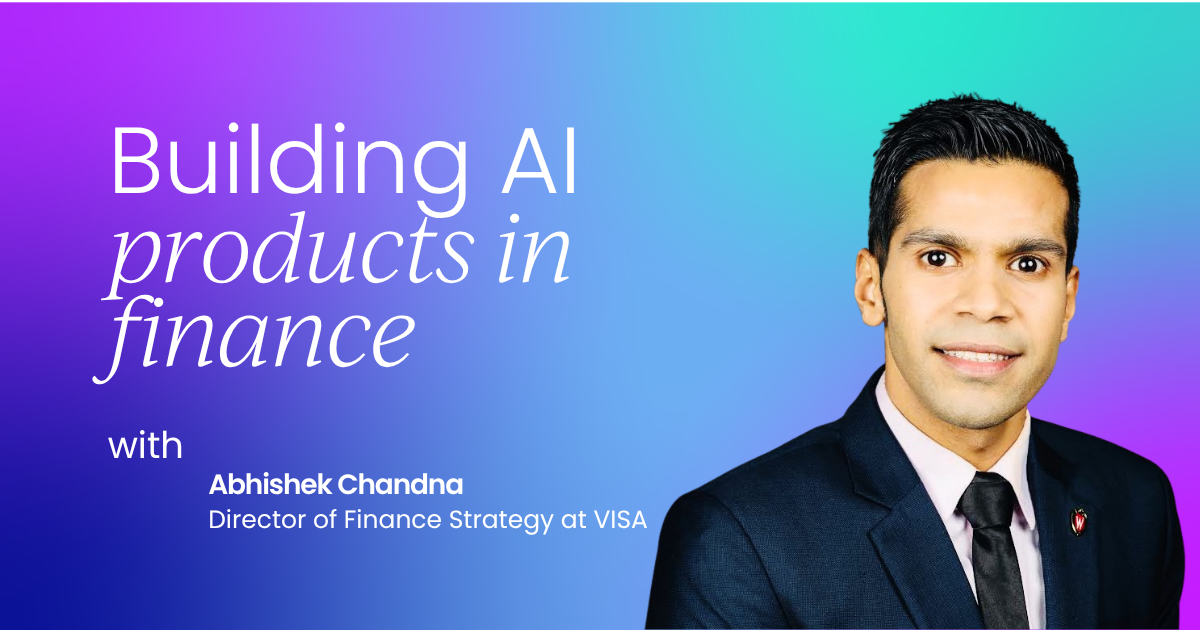
Two things that need to change
Strategy teams frequently complain that FP&A's indicators aren't timely enough to be useful, and it's a fair complaint. It isn't because finance is trying to make strategy's life difficult.
The market is changing so fast that by the time data comes in, it's often too late to act on it.
Earlier FP&A involvement
The traditional sequence uses historical data, sizes the prize, runs ROI assessments, and only then brings in FP&A to validate. That sequence isn't reliable anymore, because historic data is a poor predictor of what's coming.
We once ran a category growth strategy worth billions of dollars and sent it to FP&A, who told us the margin assumption was off by thousands of basis points, because geopolitical shifts and tariffs had moved the numbers.
Six months of work went down the drain because we hadn't brought FP&A in early enough, and I put some of that blame on strategy.
We should be the ones ensuring FP&A is involved early, so assumptions get pressure tested before too much time is sunk.
Dynamic resource allocation
The second issue sits inside the annual budgeting cycle. Most finance teams start with an annual budget, then reforecast quarterly against variance.
Equinor, the Norwegian national oil company, is a well-known exception, largely because its majority shareholder, the Norwegian government, gives it flexibility to treat project financing as a separate capital allocation process outside the annual budget.
Most organizations are still working in an older mode: this is the budget, now pivot around that baseline.
I think quarterly reforecasting isn't enough anymore, and rebudgeting needs to become the norm.
At PepsiCo, we realized that hunting for new AI agent use cases was more effective than farming existing ones for certain segments, which meant pivoting headcount out of frontline roles.
That reduces OpEx but creates a CapEx outflow in the early years, and getting that reallocation past a CFO mid-cycle is genuinely difficult, since it means changing the plan while still working against the budget.
 Noufal Basheer
Why this keeps falling on FP&A's shoulders
This is fundamentally a process and design issue, and having been in FP&A myself, I sympathize with colleagues still there.
FP&A is often trapped in a reporting treadmill: closing out the fourth quarter, moving straight into budgeting, then monthly reporting through the first quarter, followed by reforecasting.
That cycle leaves little bandwidth for anything else, and it isn't a capacity problem solved by adding headcount, since the constraint is the narrow window in which things need to get done, and done right.
On top of that, FP&A is often asked to validate decisions too late.
A mentor of mine, Robert Edmond, former CFO of Unilever, used to describe strategy as Einstein and finance as Newton: strategy pushes the boundaries of what's possible, finance keeps you grounded in what's realistic.
Strategy thinks in an ambiguous eighty-twenty world, focused on the handful of things that drive most of the impact, while FP&A speaks the language of precision, margin down to the last decimal point.
There's a middle ground where some precision can be sacrificed for directional accuracy, since strategy cares more about winning share directionally, and quickly, than whether a number is exactly ten percent or twelve.
FP&A's training favors precision over quick judgment, and that's where the two functions need a shared language.
 Imane Haouassia
Where common ground already exists
FP&A has a real opportunity to automate reporting and lean more on AI for insight generation. A consulting client I worked with years ago, one of the largest technology service providers in the world, asked us to diagnose their finance function.
We found they could have automated roughly eighty percent of their own reporting metrics, despite building exactly this kind of automation for clients, and simply hadn't done it, for no reason beyond inertia.
AWS does this well, with integrated dashboards that talk to each other quickly, close to a gold standard in the industry.
AI-enabled insight tools have also improved enormously in the last year. Models that felt unusable twelve months ago are now genuinely good at drawing on different data sources and surfacing trends.
My caveat is that AI should be used for hypothesis generation, not solution generation. It's excellent at generating a hypothesis, but a human with real understanding of the business still needs to validate it.
Moving from a budgeting mindset to an investment mindset
Finance also needs to move away from a pure budgeting mindset toward a portfolio one, the way pharmaceutical companies manage a pipeline of drug candidates.
That approach gives real perspective on what counts as sunk cost, and where capital should shift once market dynamics or ROI assumptions change. Not every KPI needs to be financial either.
A friend of mine worked on a market entry project where the team measured dollar share every quarter, so by the time the quarter closed, it was already too late to know whether capital had gone toward the wrong things.
A better proxy, tracked through third-party data on customers won versus competitors, would have shown direction much sooner.
That kind of metric is hard for finance to embrace since it isn't a balance sheet figure, but these shifts are becoming essential as the pace of change accelerates.
Shared responsibility going forward
This is a shift both functions need to make, not just FP&A. Finance can move toward directional thinking, trading some accuracy for faster feedback and quicker resource pivots.
Strategy, in turn, needs to bring FP&A in earlier and validate ambition before ideas reach an executive committee, rather than treating finance as the team that bursts the bubble later.
I'm increasingly seeing companies put the CFO directly at the head of the strategy organization, as I understand Hershey has done. Where that isn't the structure, the alternative is a dedicated node within FP&A, close to fully staffed, for strategy projects specifically.
That's the model I've built toward in my own organization.
I'd also push back on the idea that strategy still lives in the clouds while FP&A lives in day-to-day operations.
That may have been fair ten years ago, when a strategy team could hand over a ten-year, billion-dollar ambition on a slide deck and call the job done. That era is over.
Strategy today is deeply embedded in commercial execution, and compensation increasingly reflects that rather than the quality of a deck.
FP&A has shifted the same way, moving from pure reporting toward a genuine decision-making partner, particularly on projects like market entry or growth transformation, where it carries far more ownership than it did a decade ago.
That shift, more than any single tool, is what will determine whether the two functions finally speak the same language.
This article is based on Noufal's brilliant talk at our FP&A Summit Austin. Check out our upcoming events and come learn from top finance leaders.


Become an FA Insider
Thank you for subscribing
Get exclusive insights, frameworks, and strategies from finance leaders driving real business impact.
An email has been successfully sent to confirm your subscription.
 Follow us on LinkedIn