
What is a stakeholder communication plan?
A stakeholder communication plan is a structured document that outlines how you'll share information with the people who influence or are affected by a project, initiative, or business decision.
It forms part of your wider communication strategy and helps ensure the right people receive the right message at the right time.
At its best, a stakeholder communication plan reduces confusion, prevents misalignment, and makes decision-making faster.
Without one, teams often fall into reactive communication: key stakeholders are updated too late, messages are inconsistent, and expectations drift out of sync.
That matters because poor communication can affect more than project timelines. It can delay approvals, weaken trust, increase rework, and reduce return on investment.
For finance teams especially, clear stakeholder communication helps turn complex data into decisions, alignment, and action.
 Sabrinthia Donnelly
Stakeholder communication plan checklist
A comprehensive stakeholder communication plan includes more than a list of names and preferred channels.
The following checklist covers the essential components you'll need to build a plan that actually works in practice.
Copy this into your working document and fill in each item as you progress through the five-step process outlined below.
☐ Stakeholder segmentation: Categorize stakeholders by influence, interest, and communication needs using your stakeholder map.
☐ Objectives per group: Define what you want each stakeholder segment to know, feel, or do as a result of your communications.
☐ Key messages: Draft core messages tailored to each group's priorities and concerns.
☐ Channels and formats: Specify the communication methods for each segment: email, meetings, dashboards, newsletters, or collaboration tools.
☐ Cadence and timing: Establish how often each group receives updates and align timing with project milestones or decision points.
☐ Owner and RACI: Assign clear responsibility for each communication task, including who is Responsible, Accountable, Consulted, and Informed.
☐ Escalation path: Document how issues or stakeholder concerns will be escalated and resolved.
☐ Feedback loop: Plan how you'll collect and incorporate stakeholder input: surveys, Q&A sessions, or informal check-ins.
☐ Approval workflow: Clarify who reviews and approves communications before they go out, especially for sensitive or executive-level messages.
☐ Measurement KPIs: Identify the metrics you'll track to assess communication effectiveness. As David Appel, a finance and metrics expert, notes, effective planning requires knowing "how to identify the metrics that are material to what tells your story, how you set your targets, and how you track progress together as an organization."
☐ Review and update schedule: Set a cadence for revisiting and refreshing the plan as stakeholder relationships or project needs evolve.
In short, a stakeholder communication plan gives structure to stakeholder relationships.
It helps you move from ad hoc updates to a repeatable process that supports project success and better business outcomes.
As a finance professional, your role in developing and executing this plan is crucial for aligning stakeholder expectations with your company's financial strategies and performance, ensuring a cohesive path to success and sustainability.
 Nick Quiroz
Communication plan vs. engagement plan: what's the difference?
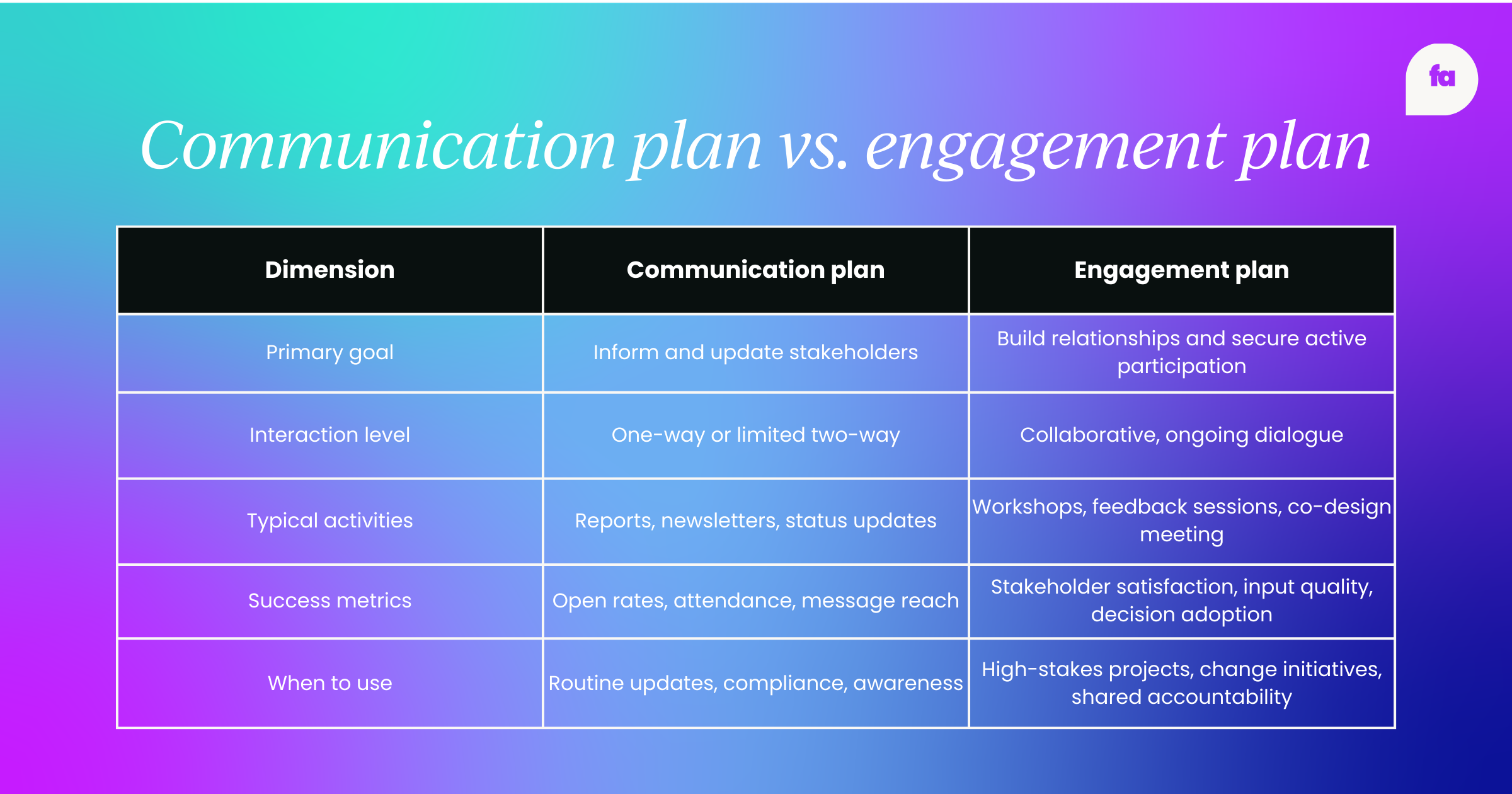
A stakeholder communication plan focuses on the structured flow of information: who receives what messages, through which channels, and how often.
A stakeholder engagement plan goes further, emphasizing two-way dialogue, relationship-building, and active participation in decisions.
Communication plans inform, engagement plans involve.
When do you need both?
High-change initiatives, complex transformations, or projects with significant stakeholder dependency typically require an engagement plan layered on top of your communication plan.
If stakeholders need to contribute input, co-create solutions, or share accountability for outcomes, engagement planning becomes essential.
For straightforward updates or compliance-driven communications, a well-structured communication plan often suffices.
As Sarita Venkatesh, a finance leadership expert, explains, effective stakeholder relationships rest on "open dialogue, mutual respect, trust, shared goals and objectives, and willingness to collaborate." These elements describe engagement, not mere communication.
When your project demands that stakeholders rely on each other's expertise, exchange constructive feedback, and hold each other accountable, you've moved beyond information-sharing into genuine engagement.
In practice, many teams use both documents in tandem. The communication plan ensures consistent, timely information flow, while the engagement plan addresses the deeper work of trust-building and collaborative decision-making.
Think of engagement as the relational layer that sits beneath your communication cadence, shaping how stakeholders feel about the information they receive and their willingness to act on it.
How to create a stakeholder communication plan in 5 steps
Having a solid stakeholder communication plan is a must, especially in the finance world.
Skipping on a custom strategy?
That's a fast track to wasted time and effort. Plus, without clear communication and input from those who matter (think employees, clients, investors, and partners), your projects might just miss the mark, affecting both your budget and deadlines.
The solution?
Adopt a systematic approach to keep communication flowing both ways. This way, you're not just talking; you're building understanding and support.
So, let's dive into creating a stakeholder communication plan that not only supports your fundraising efforts but also clarifies requirements and brings everyone on board with your vision.
1. Identify your stakeholders (internal & external)
First, make a list of everyone who has a "stake" in your company. These are the people who you’ll communicate with, so think about anyone who has an interest in the project or who’ll be influenced by it.
Your stakeholder list will include names to divide into two categories: internal stakeholders (such as employees and executives) and external stakeholders (including investors, customers, partners, and regulators).
To help tailor your communication/messages to the stakeholders’ needs, try using a stakeholder map. This will let you visually organize stakeholders based on their level of interest in and influence over your projects or company.
Here’s a basic example of what your stakeholder map might look like:
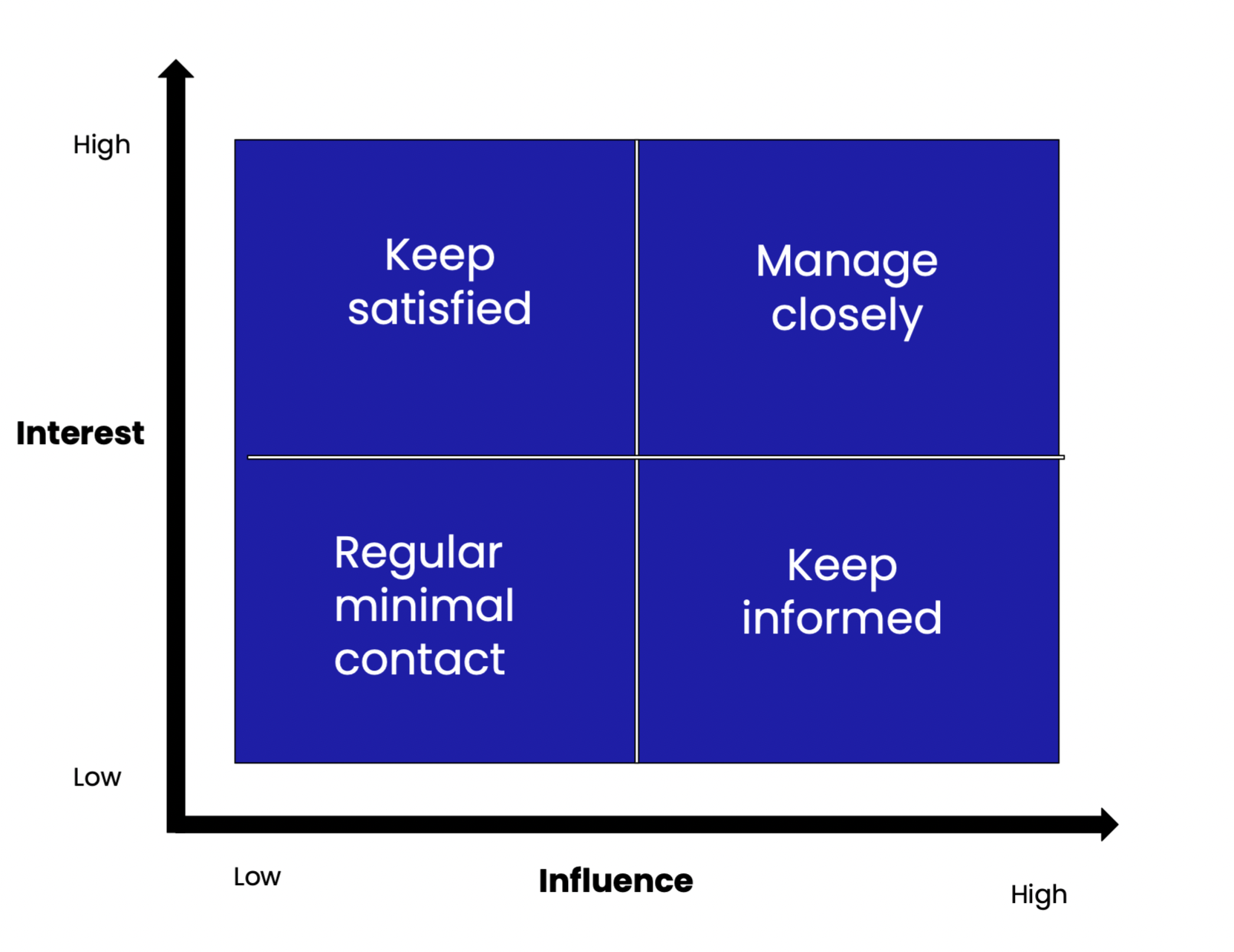
And here’s how you can make it work:
Create the stakeholder map: Draw a grid with two axes: interest and influence. Interest on one axis measures how much stakeholders care about your project, while influence on the other axis gauges their power to affect it.
Position your stakeholders: Place each stakeholder (or stakeholder group) on the grid according to their interest in and influence over your project. Doing this will help you clearly see who the key players are and who will need more engagement.
Strategize communication: Use the insights from your stakeholder map to craft tailored communication strategies. Stakeholders with high interest and high influence need frequent and detailed updates, while those with less interest and influence might require only periodic summaries.
Remember to add new stakeholders as/when they come into the scene. For this, you’ll need to come up with a process to help you keep the list updated.
How to tailor communication by stakeholder map quadrant (with examples)
Once you've positioned stakeholders on your interest-influence grid, the real work begins.
Each quadrant demands a different communication approach, and getting this wrong can cost you time, credibility, or both.
Here's how to think about each segment in practical terms.
High influence, high interest (manage closely)
These are your executive sponsors, board members, and key investors. They need frequent, detailed updates; think weekly or bi-weekly briefings with full context on risks, decisions pending, and financial implications.
Your ask from this group is active input and timely approvals. Use direct channels like one-on-one meetings, executive dashboards, or concise email summaries with clear action items.
A CFO preparing for a major capital allocation decision, for instance, needs granular data and the opportunity to shape direction before final recommendations go to the board.
High influence, low interest (keep satisfied)
Regulators, senior leaders in adjacent departments, or external auditors often fall here. They have power but limited bandwidth for your project.
Communicate less frequently (monthly or quarterly) but ensure every touchpoint is substantive and polished. Your ask is their continued support or non-interference.
Avoid overwhelming them with detail; instead, provide executive summaries that highlight compliance, risk mitigation, and outcomes relevant to their priorities.
Low influence, high interest (keep informed)
Department leads, project team members, and engaged employees want to know what's happening. They may not control decisions, but their buy-in affects execution.
Regular updates via newsletters, team meetings, or collaboration platforms work well here. Your ask is feedback and advocacy within their spheres.
A finance transformation project, for example, benefits enormously when mid-level managers understand the rationale and can answer questions from their teams.
Low influence, low interest (monitor)
General employee populations or peripheral vendors typically sit here.
Periodic, broad communications (quarterly all-hands updates or company-wide announcements) are sufficient. Your ask is minimal: awareness and compliance with any relevant changes.
A common mistake is over-communicating to high-power, low-interest stakeholders, which can erode their patience and attention when you genuinely need it.
Equally problematic is under-communicating risks to high-influence groups, leaving them blindsided when issues escalate.
Calibrate your cadence and depth deliberately, and revisit your segmentation as stakeholder dynamics shift throughout a project's lifecycle.
 Simon Dealy
2. Clarify your objectives
Next, define exactly what you want to achieve through communication with each stakeholder group.
Ask yourself, "What's the goal here?" It could be anything from rallying support for a new project to keeping everyone in the loop on financial performance.
More focused objectives help to make sure your messages hit the mark. Try to be clear about what info you need to provide and what feedback would be useful to obtain.
3. Select your communication methods
Not everyone likes their news the same way. Some prefer emails while others are all about quick meetings or updates via project management tools, etc.
Pick the communication methods that work best for your stakeholders to keep everyone informed and engaged.
The methods you choose might be based on preferences, demographics, goals, or resources.
Some methods to consider include:
- Regular progress reports
- Email or online chat rooms
- Presentations
- Digital newsletters
- Informal individual contacts
- Online communities
4. Create your stakeholder communication plan
Now that you have all your information, it’s time to pull it all together. Start by laying out a schedule on a calendar and identify how often updates need to happen (such as daily, weekly, monthly, quarterly, yearly, or on an ad-hoc basis).
Assign clear responsibilities within your team for each communication task, ensuring everyone knows their specific duties. This includes who communicates what, to whom, and how often.
Lastly, plan for feedback collection to gauge the effectiveness of your communications. This step is crucial for adjusting and improving your strategy over time.
By streamlining this process, you create a focused and efficient approach to stakeholder communication, enhancing transparency and engagement with minimal fuss.
 Lewis Danby
5. Monitor your communication plan (and assign a communication plan owner)
Your stakeholder communication plan isn’t a "set it and forget it" deal. You’ll need to pick someone to oversee monitoring channels for usage metrics, feedback incorporation, and updating of contacts or formats if needed.
Have teams provide input on what is/isn't working. Review the plan itself annually for needed revisions as stakeholder relationships or business needs change.
By following these steps, you're not just talking to your stakeholders; you're engaging them in a meaningful way that supports your company's goals and keeps everyone moving forward together.
How to measure if your stakeholder communication is working (metrics + review cadence)
Monitoring your stakeholder communication plan requires more than checking whether emails were sent.
You need a measurement framework that connects communication activities to actual outcomes.
A practical approach organizes metrics into three buckets: reach, engagement and understanding, and outcome impact.
Reach metrics
They tell you whether your messages are getting to the intended audience. Track open rates for emails and newsletters, attendance at meetings and presentations, and views on shared dashboards or collaboration platforms.
These are leading indicators; they show whether your distribution is working, but they don't confirm comprehension or action.
Engagement and understanding metrics go deeper
Look at Q&A volume during briefings, survey responses measuring message clarity, and participation rates in feedback sessions.
If stakeholders are asking relevant questions or demonstrating understanding in follow-up conversations, your communication is landing.
Low engagement often signals a mismatch between your content and your audience's priorities.
Outcome impact metrics
These are the lagging indicators that matter most. These include decision cycle time for approvals (are steering committee sign-offs happening faster?), stakeholder satisfaction scores, and milestone achievement rates tied to stakeholder input.
In finance contexts, you might track budget approval timelines, project milestone sign-offs, or the speed of executive decision-making.
As David Appel, a finance and metrics expert, emphasizes, effective measurement means knowing "how to identify the metrics that are material to what tells your story, how you set your targets, and how you track progress together as an organization."
Avoid vanity metrics; high open rates mean little if decisions stall or stakeholders remain confused.
Establish a lightweight review rhythm to keep your plan responsive. A monthly communications health check lets you spot issues early, such as declining attendance, unanswered questions, or feedback gaps.
A quarterly stakeholder pulse survey captures sentiment trends and emerging concerns. An annual plan refresh ensures your approach evolves with changing stakeholder relationships and business needs.
This cadence keeps measurement practical rather than burdensome, and it ensures your plan remains a living system rather than a static document.
 Richard King
Stakeholder communication best practices
A communication plan only works if teams use it consistently.
These best practices can help you avoid common mistakes and improve stakeholder engagement over time.
Common pitfalls to avoid
Sending too much information
Not every stakeholder needs every update. Over-communication can make important messages easier to miss.
Using the same message for every audience
Executives, project teams, customers, and regulators all need different levels of detail. Tailor messages to their priorities.
Failing to update the plan
Stakeholder needs change across the project lifecycle. Review the plan regularly and update it after major milestones, risks, or scope changes.
Ignoring feedback
Communication shouldn't be one-way. If stakeholders raise concerns or ask repeated questions, refine the message or channel.
Practical tips for stronger communication
- Use plain language, especially when explaining financial or technical updates
- Set recurring communications in advance so updates are predictable
- Use templates for status reports, meeting agendas, and decision logs
- Match the channel to the purpose: dashboards for visibility, meetings for decisions, surveys for feedback
- Close feedback loops by showing stakeholders how their input influenced action
Tools that support stakeholder communication
The right communication tools can make planning, reporting, and follow-up much easier.
- Project management software: Asana, Monday.com, Trello, or ProjectManager for task visibility and scheduled status reporting
- Dashboard and reporting tools: Tableau, Power BI, or Looker for visualizing progress, KPIs, and financial performance
- Collaboration tools: Slack or Microsoft Teams for quick updates and day-to-day coordination
- Survey and feedback tools: SurveyMonkey, Typeform, or Microsoft Forms for structured stakeholder feedback
Used well, these tools help centralize communication, improve transparency, and reduce risk of missed updates.
FAQs: Stakeholder communication plans
How do you effectively engage with stakeholders?
To engage with stakeholders, you must listen to their concerns, provide timely and relevant information, and involve them in decision-making processes.
How do you write a stakeholder plan?
You can make a stakeholder plan by identifying stakeholders, understanding their needs and interests, defining engagement goals, outlining engagement strategies, and establishing metrics for success.
Why do we build relationships with stakeholders?
It’s important to build relationships with stakeholders because it helps to ensure mutual understanding, support project goals, manage expectations, and foster collaboration and trust.
How do you build relationships with stakeholders?
Through consistent, open, and transparent communication, and by demonstrating reliability and trustworthiness in all interactions.
What is the most important aspect of a relationship with a stakeholder?
Trust is the cornerstone, as it underpins effective communication, collaboration, and the ability to navigate challenges together.
Become a Finance Alliance Insider
Level up your finance alliance career & network with finance alliance experts.
Become an Insider and enjoy free access expert insights, community, courses, templates and more to boost your finance skills and career. No catches, no monthly bills – 100% free, forever.


Finance alliance insider
Thank you for subscribing
Level up your finance alliance career & network with finance alliance experts.
An email has been successfully sent to confirm your subscription.
 Follow us on LinkedIn