
Why I believe finance leaders need to rethink the role now
Before I get into the bigger ideas, it helps to understand the context I come from, because it has shaped the way I think about finance leadership.
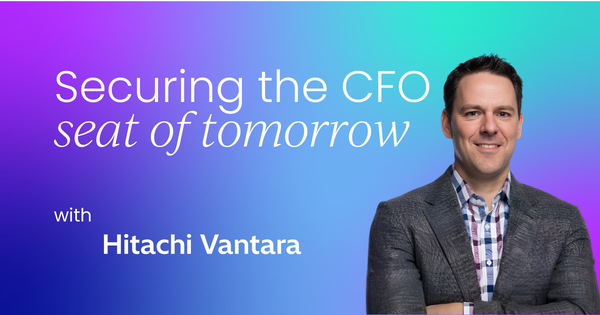
I’m the CFO at Hitachi Vantara, a storage company and a subsidiary of Hitachi Limited, a company with more than a hundred years of history behind it. We are a meaningful global business, with around 8,000 employees and a few billion dollars in revenue.
My organization spans both finance and IT, with about 450 employees in each group spread across the world. We have teams in Malaysia, Japan, India, Mexico, Poland, and the United States.
So when I talk about the future of finance, I’m not talking about it from the vantage point of a small, centralized team.
I’m thinking about it in the context of scale, complexity, geography, and real operational friction.
And yet, despite all of that complexity, I don’t think the core challenge is unique to a company of our size. The issues finance leaders are wrestling with right now are showing up everywhere. They cut across company size, geography, and operating model.
The questions are the same: What does AI really mean for finance? What happens to the work our teams do today? And what does the CFO role become if a meaningful share of traditional finance work is automated?
My view is simple: the future-ready CFO is not the one who defends the old shape of the job. It is the one who helps redesign it.
 Sabrinthia Donnelly
What I learned early in my career about comfort and complacency
I started my career at Ernst & Young about 28 years ago. Like a lot of first years, I got sent to do year-end inventory counts. And I drew what felt like the lucky straw at the time: driving to Fresno on New Year’s Eve to count pipe fittings at an industrial pipe company.
It was exactly what it sounds like. A giant field with huge pipes laid out everywhere, and my job was to count them and make sure the numbers tied to the inventory register.
When I got there, the controller, who had been at the company for 15 years, handed me the inventory register. I opened it up and it was a sheet of ledger paper with handwritten numbers and descriptions of inventory.
He had written it out by hand so I could do my work. There was no ERP system. He was doing the accounting manually. I asked if there was a photocopier so I could make notes, and he told me, “That’s yours.”
So I wrote on it, and then he wrote himself a second handwritten copy so he could track what I was doing.
That moment stuck with me. Not because it was quaint, but because it showed me how easily people can get comfortable inside a process and stop challenging whether the process still makes sense.
In his mind, that was the job. You wake up, it’s month-end, you do the same set of tasks, and when you finish item ten on the checklist, you go home and relax. There was no real pressure in his mind to think, “Is there a better way to do this?” He had built his routine and settled into it.
That pattern exists everywhere in finance if we let it.
When I moved into industry, I saw the same thing. There were people who were hesitant to embrace new technology, people who felt they had no time to learn it, and people who simply did not yet understand what it could do for them. I went in the other direction.
I spent a huge amount of time learning Excel, figuring out how I could do work faster and better than anyone else around me. Then I taught myself Visual Basic. Then I got annoyed by Excel’s row limits and moved into Access and SQL so I could do more with larger sets of data.
What I started doing was taking the work no one else wanted. I would go to my bosses and say, “Give me the three crappiest things on your plate.”
Those were usually the tasks they were happiest to hand off. I would take them over, automate them, simplify them, and learn from them.
That became a way for me to differentiate myself, to build new skills, and to expand my career. I never worried too much about what I was leaving behind by not doing the exact same work as the person before me.
That mindset matters even more now than it did then.
 Sabrinthia Donnelly
Technology does not replace good finance people. It elevates them.
One of the biggest mistakes I think finance teams make is treating each wave of technology as a threat instead of an opportunity. I didn’t see Excel that way when I was coming up. I didn’t see databases that way either. And I don’t think we should see AI that way now.
Technology is not going to replace great finance talent. It is going to make great finance talent better.
It allows you to remove the work that consumes time but doesn’t truly require judgment. That, in turn, creates room for the work you should have been doing in the first place or the work you never had time to get to.
That is the real promise. It is not about doing the same job with fewer people. It is about doing more valuable work with the talent you already have.
That is how I think about AI today. In some ways, I see the same opportunity I saw when I was first starting my career. I didn’t spend much time along the way learning data science or Python. A lot of that passed me by.
But when I look at AI, I recognize the moment. I recognize the inflection point. And I’m pushing myself and my teams to treat it as a chance to move into the fast lane, not a reason to stay in the comfort lane defending an old version of the job.
The real question is not whether AI changes finance. It obviously will. The real question is whether we change ourselves fast enough to use it well.
 Geeta Malhotra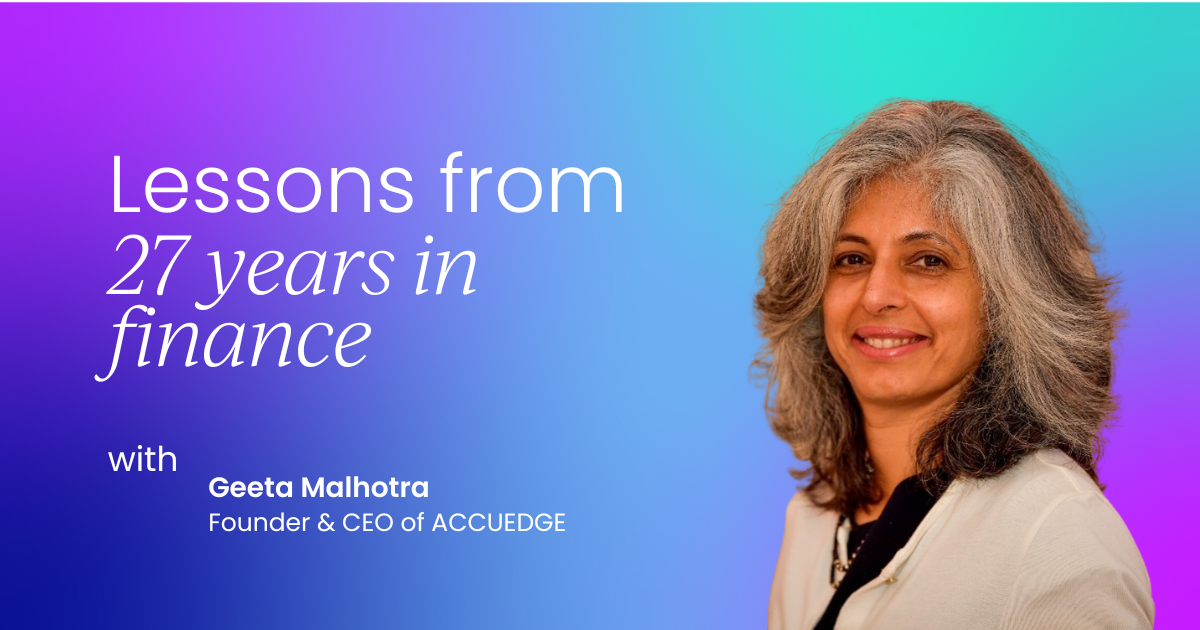


Finance alliance insider
Thank you for subscribing
Level up your finance alliance career & network with finance alliance experts.
An email has been successfully sent to confirm your subscription.
 Follow us on LinkedIn