

Ever struggled to explain an investment's true value to a client or stakeholder?
It can be hard to communicate the impact of potential or even existing investments without a clear understanding of Multiple on Invested Capital (MOIC).
This important metric cuts through the jargon and reveals the true return on investment.
MOIC serves as a crucial indicator of investment success, offering a solid foundation for making well-informed financial decisions.
In this article, we’re zeroing in on MOIC to uncover what it is, its role in private equity (PE), and more importantly, how you can use it to sharpen your investment evaluation skills.
Key takeaways 👇
- MOIC measures how many times your investment has paid off, making it a clear and simple way to see an investment's success.
- It doesn’t consider how long it takes to see returns, unlike metrics like IRR, so it’s best used alongside other measures.
- A high MOIC signals a profitable investment, often influencing further funding and investment decisions.
What is MOIC?
MOIC stands for "Multiple on Invested Capital” – a financial metric used to evaluate the value of an investment relative to the initial capital invested.
It’s worth noting that the term MOIC is often interchangeable with terms like cash-on-cash return and multiple on money (MoM).
If we were to define MOIC in simple terms, we’d sum it up as a ratio to help determine the potential return on investment. It does this by calculating how many times the initial investment (cost) will be returned.
Both profits and losses are included.
MOIC is calculated by dividing the total value (current or projected) of an investment by the initial capital invested.
For example, if an investor puts $100,000 into a project and expects to receive $300,000 in returns, the MOIC would be 3.0 (300,000 / 100,000).
What is MOIC in private equity?
MOIC is widely used in private equity, venture capital, and other investment sectors to evaluate and compare different investment opportunities.
It provides a straightforward way to assess the potential profitability and efficiency of an investment relative to the capital required.
This makes MOIC private equity a simple yet powerful way to see if an investment is worth it.
But what exactly does MOIC tell you about private equity?
There are three key insights:
1. Performance: A high MOIC proves the fund is generating strong returns for its investors.
2. Comparison: It allows you to compare the performance of different investments or funds.
3. Potential: By analyzing the MOIC of past investments made by a fund, you can get a sense of their potential for future deals.
 Sabrinthia Donnelly
What is the average MOIC in private equity?
There isn't a single, universally accepted "average" MOIC for private equity. However, some sources report that a MOIC of 2.0x or higher is generally a “good benchmark for investment performance in private equity.”
Of course, it’s still difficult to land on a concrete number. For one thing, the year an investment is made (vintage year) significantly impacts the MOIC. A fund launched during a booming economic period might have a higher average MOIC compared to one launched during a recession.
Not only that, but different private equity funds have different investment strategies (e.g., growth capital, buyouts). These strategies can lead to different average MOICs.
Risk profiles also vary. Higher-risk investments typically have the potential for a higher MOIC, but also come with a greater chance of failure.
What's considered a good MOIC in private equity?
The 2.0x benchmark you'll often hear cited in private equity circles serves as a reasonable baseline, but context matters enormously.
For traditional buyout funds, a 2.0x to 2.5x net MOIC over a typical five-to-seven-year holding period generally signals solid performance.
Growth equity strategies, which take on different risk profiles and often involve minority positions, might target slightly higher multiples (think 2.5x to 3.0x) to compensate for the additional uncertainty.
Vintage year plays a significant role here. Funds that deployed capital during favorable market conditions (lower entry valuations, accessible credit) tend to produce higher MOICs than those investing at cycle peaks.
A 2.0x multiple from a 2009 vintage fund tells a different story than the same multiple from a 2021 vintage.
What's considered a good MOIC in venture capital?
Venture capital (VC) operates under entirely different return dynamics. The power-law nature of VC means most investments return little or nothing, while a small number of winners drive fund performance.
At the deal level, VCs often target 10x or higher on individual investments, knowing that many will fail entirely. At the fund level, however, a 3.0x net MOIC is generally considered strong performance, and top-quartile funds might achieve 4.0x or higher.
The dispersion in VC outcomes is much wider than in PE. A buyout fund rarely sees a single investment return 50x, but that's precisely what venture investors hope for from their best bets.
This makes comparing VC and PE MOICs directly somewhat misleading without understanding the underlying strategy.
How to use benchmarks responsibly
MOIC benchmarks provide useful reference points, but they can mislead if used in isolation. A 3.0x MOIC over ten years looks different from a 3.0x over four years, the latter represents far better capital efficiency.
Always pair MOIC with time-based metrics like IRR when possible. Additionally, consider realization status: a fund showing 2.5x with most of that value still unrealized carries more uncertainty than one showing 2.0x that's largely distributed.
DPI (distributions to paid-in capital) helps you understand how much of that multiple has actually been returned to investors versus sitting on paper.
MOIC formula and calculation
How to calculate MOIC
Calculating MOIC is quite straightforward. You simply divide the total value you get back from your investment by the original amount you put in.
The MOIC calculation gives you a clear number showing how many times your investment has paid off.
Here's the MOIC formula:
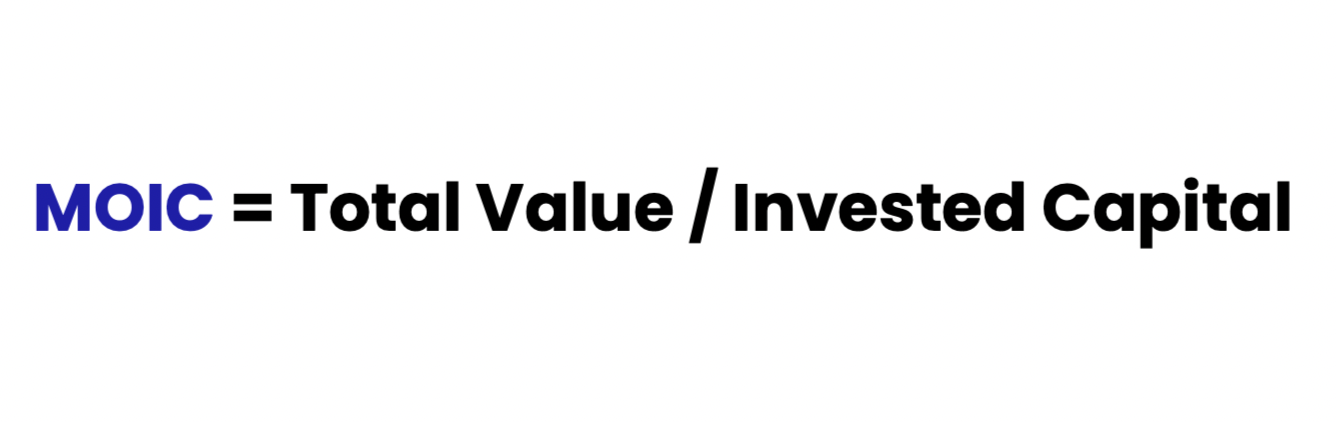
Here's a breakdown of the terms:
Total value of investment: This includes all the cash received from the investment, such as dividends, profits, and the eventual sale proceeds. It also considers the unrealized gains, which is the potential future value of the investment if it were sold today.
Total invested capital: This is the total amount of money initially invested in the deal.
MOIC calculation in 3 steps
Sometimes the clearest way to understand a formula is to walk through it with the simplest possible numbers. Here's a minimal example you can follow along with a calculator.
The Setup: You invest $50,000 in a company. Over the next few years, you receive two cash distributions: $20,000 from a dividend and $40,000 when the company is partially sold. You still hold shares worth $30,000 at current fair value.
Step 1: Calculate total value
Add up everything you've received plus what your remaining stake is worth today.
$20,000 (dividend) + $40,000 (partial sale proceeds) + $30,000 (current fair value of remaining shares) = $90,000
Step 2: Identify invested capital
This is simply the cash you originally put in: $50,000
Step 3: Divide to Get MOIC
$90,000 ÷ $50,000 = 1.8x
What This Means: A 1.8x MOIC tells you that for every dollar you invested, you've received (or currently hold) $1.80 in value.
You haven't doubled your money yet, but you're well on your way, assuming that remaining $30,000 in fair value holds or grows.
 Sabrinthia Donnelly
A few things to keep in mind as you run your own calculations. The total value figure combines both realized returns (cash you've actually received) and unrealized value (what your remaining position is worth on paper).
If you want to know your realized MOIC specifically, you'd exclude that $30,000 fair value and calculate $60,000 ÷ $50,000 = 1.2x.
That distinction matters when you're reporting to stakeholders who want to know what's been locked in versus what's still at risk.
The arithmetic here is intentionally simple. In practice, you might have multiple follow-on investments, various distribution types, and complex valuation methodologies.
But the core logic never changes: sum up what you've gotten back and what you still hold, divide by what you put in, and you have your multiple.
What counts as total value vs. invested capital?
Getting the MOIC formula right depends entirely on what you include in each component. Sounds simple, but this is where most calculation errors happen.
Include in total value: Cash distributions received, sale proceeds from partial or full exits, current NAV or fair market value of remaining holdings.
Include in invested capital: Initial investment amount, any follow-on capital contributions, transaction costs directly tied to acquiring the position.
Exclude: Uncalled commitments, management fees (unless calculating net MOIC), and any value already counted in distributions if you're also counting remaining fair value.
A few common mistakes trip people up regularly:
- Using committed capital instead of called capital inflates your denominator and understates your multiple.
- Mixing gross and net figures (say, using gross value in the numerator but net invested capital in the denominator) creates an apples-to-oranges comparison.
- And after a partial sale, some analysts accidentally double-count by including both the sale proceeds and the pre-sale fair value.
Once you've distributed cash, that portion moves out of unrealized value and into realized distributions. Keep these categories clean, and your MOIC will actually mean something.
 Sabrinthia Donnelly
Examples of calculating MOIC with the formula
Let's put the calculating MOIC formula into practice with a couple of scenarios:
Scenario 1: You invest $1 million in a startup.
After a few years, the company is acquired for $5 million, and you receive your share of the proceeds.
In this case, your total value of investment would be $5 million (acquisition proceeds).
Since you initially invested $1 million, the MOIC would be:

The MOIC calculation indicates a very successful investment, generating a fivefold return on your initial capital.
Scenario 2: A private equity fund invests $100 million in a company.
Over a five-year holding period, the fund receives $20 million in dividends and ultimately sells the company for $120 million.
Here, the total value of investment would be $20 million (dividends) + $120 million (sale proceeds) = $140 million.
So, the MOIC formula would be:

It’s a more modest return, but it's important to consider factors like the holding period and the overall investment strategy of the fund.
Calculating MOIC for a portfolio or fund (aggregation)
The core MOIC formula stays the same whether you're measuring a single deal or an entire portfolio.
What changes is how you assemble the inputs. Instead of tracking one investment's cash flows, you're summing across multiple positions, and that requires consistency in timing and treatment.
Here's a five-step method for calculating portfolio-level MOIC:
Step 1: Establish a single valuation date. Every unrealized position in the portfolio needs to be marked to fair value as of the same date. Using stale valuations for some holdings while others are current creates a distorted picture.
Step 2: Sum all distributions received across deals. This includes dividends, interest, and proceeds from partial or full exits, everything that has been returned to the fund or LP.
Step 3: Sum the current fair value of all remaining holdings. For partially exited positions, include only the remaining stake's fair value, not the portion already distributed.
Step 4: Add Steps 2 and 3 to get total value for the portfolio.
Step 5: Sum all paid-in capital across deals. This is your invested capital. Divide total value by invested capital to get portfolio MOIC.
 Sabrinthia Donnelly
Unrealized vs. realized MOIC
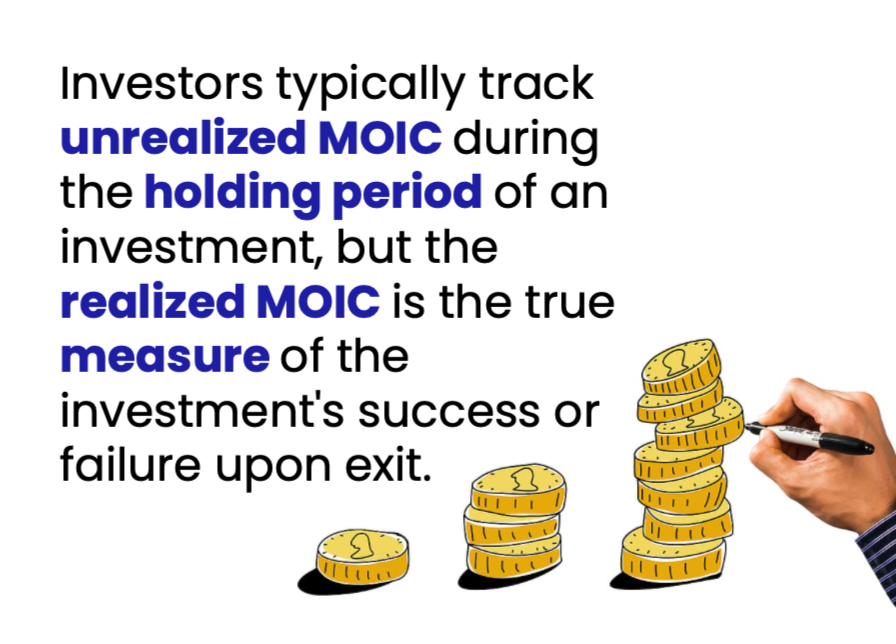
When discussing MOIC, it's important to distinguish between unrealized and realized MOIC.
Unrealized MOIC
This is like a progress report. It uses the current value of your investment (think market price for a stock or an expert's guess for a company) to estimate how much you might get back if you cashed out today.
It's a good way to track how your investment is doing over time, but it's not guaranteed - the value could go up or down before you sell.
Realized MOIC
Realized MOIC is calculated only after you've completely sold your investment and received all the money. This is the true picture of how much money you made (or lost) on the investment.
The key difference is that unrealized MOIC is a forecast or estimate, while realized MOIC is the definitive, actual return on investment.
What's the difference between MOIC and IRR?
The key difference between MOIC and IRR (Internal Rate of Return) lies in how they measure and express investment returns.
They’re both important metrics to assess the performance of an investment, but they approach it differently.
MOIC focuses purely on the total return, telling you how much the investment has grown compared to what you initially put in.
IRR, on the other hand, measures the annualized rate of return on an investment. It considers the timing of cash flows, providing a more comprehensive view of an investment's performance over time.
When to use MOIC vs. IRR (practical decision guide)
Both MOIC and IRR have their place in investment analysis, but they answer different questions.
Knowing when to emphasize each metric helps you communicate more effectively with stakeholders and make better-informed decisions.
As Christopher Toumajian, a finance executive, notes when discussing financial oversight:
"Understanding what metric is right for your industry is certainly sort of step one when you're talking about valuation."
He points out that private equity-backed companies often focus on MOIC, while other contexts might prioritize IRR or DCF approaches.
Use MOIC when:
You need a quick, intuitive measure of how much an investment has grown. MOIC works well for comparing the magnitude of outcomes across deals: did this investment double, triple, or return five times the capital?
It's particularly useful in early-stage or mark-to-market contexts where timing is uncertain and you want to track value creation without getting tangled in cash flow timing assumptions.
MOIC also shines in LP communications when you want to convey the overall scale of returns in straightforward terms.
Use IRR when:
Time matters. If you're comparing investments with different holding periods, IRR accounts for how quickly capital was returned.
A 2.0x MOIC over three years represents much better capital efficiency than a 2.0x over eight years, and IRR captures that difference.
IRR is also essential when evaluating reinvestment opportunities; understanding your annualized return helps you assess whether redeploying capital elsewhere might generate better outcomes.
 Sabrinthia Donnelly
When the metrics disagree:
Consider two investments: Deal A returns 3.0x over seven years, while Deal B returns 2.0x over two years.
MOIC favors Deal A (higher multiple), but IRR likely favors Deal B (faster return).
Neither metric is wrong, they're just measuring different things. In situations like this, use both. Report MOIC for magnitude and IRR for speed, and let the context determine which matters more for your specific decision.
The key trade-off to remember: MOIC ignores timing entirely, which can make slow-returning investments look better than they are.
IRR, meanwhile, can be distorted by early distributions or unusual cash flow patterns. Relying on either metric alone gives you an incomplete picture.
What factors impact MOIC?
MOIC can be a bit of a moving target. There are a few things that can swing the number up or down. Knowing these factors helps you understand what the MOIC means for an investment's success.
Here’s a breakdown of factors that can impact MOIC:
- How the investment does: Strong investments with big returns naturally lead to a higher MOIC. The opposite is true for losses.
- The time you're invested: MOIC doesn't consider how long you hold an investment, but faster wins can be more attractive even if the MOIC is the same as a long-term play.
- Fees and costs: Just like any purchase, fees and expenses take a bite out of your return, lowering the MOIC.
- How you cash out: Selling at the right time or through a good deal can boost your return (and MOIC). The opposite can hurt it.
- The overall market: Big economic swings, changes in what people buy, and industry trends can all affect how much you make on your investment, impacting MOIC.
By understanding these factors, you can get a better sense of what an MOIC really means and make smarter investment choices.
 Sabrinthia Donnelly
Gross MOIC vs. net MOIC (and why LPs should care)
When evaluating fund performance, the distinction between gross and net MOIC determines whether you're looking at the investment team's results or what limited partners (LPs) actually take home.
These two figures can differ substantially, and mixing them up leads to flawed comparisons.
Gross MOIC formula
Gross MOIC measures investment performance before fund-level fees, expenses, and carried interest are deducted.
The formula remains the same (total value divided by invested capital) but both components reflect pre-fee figures. This is the number deal teams and GPs (general partners) typically use internally to evaluate their investment selection and value creation.
It answers the question: how well did we pick and manage these companies?
Net MOIC formula (After fees and carry)
Net MOIC reflects what LPs actually receive after management fees, fund expenses, and carried interest have been subtracted.
The numerator becomes the total distributions to LPs plus their share of remaining NAV, while the denominator stays as called capital from LPs. This is the figure that matters for LP reporting and fund-to-fund benchmarking.
A fund calls $100 million from LPs and generates $250 million in total value at the portfolio level. Gross MOIC equals 2.5x.
However, after deducting $20 million in cumulative management fees, $5 million in fund expenses, and $25 million in carried interest (assuming 20% carry on profits above a hurdle), the net value to LPs is $200 million. Net MOIC equals 2.0x.
That 0.5x difference represents real money; in this case, $50 million that went to fees and GP compensation rather than LP returns.
GPs typically report gross MOIC when discussing deal performance and investment track records. LPs should focus on net MOIC when evaluating fund returns and comparing managers.
Problems arise when these figures get conflated in marketing materials or due diligence conversations. Always clarify which version you're looking at, and when benchmarking against industry data, ensure you're comparing net to net or gross to gross.
What are the disadvantages of MOIC?
Yes, MOIC is an incredibly valuable metric, especially for finance teams. But it has some limitations to consider…
Doesn't account for the time value of money
MOIC compares the total return to the initial investment. It doesn't consider when the cash flows occur.
An investment that delivers a large return all at once might have the same MOIC as one that provides smaller returns spread out over time. However, the first option is generally considered more favorable due to the time value of money.
Limited view of risk
MOIC doesn't tell you anything about the risk involved in an investment. A high MOIC could be the result of a very risky investment that just happened to pay off.
Sensitive to exit strategy
The final value of an investment, and therefore its MOIC, can be significantly impacted by how you exit the investment.
A well-timed sale can maximize returns, while a forced sale might result in lower returns and a lower MOIC. MOIC doesn't account for the skill of the investor in achieving the exit strategy.
Focuses on overall return, not performance
While MOIC tells you how much you made in total, it doesn't provide details about the investment's performance over time. This can be a drawback for investors who want to understand the investment's consistency and stability.
It's important to use MOIC in conjunction with other metrics like IRR (Internal Rate of Return) that consider the time value of money and risk.
How MOIC influences decision-making
MOIC plays a significant role in shaping investment decisions, particularly in private equity. Here's how it can influence decision-making and help companies make smarter business choices:
1. Choosing investments
MOIC is often used as a screening metric when evaluating potential investment opportunities. Investors often set a minimum MOIC they expect.
Deals with a lower projected MOIC might get passed over in favor of those with a higher potential return.
2. Risk assessment
MOIC provides insight into the risk-return profile of an investment. A high MOIC could mean a high potential return, but also potentially higher risk. Investors use MOIC with other tools to see if the expected return is worth the risk.
3. Performance evaluation
MOIC is a simple way to measure how well an investment is doing. It tells you how many times you've gotten your money back. This helps investors decide whether to hold, sell, or invest more in something based on its performance.
4. Attracting investors
For companies and fund managers, showcasing investments with high MOIC can be a powerful tool in fundraising efforts and maintaining positive investor relations.
A strong track record of achieving high MOICs shows they’re good at managing money, which attracts more investors and funding.
5. Resource allocation
Investments with a higher MOIC might get more resources because they're seen as a better use of the money. This can also help CFOs when it comes to allocating the budget across departments.
6. Exit strategy
If an investment hits or surpasses its MOIC target, investors might be more likely to cash out and take the profits.
7. Portfolio construction
Fund managers use MOIC to balance their portfolios and allocate capital across different investment opportunities.
They may aim to maintain a certain average or targeted MOIC for their overall portfolio, which influences how they distribute their investments.
FAQs: MOIC
What is typical Moic in private equity?
While a definitive average is elusive, typical MOICs in private equity can range from 2x to 3x the invested capital. This means for every $1 invested, the expectation is to receive $2-$3 back. However, some successful funds might achieve MOICs well above 3x, while others might struggle to reach 2x depending on the factors mentioned above.
What is MOIC and DPI?
PI (Distribution to Paid-In Capital) is another metric used in private equity. It measures the total amount of cash returned to investors relative to the amount they originally invested. MOIC, on the other hand, considers both the cash received and the unrealized gains (potential future value) of the investment.
What is the MOIC return multiple?
The MOIC return multiple is simply another way of saying "MOIC." It emphasizes that MOIC is a multiple of the initial investment.
How is MOIC calculated?
MOIC is calculated by dividing the total value of the investment (including realized and unrealized gains) by the total invested capital.
Is IRR or MOIC more important?
There's no single "more important" metric. MOIC is simpler and quicker to calculate, offering a snapshot of overall return. IRR is more complex but provides a more nuanced picture by considering the time value of money. Use MOIC for a quick comparison, and IRR for a deeper analysis.
Does higher IRR mean riskier?
Not necessarily. A higher IRR can indicate a potentially better investment, but it doesn't automatically mean higher risk. You should always consider other factors alongside IRR.
What is the difference between MOIC and ROI?
ROI (Return on Investment) is a broader term used for any investment. MOIC is specific to private equity and considers both cash received and unrealized gains.
What is a good MOIC multiple?
A "good" MOIC depends on the context. In general, a higher MOIC is better, but consider the risk involved and compare it to similar investments.


Become an FA Insider
Thank you for subscribing
Get exclusive insights, frameworks, and strategies from finance leaders driving real business impact.
An email has been successfully sent to confirm your subscription.
 Follow us on LinkedIn