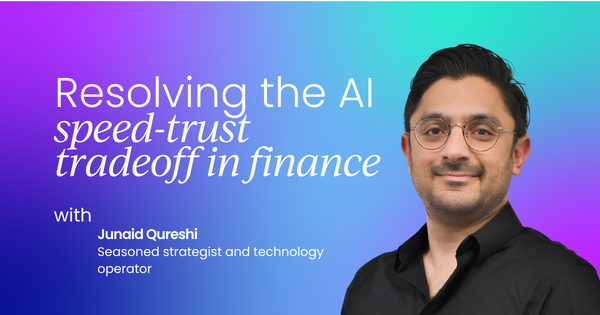

This article is based on Junaid's brilliant talk at our FP&A Summit San Jose when he worked at Shadowfax AI.
Before starting Shadowfax AI, I spent about six years at Alteryx and, before that, roughly a decade in management consulting at Monitor Deloitte, advising executive leaders, including CFOs, on profitable growth strategies.
That mix of enterprise software and advisory work is why I keep coming back to one question: why has finance been so slow to put AI to work on its real analytical core?
This isn't a pitch for our platform, but an argument for how finance leaders should think about AI, why the current front-runner philosophy for adopting it is wrong for most organizations, and what a more pragmatic path looks like: balancing AI's productivity gains against the precision, rigor, and defensibility our profession demands.
A new dividing line
Historically, the dividing line in enterprise productivity has been pre- versus post-industrial revolution, which unfolded over roughly a century starting in the 1760s, driving the mechanization and mass production behind our modern standard of living.
Today, a new dividing line is emerging: pre- versus post-LLM.
We're no longer talking about mechanical automation but cognitive automation, and given that Western GDP is collectively more than 80% services, that has profound implications for society.
 Geeta Malhotra
The scale of investment, and the gap in results
This has driven staggering investment: what started as roughly eighty billion dollars in the year after ChatGPT launched is now projected by IDC to reach six hundred seventy billion dollars by 2027, an eightfold increase, excluding hardware spending, which is roughly similar in size.
Yet the return has been hard to pin down. Deloitte reports that business cases initially projected to pay back in seven to twelve months are now being readjusted to four- or five-year paybacks, and BCG found that only about 5% of organizations reported achieving value at scale, while 60% reported no gains whatsoever.
We're early in this, but it looks like a lot of organizations are kicking the accountability can down the road.
What's actually happening inside finance
Two surveys stand out. Bain Capital Ventures found that 71% of CFOs had not adopted AI in any meaningful capacity, and LEK found that 89% were not actively using it in production.
That tracks, to a point: finance has unique constraints, from regulatory scrutiny to audit trails, and it runs on deterministic outputs. Being directionally accurate might pass in marketing, but it doesn't fly in finance.
The metric I find more telling is what's happening among practitioners themselves.
A study from the Association for Finance Professionals found that one in five finance professionals use AI regularly, and three in five have tried it sporadically, but only 9% reported using it for actual analytic work: variance analysis, forecasting, reconciliations, the tasks that eat up the most time.
That's the number that matters, because if productivity gains are coming, that's where they have to come from.
Contrast that with software engineering, an adjacent function with similar characteristics.
For expert advice like this straight to your inbox, sign up for Pro+ membership.
You'll also get access to hundreds of hours of exclusive video content, a complimentary Summit ticket, and so much more.
So, what are you waiting for?
The largest survey, from Stack Overflow, found that 70% of engineering teams are already using AI-first workflows, with 88% planning to within the year, and among elite Bay Area software companies, that number approaches 100%, with self-reported productivity gains of two to ten times.
My own co-founder, a principal engineer with decades at some of the biggest names in the Valley, reports being ten times more productive using these tools.
Why the gap comes down to trust
Why such a large gap between two functions with similar underlying characteristics? When you ask FP&A professionals why they aren't using AI, the single biggest theme is trust.
Having talked to hundreds of them, the explanations sound like this: our work has fuzzy rules, scattered data, and layers of stacked assumptions.
It's reasonable, but nearly all of those arguments apply to software engineering too, where codebases are arguably more fragmented, tribal knowledge is worse, and specs are often vague.
So that explains part of the gap, but not all of it. There's something deeper, which I call the verifiability problem.
In domains where LLMs have had a transformative impact, marketing, copywriting, legal drafting, even software engineering, it's relatively easy to judge output just by inspecting it: you ask for something, look at what comes back, and know almost instantly whether it's good.
Finance analytics doesn't work that way, because these problems get solved by writing code, and LLMs aren't naturally suited to a thirty-year-old spreadsheet paradigm with its own built-in limitations.
 Sharon Mahoney
Real-world work requires cleaning data, joining it across sources, and stacking assumptions well beyond a simple lookup, so hand a real problem to an LLM and you typically get back hundreds of lines of Python.
It's one thing for code to run and another for it to be correct, and unless you have real coding expertise, you often can't tell the difference.
Ask the same real-world question twice, an hour apart, and you'll often get slightly different answers, not because the model is wrong, but because the assumptions stacked across a dozen steps were made probabilistically and never surfaced.
Unless those assumptions are made deterministic upfront, your outputs won't be either, and that's why nobody will stake their reputation on it.
Two philosophies, and why I don't buy the first one
Everyone wants to move faster and do less manual work. The reluctance isn't about the outcome; it's the skepticism. And what nobody will compromise on, alongside accuracy, is transparency, speed, and efficiency.
The prevailing consensus among some of the loudest voices in this space is a capital-T Transformation approach, sometimes called the ServiceNow-Palantir model: transform your systems of record and operating systems, rebuild the organization from the inside out, and reskill everyone as coders.
It's top-down, expensive, high-friction, and full of points of failure. It might work for the very largest organizations, and it will make consultants a great deal of money through multi-year engagements, but top-down edicts are notoriously hard to make stick.
The board can pressure the C-suite, and the C-suite can pressure middle management, but the person with hands on the keyboard is the one who ultimately decides whether to use the tool.
Grand mandates to reinvent an entire organization rarely help the practitioners actually doing the work.
 Amal Mammadov
A more pragmatic framework: TVCD
I'd propose a more pragmatic, higher-ROI framework built around four pillars: transparency, value stream–based prioritization, core context, and decentralized execution.
My co-founders and I built our entire platform around these four ideas, but the philosophy behind them matters independent of any specific product.
1. Transparency
Transparency is the foundational pillar, because it's the raw ingredient that produces trust.
If transactions are the flow metric for a company, trust is the balance sheet metric, the accrual you build over time, and the more experience you gain, the more you realize that almost everything in life, not just business, is rate-limited by the speed of trust.
You can't mandate trust. Anyone with kids knows that ordering them to tell the truth doesn't work; you earn it through rigor, accuracy, and verifiability.
Finance people trust, but they verify. So for AI to work in finance, it cannot be a black box, and this has to remain a human-in-the-loop process, not a fully autonomous one.
A finance professional empowered by AI is like a human with a vehicle instead of a horse: fundamentally more capable, essentially wearing an Ironman suit. But this isn't a predator drone operating on its own. It's closer to a fighter jet's avionics, extraordinarily powerful, but still piloted by a human.
When evaluating any AI tool, the real question is whether trust and verifiability were designed in from the start, or bolted on afterward as an afterthought.
 Supreeth Meka
2. Value stream focus
The second pillar is value stream focus.
Whenever there's a technology frenzy like this one, especially with prominent voices insisting that wholesale operating-model transformation is required, you get a lot of scattered, noisy experimentation.
Experimentation itself isn't bad; the problem is too many disconnected efforts running in random directions without a guiding framework, because that's when you're not actually making progress, just generating noise. Instead, harness that energy using a value stream lens.
In my experience across companies ranging from roughly a hundred million to two billion dollars in revenue, most FP&A functions boil down to the same six core value streams, each containing its own set of core activities.
Just as a business creates value through three basic levers, revenue growth, cost reduction, and capital efficiency, AI in finance creates value through three parallel levers.
The first is data automation: faster, automated movement from source to output without cutting IT out of the process, so the line of business is empowered rather than working around the system.
The second is diagnostic deep-dive automation: getting rid of the detective work that turns a routine variance spike into a multi-day investigation, by mapping the driver tree behind it so the "why" surfaces immediately.
The third is predictive modeling: building the scenario models everyone is constantly asked for, faster and with a defensible range of outcomes, rather than reconstructing inputs, outputs, and logic from scratch every time.
Take your value streams and activities, build an honest baseline, and overlay these three levers on top. The opportunity tends to become clear within minutes.
 Teresa Garanhel
Core context
The third pillar is core context, and it's the antidote to a common excuse: that this work requires exhaustive ontologies, clean master data, and formal documentation before you can even begin.
Some organizations genuinely do have sophisticated documentation and taxonomies already, and if that's you, great. But it isn't a prerequisite, because AI thrives on unstructured information.
Email threads, open-ended documents, Slack conversations, canonical spreadsheets, even what's sitting in someone's head that they can just dictate into a phone, all of that counts as usable business context.
You do need a minimum viable knowledge base to get accurate, good outputs from AI, but the lift required to assemble it is a days- or weeks-long effort, not an ERP implementation, and the mental model a lot of people apply to this needs to be rethought completely.
AI can't read your mind, but it's remarkably good at taking randomly structured thoughts and making sense of them.
Decentralized execution
The fourth and final pillar is decentralized execution. As experienced operators know, top-down edicts rarely work; mandate an ambiguous initiative from the top of the organization and watch it stall somewhere in middle management.
If you genuinely believe in a human-in-the-loop model, you have to empower your people, especially your best performers, to exercise real agency. Give them the degrees of freedom to take chances, and give them clear outer bounds to operate within. Yes, coordinate the effort centrally.
Yes, give people input on priorities. But within secure, well-governed environments, let your strongest people actually take the shots, rather than having executives design projects in an off-site with no ground-level business context.
When you see something work, let it be decentralized and let the team scale it themselves, and do what the best software companies do: celebrate the win and scale it.
That bottom-up model, not top-down mandates, is exactly what drove software engineering's adoption curve, and it's a far more effective and higher-likelihood path than trying to force adoption on the knowledge workers who are actually on the front lines running the business.
 Anders Liu-Lindberg
Where this leaves us
We're at a seminal moment, and an anxious one for finance professionals. There's real uncertainty about careers, and teams are being asked to do more with less while holding the same rigor and quality standards.
Trust remains the number one barrier keeping teams from experimenting with this technology on the work that actually matters.
As finance leaders, you have a choice. You can embrace capital-T transformation and eventually watch the energy run out until everyone quietly returns to business as usual.
Or you can take agency, prioritize AI tools that are transparent, verifiable, and reasonably governed, and focus your team's efforts on the value streams baselined against the levers that matter.
Don't let great become the enemy of good; get the essentials right, and let your best people lead.
Finance professionals often rate-limit their ability to harness AI by what's possible inside a spreadsheet tool built in the 1980s. That's a legitimate choice, but what's possible today goes well beyond forcing everything through a spreadsheet.
In my view, this was never a smarter-model problem. It's an architecture and user experience problem, worth understanding before deciding what's right for your organization.
As a Pro+ member, don't forget to use your free pass on one of our upcoming in-person events.


Become an FA Insider
Thank you for subscribing
Get exclusive insights, frameworks, and strategies from finance leaders driving real business impact.
An email has been successfully sent to confirm your subscription.
 Follow us on LinkedIn