


Most finance people like stability, predictability, and certainty.
As CFO of AWA Studios, I work in an environment that offers almost the exact opposite, and that is where some of the most important qualities of a finance leader get tested.
AWA stands for Artists, Writers & Artisans. We're a media and entertainment startup. We publish graphic novels and comic books, then develop those stories into films and TV shows in Hollywood.
A creative business always has new ideas and new stories to tell, which keeps it fun. It also makes it one of the more challenging places to run a finance function.
This article is based on Diya's podcast episode, which you can watch in full here:
What a hit-driven business really means
We don't have recurring revenue. We run a hit-driven business model, so our revenue is lumpy and its timing can be unpredictable.
Our revenue profile can change significantly from one year to the next, as it does for many hit-driven media businesses.
For us, the uncertainty comes from developing films and TV shows. We may expect a project to land in a particular quarter or year.
But we're subject to Hollywood timing, so we don't control when it happens, and the timing can swing widely.
We also don't have the contracted revenue that gives recurring-revenue businesses some visibility into the future.
Right now, for example, we plan for AWA's first film to go into production next month. That could change at any point, because that's how our industry works.
 Alexander Roche
The two biggest challenges: forecasting and fundraising
Planning from one year to the next is difficult in a business like ours. As a result, actuals miss budget more often than I would like.
When that happens, I have to explain to the board why the company is still on track for the long term, even if we aren't tracking exactly to plan in the short term.
The CFO has to be empathetic toward the business here.
Usually no team is at fault, and the reason the timing changed is outside our control.
Fundraising is the other big challenge. Venture capital and private equity investors don't typically like this kind of model. They prefer the recurring cash flows of more stable businesses, usually software and sometimes AI.
So we tend to attract two kinds of investors. Some are strategic investors who understand our model or already work in our industry.
Others have long-term, patient capital that can withstand short-term swings in our financial profile.
 Sabrinthia Donnelly
Stay close to the inputs, not just the outputs
Preparedness, agility, and good storytelling matter for a CFO in any business. In an unpredictable business, you also have to move with the business.
When something changes, you need to be as close to it as possible. You can't just sit there reporting. The numbers aren't just the output, and you have to stay close to the inputs.
Being nimble requires ongoing, communicative relationships across the company. Revenue recognition is a good example.
The business may want to take on a project at a time that makes a particular quarter's revenue very difficult. In finance, we may prefer to recognize revenue sooner rather than later.
In that situation, I always say to do what works best for the business. That means doing what maximizes revenue and profitability and drives us forward over the long term, rather than taking a short-term view.
Looking for the yes before the no
Every finance leader has heard of the CFO who always says no. When I hear a creative idea, I start from first principles and try to understand the opportunity.
I work out what the person, the team, or the business really wants to achieve. Then I try to quantify it.
 Kevwe Ijatomi
Creatives may not have the terminology, or they may not be thinking about the financial impact. Putting numbers behind creative ideas and stories is our job in finance.
My first instinct is to ask how we can make something possible. I only slam on the brakes when an idea is really off course and could jeopardize the future of the business.
Even then, I look for other ways to bring the idea to life. We might do only parts of it, or do it in a year's time rather than in three months.
Because we so often have to say no, it helps to save it for when we really need it. The more dialogue you have with other leaders, the better they understand the role of finance.
They can then shape their ideas to work for finance and the whole business before they even bring them to you.
It can be hard to be strategic about creativity. Creativity is people wanting to tell stories, make incredible art, and express ideas. I approach it by building frameworks for the kinds of creative ideas that work.
Ideas that fit those frameworks should also fit the business's strategic objectives. From there, you can think about the impact on the P&L and cash flow.
Our mission helps with this. AWA is a creator-friendly business, and we prioritize doing right by creators and rewarding them fairly for their work.
When people understand that mission, and also understand that we have to make money, everyone stays aligned. At the end of the day, we're a commercial enterprise, and a private company raising funds needs to survive.
 Noufal Basheer
Strategic investment versus unsustainable loss
People often assume that a company losing money must have something wrong with it. I don't think that's necessarily true.
A growing business needs strategic investment in product, people, technology, or even M&A, and it will burn cash or take short-term losses to make those investments.
That is different from a company that is losing money because it's running out of cash.
The test is the return on investment. In the short term, the cash you burn should generate revenue or grow margin.
In the long term, it should build asset value and grow equity value. If neither is happening, the business may be burning cash for the wrong reasons.
A five-year bet that's finally paying off
The best example is happening at AWA right now. Every year we invest in several graphic novels, and only some of them will become Hollywood hits.
Our first film is going into production with Apple five years after our initial investment in the comic book behind it.
That comic book made a loss at the time. The publishing market these days simply isn't big enough to cover the cost of producing comics.
This film will make good on that entire investment and on investments in other graphic novels, some of which may never reach Hollywood. That's the hit-driven model at work: one hit can pay for many bets.
 Teresa Garanhel
How we de-risk a creative bet
Creators will tell you that a project's success comes down to the strength of the story. From a finance perspective, the story is part of it, but a relatively small part.
What also helps is attaching high-profile people from sports and entertainment to a graphic novel, either as promoters or as writers. They often have millions of followers, so the book launches with an inbuilt fan base.
That de-risks the project. It also makes the story more likely to be developed into a film or TV show. Not every story needs a big name attached from the start. When one is attached, though, we can think about audience and revenue from day one.
None of this is ever 100% certain. The decision is never purely about the numbers or purely about gut feeling. It's a mix of creative and commercial judgment.
That's why we bring in people from across the company, each representing a different function. More perspectives can make decisions harder to reach, but it's important to hear all of them first.
 Masha Chandrasekaran
Three inflection points from cash burn to profitability
I break the path to profitability into three inflection points.
The first is unit economics. Look at the direct costs of each unit you sell, before fixed costs or overhead, and ask whether that unit makes money.
Across a business line, this becomes your gross margin. When gross margin turns from negative to positive, your unit economics work, and you should keep producing and selling.
The second is covering your operating expenses, which is essentially reaching economies of scale. The question is whether you can hold your fixed costs flat while you grow and so turn profitable.
Depending on how you measure it, that may mean positive EBITDA or positive net income. For us, publishing often makes a loss. Once a few books turn a profit, we know we can make more of them profitably, so we keep investing there.
When film and TV revenue comes through, it may cover the overhead and operating expenses behind that story.
The third is the ultimate goal: positive free cash flow every year. At that point you cover your capital expenditure and investments as well as operating expenses, and the business generates more cash than it burns.
You then have a highly sustainable business and real flexibility. You can decide whether to raise capital to grow faster or to invest off your own balance sheet.
Balancing operational reality with investor pressure
First, you need alignment between the board, the investors, and the business. Pressure will always run in both directions.
The business may not be doing precisely what the board expected, and it's the board's job to push for performance and shareholder value.
Keeping that balance takes several things. You have to communicate regularly, about the downs as well as the ups.
You have to give context on the industry: we aren't the only hit-driven business, and even giants like Disney deal with the same pressures.
You also have to show results the board can trace back to your plans. With our first film, I can say that it took five years, but we got there, and the model we described is working.
Now imagine the momentum as more of our graphic novels move into film and TV.
 Tony Gonnella
Taking stories beyond the page
This model isn't unique to comics. It applies to IP businesses generally, including book publishers, podcast companies, and even magazines. You want to take a story off the page and into film, TV, documentaries, and beyond.
Eventually you also want commercial revenue streams such as merchandise, toys, and consumer products. Film and TV are how a mass audience discovers a story.
Disney have mastered this model over decades, and they think about how to make money in all these ways from the moment they conceive a story.
Creativity can drive financial success, as the biggest media companies have shown time and again. The key is finding a playbook of concepts that work.
For us, that means mostly young adult and teen stories, across action, sci-fi, drama, and romance, all genres with a track record in the industry.
You also need the right time horizon and sound commercial decisions up front. Consumer tastes change from generation to generation, so we try to stay contemporary and tell stories that resonate with the world as it is.
We work with a wide range of artists and writers who have distinctive styles of their own, and we choose a different creative team for each story.
The biggest pitfall: hiding behind the long term
The biggest pitfall is using the long time horizon as an excuse. Teams invest in ideas that seem fun or cool and rely on gut feeling, knowing the results won't show for five or more years.
Losses can pile up before anyone realizes the investments will never pay off. Companies have failed this way because they couldn't balance creative and commercial judgment.
Because results don't show up next quarter, it's tempting to keep saying a story will become a film "in a few years." By the time those years pass, newer and more exciting projects are underway, and nobody looks back at the earlier ones. That's a real problem.
Timing matters too. Some projects sit in development for years, and some that seem certain to succeed simply don't.
A show like Heated Rivalry succeeded partly because it arrived at a moment that matched people's attitudes and the stories they wanted to see. Timing is the exciting part of this business, and also the hardest.
 Peter Turner
Three underrated qualities of a great CFO
The first is balance. People remember our nos more than our yeses. A good CFO stays level-headed, weighs the pros and cons of every decision, and never says no, or yes, for the wrong reasons.
The second is patience. The CFO often isn't the person driving the business. Other leaders run their areas, and you deal with the results.
Your input matters, but you aren't the one executing. So you have to give people the benefit of the doubt when things don't go exactly as they described.
The third is being forthright. Big investments and decisions about strategic direction can completely change a company's future.
You need to state your view firmly and be clear about its impact on the company's financial position.
AI is an asset for finance
I see AI as an asset. It will touch reporting, financial planning, and cash monitoring, and it will be able to alert you when something needs attention.
Day-to-day work will shift away from matching numbers and reconciling, provided the data going into the models is accurate.
Instead, finance teams will spend more time understanding what the data is telling them and making quicker decisions.
People are experimenting with many AI tools right now. Today a few platforms like QuickBooks and NetSuite dominate.
In the same way, I expect certain AI tools to lead in particular areas of finance, and companies will choose them based on their stage of growth. I'm interested to see which tools come out on top.
 Geeta Malhotra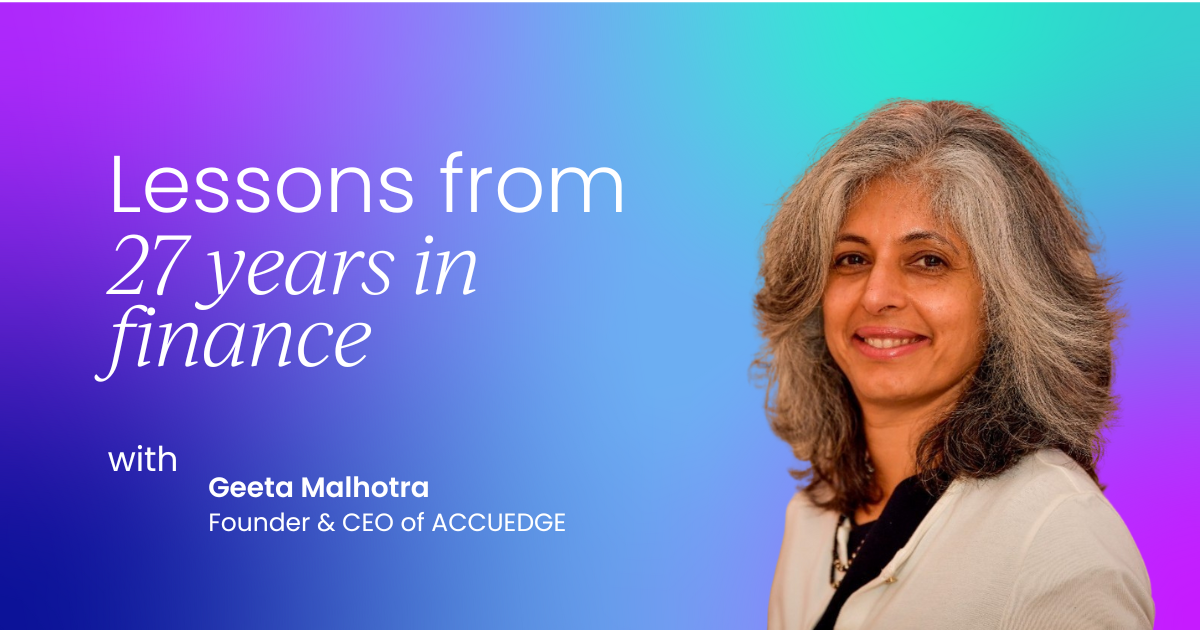
The same function, a different job
Finance may be the same function everywhere, but the role varies a lot. You're always the financial steward of the business.
In a hit-driven or cash-burning business, though, you're constantly weighing different questions, even when the goal you're working toward is the same.


Become an FA Insider
Thank you for subscribing
Get exclusive insights, frameworks, and strategies from finance leaders driving real business impact.
An email has been successfully sent to confirm your subscription.
 Follow us on LinkedIn