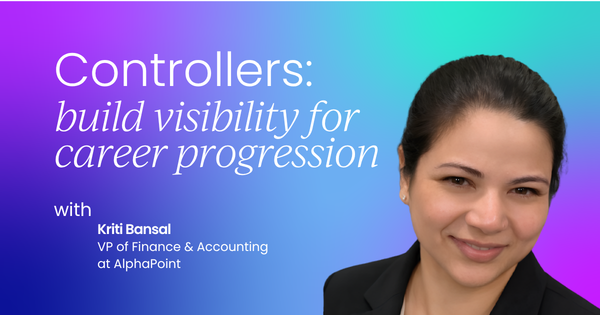

For much of my career, I believed that being the most technically accurate person in the room would naturally lead to greater influence.
I thought that if I mastered every accounting standard, closed the books flawlessly, and made sure every number was accurate, opportunities would eventually follow.
Technical excellence was the benchmark I measured myself against because, like many controllers, that's exactly what I had been trained and rewarded to do.
Over time, though, I realized something that completely changed how I thought about my career.
Being technically excellent doesn't automatically earn you a seat at the table where the biggest business decisions are made.
That realization wasn't discouraging. It was empowering.
It forced me to rethink what it really means to create value as a finance leader and, more importantly, what separates controllers who remain in the back office from those who become strategic partners to the business.
Looking back, I wish someone had challenged my assumptions much earlier. I wish someone had told me that precision and rigor are essential, but they are only the starting point.
The real opportunity begins when you learn how to translate financial expertise into business influence.
My path wasn't planned
If there's one thing I've learned throughout my career, it's that very few successful careers follow a perfectly designed roadmap.
Mine certainly didn't.
I began my career at Deloitte in India, auditing U.S. and Netherlands-based asset management clients. The work was demanding, highly technical, and incredibly disciplined.
It gave me a strong accounting foundation that I continue to rely on today.
But I knew I wanted to broaden my perspective.
That desire led me to move to San Francisco to pursue a Master's in Finance, essentially pressing reset on my career.
After graduating with a 4.0 GPA and earning Dean's List recognition throughout the program, I relocated once again, this time to New York, where I began working in startup environments.
That decision completely changed the trajectory of my career.
At one of those early startups, the CFO unexpectedly resigned. I wasn't hired to replace him permanently. I was simply asked to hold everything together until the company found someone else.
Was I nervous? Absolutely.
Did I feel completely prepared? Not at all.
But I also recognized that I was probably the most qualified person available to step into the role, even if I didn't yet believe it myself.
Those few months taught me more about strategic finance than the previous several years combined.
Suddenly I wasn't just focused on whether the numbers were correct. I had to understand how those numbers influenced decisions, priorities, and conversations happening across the company.
 Richard King
That experience fundamentally changed how I viewed finance leadership.
From there I joined Beacon Platform, where I led multinational close processes and external audits across the United States, the United Kingdom, and Japan while helping build the financial infrastructure that growing companies need.
Later I joined AlphaPoint as Head of Accounting, entering an industry where there wasn't an established playbook for many of the accounting challenges we faced.
Crypto accounting in 2021 required us to navigate new territory almost every day. We were figuring out accounting treatments while the broader industry was still working through the same questions.
It was uncomfortable, uncertain, and incredibly challenging, but it also became one of the most formative experiences of my career.
Eventually I was promoted to Vice President of Finance and Accounting, reporting directly to the CEO. Today my responsibilities extend well beyond accounting into fundraising discussions, strategic planning, budgeting, treasury management, and crypto treasury.
None of those opportunities appeared because I became more technically accurate.
They appeared because I learned how to make my expertise visible.
 Lewis Danby
Why so many controllers remain invisible
Controllers are often the people who understand the financial reality of a business better than anyone else.
- We see every dollar entering and leaving the organization.
- We understand how transactions connect across departments.
- We know where the operational weaknesses exist because we encounter them every month during the close.
Yet despite having access to this unique perspective, many controllers are excluded from strategic conversations.
I've spent a lot of time thinking about why.
In my experience, there are three common traps that prevent talented finance professionals from moving beyond the back office.
The first is the identity trap.
Many of us define ourselves by our technical accuracy. We become known as the person who always gets the numbers right. While that reputation is valuable, it can also become limiting.
When someone asks for a strategic opinion rather than a technical answer, we hesitate because strategy isn't where we've traditionally been rewarded.
The second is the bandwidth trap.
Anyone who has worked in accounting knows the close cycle never really ends. As soon as one month finishes, preparation begins for the next.
Between reconciliations, audits, variance analysis, and reporting, there often isn't enough time left to think strategically.
The third is the access trap, and I believe this is the most important one.
Many people assume someone will eventually invite them into strategic conversations because of the quality of their work.
That invitation rarely comes.
The people influencing decisions are often the people who intentionally placed themselves in those conversations.
Waiting for permission can become one of the biggest obstacles to career progression.
 Alexander Roche


Become an FA Insider
Thank you for subscribing
Get exclusive insights, frameworks, and strategies from finance leaders driving real business impact.
An email has been successfully sent to confirm your subscription.
 Follow us on LinkedIn