

Expense management has become one of the most underestimated pressure points in modern finance.
While revenue growth remains uncertain and budgets are under scrutiny, finance leaders are being asked to do more with less: cut costs, protect margins, and maintain control without slowing the business down.
At the same time, employees are navigating a very different reality. Rising costs of living, evolving work models, and unclear expense boundaries are reshaping how people experience corporate spending policies day to day.
When those two realities collide, the result isn’t just frustration. It’s spendageddon.
Spendageddon occurs when tension peaks between employees’ needs and finance department practices, causing finance leaders to lose control of spending and their ability to protect the bottom line.
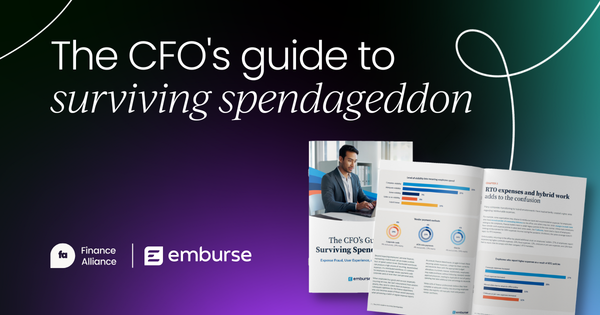
In The CFO’s guide to surviving spendageddon, Emburse examines new research from more than 2,000 finance professionals and employees to uncover what’s really driving expense fraud, rising tension around corporate cards, and declining visibility into spend.
The findings reveal an uncomfortable truth for finance leaders still relying on legacy expense practices: when employee experience is ignored, cost control starts to break down.
You’ll need to download the full (free) guide to see the complete research, data, and recommendations for averting it.
 Finance Alliance
Why cost control feels harder than ever
Finance leaders everywhere are tightening their belts. In the wake of economic uncertainty and the push for return-to-office mandates, organizations are under pressure to increase profitability even when revenue growth slows.
When growth can’t close the gap, expenses become the lever. But cost control measures don’t exist in a vacuum.
The stricter policies become, the more they show up in employees’ daily workflows, especially when it comes to buying what they need to do their jobs.
Most employee expectations are reasonable. They want clarity around what they can spend, confidence that purchases are allowed, and the ability to pay without risking their personal finances.
When expense systems fail to deliver on those basics, friction builds quickly.
The growing disconnect around corporate cards
At the center of spendageddon is a simple but powerful disconnect: how employees want to pay for business expenses versus how organizations actually enable them to do so.
The majority of employees would prefer to use corporate cards for business purchases, particularly as personal cash flow becomes more strained.
Yet many employees still rely on personal debit or credit cards because they don’t have access to a company card at all.
From a finance perspective, limiting card access can feel like a responsible control mechanism. Corporate cards are often issued only to senior executives or managers, sometimes with additional qualification requirements.
In practice, this means a relatively small portion of employees are empowered to make purchases independently, even when those purchases are essential to their work.
For employees without access, the choice becomes uncomfortable: front the cost personally and wait for reimbursement, or delay work while seeking approvals and alternative payment paths. Over time, that friction erodes trust in the system.
Hybrid work has blurred expense boundaries
The shift from fully remote work to hybrid environments has added a new layer of complexity. Expenses that once felt clearly defined (commutes, meals, childcare, relocation) now fall into gray areas that policies weren’t designed to address.
Employees report increased costs directly tied to return-to-office policies, while reimbursement rules vary widely across organizations. In some cases, legal requirements further complicate the picture, forcing finance teams to adapt legacy policies to a new reality.
At the same time, hybrid work has accelerated decentralized purchasing. Employees increasingly manage vendor relationships themselves, especially for recurring software, subscriptions, and digital services.
These purchases often surface only when expense reports are submitted, long after the transaction occurred.
For finance teams, this creates delayed visibility, misclassified spend, and a growing reconciliation burden, exactly the opposite of what tighter controls are meant to achieve.
When expense friction hits personal finances
As policies become more restrictive and reimbursement timelines stretch, the impact on employees becomes financial, not just operational.
A significant number of employees report incurring overdraft fees, interest charges, or late payment penalties because business expenses were charged to personal cards and reimbursements didn’t arrive in time.
Others report needing to closely monitor their personal finances or delay purchases altogether while waiting to be reimbursed.
This effectively turns employees into short-term lenders for their employers, an arrangement that becomes increasingly untenable as personal financial stress rises.
Despite this, many finance leaders believe their expense experience is strong. A large portion rate their organization’s process highly, suggesting a growing gap between leadership perception and employee reality.
How stress turns into risky behavior
The most dangerous outcome of spendageddon isn’t dissatisfaction, it’s behavior change.
When financial pressure builds, some employees begin to bend the rules. A notable percentage admit to passing off personal purchases as business expenses, while others say they’ve considered doing so.
Historically, fraud rates have increased during periods of economic strain. What’s striking now is the magnitude of the jump compared to previous years, coinciding with higher living costs, delayed reimbursements, and hybrid work complexity.
Taken together (out-of-pocket expenses, reimbursement delays, personal financial stress, and rising fraud) the message is clear.
Expense management is no longer just an operational process. It’s a user experience problem with direct financial consequences.
Download the full guide to surviving spendageddon
The insights above only scratch the surface of what’s driving spendageddon, and what finance leaders can do to avoid it.
In The CFO’s guide to surviving spendageddon, Emburse goes deeper into the research and also outlines practical strategies for restoring visibility, enforcing policy earlier in the spend lifecycle, and balancing control with employee autonomy.
If expense management is quietly eroding trust, visibility, or your ability to protect the bottom line, this guide offers a clear-eyed look at what’s really happening and how you can change course.
👉 Download the full (free) guide to learn how to avert spendageddon before tension turns into lost control.


Finance alliance insider
Thank you for subscribing
Level up your finance alliance career & network with finance alliance experts.
An email has been successfully sent to confirm your subscription.
 Follow us on LinkedIn