
For a while, business travel budgeting felt almost theoretical.
Trips were limited. Volumes were unpredictable. And finance teams quietly accepted higher prices as the cost of simply getting people back on the road.
That phase is over.
Business travel has fully reasserted itself as a major line item, one that now comes with renewed scrutiny, tougher internal questions, and far less tolerance for “that’s just what it costs now.”
But here’s the part that doesn’t show up in headlines: higher travel spend doesn’t automatically mean higher travel prices.
Not everywhere. Not across every category. And not for teams that know how to read the market signals hiding beneath the surface.
Recent data from Emburse paints a picture of a travel landscape that looks expensive at first glance, but behaves very differently once you dig in.
And for finance teams paying attention, that difference matters.
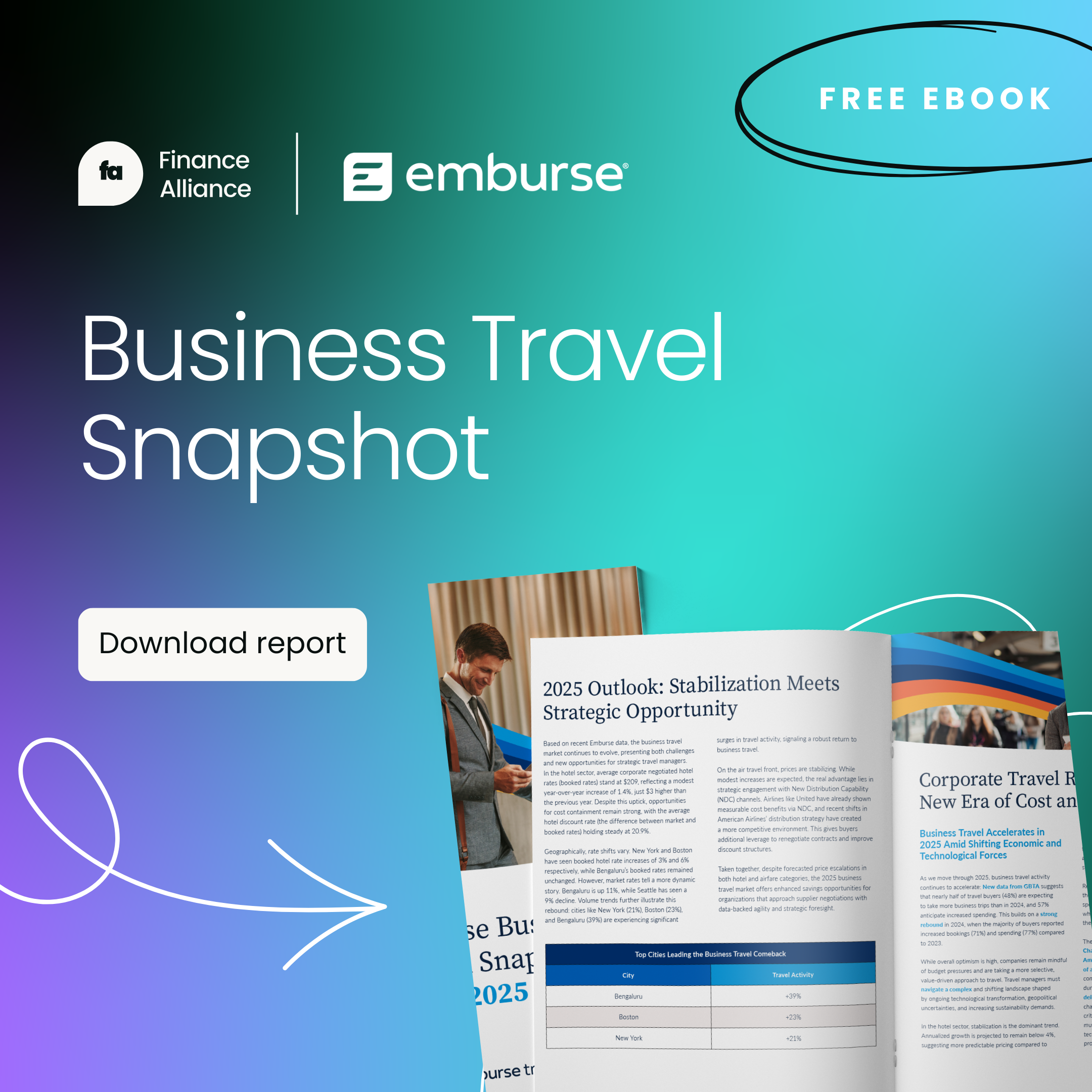
Inside the Business Travel Snapshot, you'll find:
- Stabilizing rates and new pricing opportunities
- A clear picture of returning business travel demand
- How NDC and AI are evolving from buzzwords to real savings levers
- Geography matters more than ever
- Forces reshaping program design
The return of business travel (with unexpected leverage)
There’s no question that business travel activity has accelerated. More trips. More meetings. More pressure on budgets to keep up.
What’s surprising is how uneven the recovery actually is.
Supplier confidence has returned but not uniformly. Some markets are tightening quickly. Others are struggling with excess capacity, softer leisure demand, or shifting traveler behavior.
Airlines are revising distribution strategies. Hotels are experimenting with pricing structures that look nothing like what finance teams were used to a few years ago.
The result is a travel market that appears strong, but isn’t universally expensive.
That imbalance is where leverage lives.
Why averages are misleading finance teams
Most travel budgeting still starts the same way: with averages.
Average airfare. Average hotel rates. Average year-over-year increases.
The problem is that averages smooth out exactly the volatility that creates opportunity.
The Emburse data shows wide variation by city, region, supplier, and booking channel. In some places, rates are climbing. In others, they’re flat or quietly declining.
Negotiated prices often tell a very different story than market prices, especially for organizations willing to revisit agreements instead of letting them roll forward untouched.
When finance teams rely on blended numbers, they end up budgeting defensively, and missing the chance to reallocate spend more strategically.
Airfare is fragmenting
Air travel remains one of the most scrutinized categories in corporate spend, and for good reason. It’s visible, volatile, and often assumed to be uncontrollable.
But the data suggests something more nuanced.
While market fares haven’t collapsed, negotiated fares have quietly diverged from published prices.
In many cases, the gap between what companies could be paying and what they are paying has widened, especially for organizations that actively manage airline relationships rather than accepting default terms.
At the same time, airline distribution models are in flux. Some carriers are pushing aggressively into newer booking channels.
Others are adjusting strategies after discovering that corporate buyers are more willing to shift loyalty than expected.
For finance teams, this creates a rare dynamic: suppliers that still need volume, combined with pricing models that reward flexibility and attention.
That’s not chaos, that’s leverage.
Hotel pricing looks calm until you zoom in
On paper, hotel pricing appears stable.
Growth has slowed. Extreme spikes have moderated. Compared to recent volatility, things look almost predictable.
But stability at the macro level masks significant movement underneath.
Some cities are experiencing strong rebounds in corporate demand. Others are dealing with excess inventory, changing group travel patterns, or reduced leisure pressure.
Even within the same hotel brand, pricing behavior can vary dramatically based on location and traveler mix.
Many travel programs still negotiate hotels at a high level (brand-wide, region-wide, or portfolio-wide) and assume consistency where it doesn’t exist.
For finance teams willing to get more granular, that assumption can be costly.
The quiet budgeting mistake that keeps repeating
Here’s what the data makes clear: the biggest risk in today’s travel market is complacency.
Too many organizations are:
- Carrying forward agreements signed under very different conditions
- Treating negotiated rates as static instead of dynamic
- Using travel data for reporting instead of leverage
In a market where supplier strategies are shifting and pricing power is uneven, doing nothing is a decision, and usually an expensive one.
The teams that struggle most aren’t the ones traveling more. They’re the ones assuming the market has already made its move.
Precision matters more than restraint
When travel budgets rise, the instinct is often to clamp down: restrict trips, tighten approvals, delay negotiations.
But the data suggests that restraint alone doesn’t create savings. Precision does.
Organizations that perform best are the ones that understand:
- Which cities and routes behave differently than the average
- Where negotiated pricing has quietly improved
- Which suppliers are signaling vulnerability and which aren’t
Instead of asking, “How do we spend less on travel?” they ask, “Where are we overspending without realizing it?”
That shift in mindset changes everything.
This isn’t a warning, but an opportunity
It’s easy to frame rising travel spend as a threat. And for teams relying on outdated assumptions, it can be.
But for finance leaders willing to engage with the data, the current landscape offers something rare: a chance to regain control without sacrificing movement, growth, or connection.
Not by cutting travel, not by freezing budgets. But by negotiating smarter, budgeting with intent, and questioning averages that no longer tell the full story.
Want to see where the savings actually are?
The Business Travel Snapshot breaks down what’s really happening across air and hotel spend, and where finance teams still have room to maneuver.
If you’re heading into budget planning, supplier negotiations, or leadership conversations about travel costs, this is insight worth having before decisions get locked in.
👉 Read the full business travel snapshot to see where savings are hiding in plain sight.
 Finance Alliance


Finance alliance insider
Thank you for subscribing
Level up your finance alliance career & network with finance alliance experts.
An email has been successfully sent to confirm your subscription.
 Follow us on LinkedIn