
For most companies, people costs represent the single largest category of operating expense, spanning compensation, benefits, workforce investments, and long-term talent strategy.
Yet when those costs shift unexpectedly, finance leaders are often left defending variances without being able to clearly explain what actually changed or why.
Boards and executive teams expect precision around revenue drivers and capital allocation, but people-cost movements are often explained in broader, less definitive terms.
That gap can create discomfort at the leadership level, particularly when workforce-related expenses materially impact margin performance and forecasting accuracy.
Reports and dashboards may outline year-over-year movement. Vendor summaries may offer high-level explanations.
But surface-level reporting rarely answers the questions that matter most to fiduciary oversight: What is truly driving cost? What is controllable? And where does governance need to be strengthened?
Finance teams are increasingly held accountable for major variances in people costs, yet many remain reliant on reporting that stops at “what happened” without delivering an independent explanation of why it happened or how to act on it.
The governance challenge in people costs
An upcoming live session from Andovia examines how finance teams can move beyond vendor narratives and build a more defensible, finance-led view of complex cost categories.
 Finance Alliance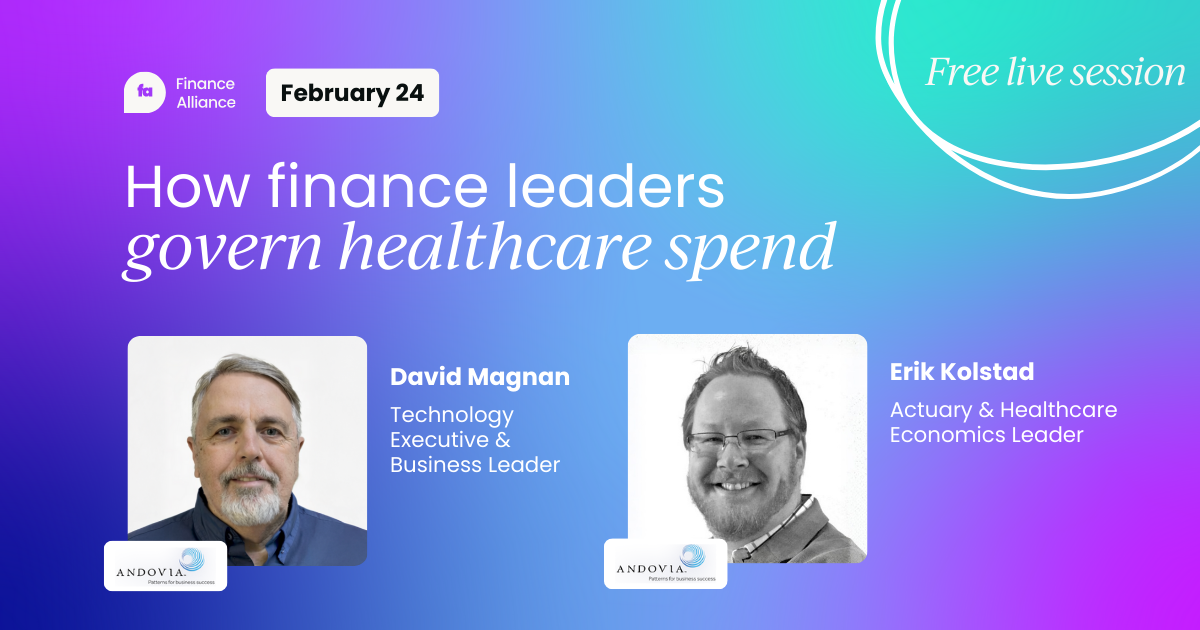
Rather than focusing on reporting outputs alone, the session centers on governance-grade insight, grounded in actuarial rigor and practical finance frameworks that support informed decision-making and sustainable cost control.
Traditional dashboards are designed to summarize activity, not to establish accountability. They aggregate trends and benchmarks, but often lack the analytical structure required to separate signal from noise.
Without a structured governance lens, even sophisticated reporting can leave finance leaders without a single, comprehensive, and independent view of truth or a clear path from data to action.
Data may exist in massive volumes, yet it remains difficult to use, validate, or translate into meaningful operational and financial decisions.
As a result, organizations can become reactive (relying heavily on external partners to interpret results) while still carrying full fiduciary responsibility for outcomes.
From reporting to accountability
The emphasis of this session shifts from static dashboards to insight that can withstand scrutiny, enabling finance leaders to validate underlying drivers, assess predictability, and distinguish between structural trends and controllable cost factors.
Governance, in this context, is about establishing clear ownership, independent validation, and structured decision-making processes that allow finance to lead with confidence.
When governance frameworks are aligned with financial priorities, major people-cost categories become managed cost centers rather than recurring surprises.
Attendees will explore how to move from opaque reporting and reactive decisions to governance-grade insight that supports fiduciary oversight, informed action, and sustainable cost management, without adding internal burden or unnecessary complexity.
Applying this lens to healthcare spend
Healthcare costs continue to rise year over year, yet many self-insured employers still struggle to answer a basic question: why.
Within the broader category of people costs, healthcare often represents one of the most volatile and least transparent components, making it especially challenging to forecast, govern, and defend.
CFOs and HR leaders are inundated with dashboards, vendor reports, and retrospective summaries that lack a single, comprehensive, and independent view of truth or detailed, actionable insight.
Employers frequently rely on vendors to report on and manage spend (often without independent validation) while remaining ultimately responsible as fiduciaries.
This webinar explores how self-insured employers are moving beyond high-level dashboards and blind trust to better govern healthcare spend.
By combining comprehensive data visibility, actuarial and clinical insight, and a clear path to action (executed in partnership with brokers) employers can achieve better control, improve quality, and reduce healthcare spend.
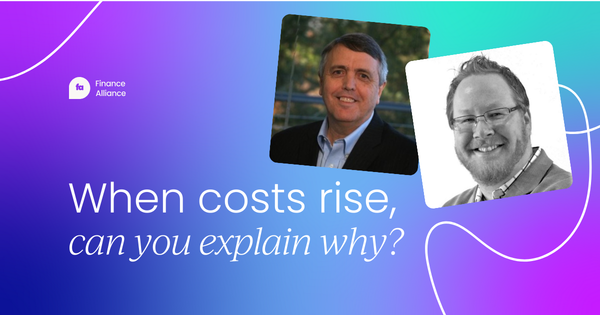
Erik Kolstad, Actuary and Healthcare Economics Leader at Andovia, brings deep experience across commercial health, Medicaid, and Medicare markets.
As an Associate of the Society of Actuaries and a Member of the American Academy of Actuaries, Kolstad will address structural drivers behind healthcare cost increases, including utilization patterns and hidden data gaps that can quietly undermine financial predictability.
His perspective underscores how actuarial discipline and independent analysis strengthen financial oversight in one of the most complex areas of people spend.
Joining him is David Magnan, a technology executive and business leader with more than 50 years of leadership experience across growth, transformation, operational excellence, and large-scale organizational change.
Drawing from decades of experience leading complex organizations through turnarounds and strategic acquisitions, Magnan will explore how finance leaders can strengthen oversight, shift from passive reporting to active governance, and build frameworks that translate insight into measurable cost impact.
His operational experience reinforces that sustainable cost control depends not only on better data, but on stronger governance structures that turn insight into disciplined execution.
At its core, the discussion reflects Andovia’s approach to healthcare cost governance for self-insured employers:
- Combining actuarial expertise
- Advanced data analysis
- Finance-oriented governance frameworks to help organizations see through complexity, validate spend, and make defensible decisions with confidence.
For finance leaders managing the largest line items on the income statement, the issue is no longer whether people costs are rising, but whether the organization can clearly explain what is driving those increases, and demonstrate that the right controls are in place.


Finance alliance insider
Thank you for subscribing
Level up your finance alliance career & network with finance alliance experts.
An email has been successfully sent to confirm your subscription.
 Follow us on LinkedIn