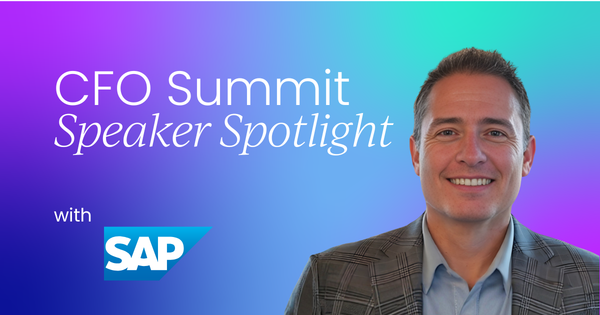

The CFO Summit is on the horizon, and we’re excited to feature Rob Seifert, Senior Director at the SAP S/4HANA Cloud Center.
With over 30 years of experience at the intersection of business, finance, and SAP, Rob is a trusted advisor to CFOs navigating the shift from legacy systems to connected, automated, and insight-driven enterprises.
In his upcoming session, “Defining 2026: The five decisions that will shape finance leadership," Rob will address a critical question: How can CFOs transform their finance organizations to lead with confidence in an era of volatility, abundant data, and rising expectations?
Drawing on his deep expertise, Rob will explore the decisions that close the gap between ambition and execution, helping finance teams spend less time defending numbers and more time driving outcomes.
We sat down with Rob to discuss his session, the evolving role of the CFO, and why this moment is pivotal for finance leaders.
About Rob Seifert
Rob Seifert is a Senior Director at SAP focused on Cloud ERP, where he partners with CFOs to modernize finance operations, balancing growth, control, and risk.
As a hands-on finance partner, program sponsor, and executive advisor, Rob has guided senior leaders through the critical decisions required to transition from fragmented legacy environments to integrated, automated, and insight-driven enterprises.
His work is rooted in the belief that finance leadership is central to enterprise resilience and growth.
A conversation with Rob Seifert
What sparked this session?
CFOs are no longer asking “Should we transform?” They’re asking “How do we make faster calls without increasing risk?”
They’re being pushed to run more scenarios, answer the board faster, and navigate cost pressure with flatter teams.
But too many finance organizations are still spending too much time reconciling data, explaining variances, and stitching information together.
This session is about the decisions that close that gap, so finance can spend less time defending numbers and more time driving outcomes.
How has the CFO role changed and what hasn’t changed enough?
The biggest change is that CFOs are now expected to be enterprise decision leaders, co-owning strategy, investment tradeoffs, and risk posture in real time, not after the fact.
What hasn’t changed enough is the system behind the numbers. Too many teams are still operating with fragmented data, manual controls, and processes that make it hard to answer basic questions quickly, like “What’s the margin impact if demand shifts 3%?” or “Where is working capital tightening?”
The mandate moved faster than the mechanics of finance, and that mismatch is where a lot of stress comes from.
What’s at stake if finance leaders delay transformation?
What’s at stake isn’t just efficiency, it’s credibility and influence when it matters most.
When volatility hits, the board doesn’t want a spreadsheet debate. They want a defensible answer. What’s happening, why, and what we are doing about it.
If finance can’t close quickly, trace assumptions, or produce audit-grade reporting without heroics, you end up reacting instead of leading.
Delaying transformation doesn’t keep your choices open, it raises the odds that the next disruption will force rushed decisions.
CFOs who act earlier create breathing room to lead deliberately instead of operating in emergency mode.
Why is trust fragile even with abundant data?
Confidence doesn’t come from having more data but from being able to explain and stand behind the answer.
Many organizations have plenty of dashboards, but the underlying data isn’t always consistent across systems, and the path from source transaction to board metric isn’t always clear.
When numbers don’t reconcile quickly or assumptions can’t be traced, trust erodes.
AI amplifies this: it can accelerate insight and productivity, but only if your foundation is solid. Clean master data, clear controls, and transparency into how outputs were produced. Without that, AI can move faster than your ability to validate it, and that creates hesitation instead of confidence.
What external pressures are CFOs underestimating?
I think leaders are underestimating how quickly these pressures are converging.
It is not just macro volatility. It’s also pricing pressure, supply and tariff uncertainty, rising expectations around cyber and disclosure readiness, and new governance expectations as AI touches finance processes.
These are not separate work streams anymore. They collide in planning, close, controls, and reporting at the same time.
So the real challenge is not predicting the next disruption. It’s building a finance engine that can adapt, enabling faster scenario planning, tighter controls, and decision ready data without weeks of rework.
What are your reasons for supporting the CFO Summit?
I supported this event because it is a room full of people dealing with the same real problems.
CFOs are being asked to move faster, explain more, and take on more risk at the same time.
I’m here because I learn a lot from how CFOs are tackling that, and I can share what I am seeing work in the field.
What are you most looking forward to?
I am looking forward to what people are willing to share about what worked and what didn’t. CFOs are dealing with the same tension right now. Move faster, keep controls tight, and still fund growth.
I want to hear where leaders are seeing real payoff and where they are still hitting friction. Whether teams are spending too much time reconciling data, forecasting takes too long, or teams are stretched thin.
What does this partnership mean to your company?
It reflects a shared belief that finance leadership is central to enterprise resilience and growth.
For us, this partnership is about helping CFOs build trust in the numbers, speed in decision making, and strength in governance so finance can lead confidently through uncertainty.
When CFOs have that foundation, the whole organization moves faster and with less risk.
Who is SAP?
SAP helps CFOs manage complexity and lead with confidence by connecting business processes, data, and AI across the enterprise.
Through its integrated business suite, SAP brings finance, supply chain, procurement, HR, and operations together on a shared data foundation, giving finance leaders real time visibility into performance, risk, and opportunity.
A connected and complete data foundation is critical as finance teams scale automation and AI. SAP helps ensure business data is consistent, contextual, and grounded in common business meaning, so insights can be trusted and acted on.
By embedding intelligence directly into business processes, SAP enables CFOs to improve productivity, maintain strong governance, and respond more effectively to economic and regulatory change.
Want to connect with Rob or learn more? Rob is always eager to engage with finance leaders and share insights. You can connect with him on LinkedIn or reach out through SAP’s official channels.
CFO Summit in San Jose
Don’t miss your chance to connect with pioneering finance leaders and shape the future of your organization.
The CFO Summit San Jose brings together CFOs and senior finance executives who are designing next-gen operating models, securing long-term performance, and navigating the same transformation challenges you face every day.
Ready to lead with confidence? Register now to secure your spot at the CFO Summit San Jose. Can’t attend in person? Virtual tickets give you access to all live sessions, on-demand content, exclusive frameworks, and member-only events.
Your future in finance starts here.


Finance alliance insider
Thank you for subscribing
Level up your finance alliance career & network with finance alliance experts.
An email has been successfully sent to confirm your subscription.
 Follow us on LinkedIn